
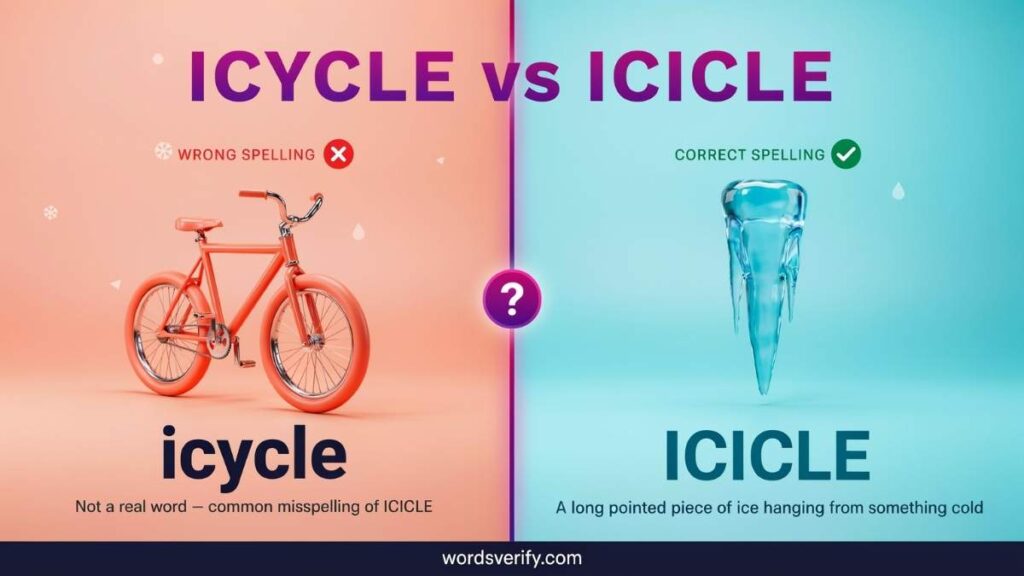
Winter brings frosty mornings, icy rooftops, and icicles dangling like nature’s tiny decorations. But when it comes to spelling, things can get a little slippery. Is it “icycle” vs “icicle”? One misplaced letter can turn a simple word into a chilly grammar mistake! If you’ve ever paused while writing this word, don’t worry. You’re not alone in this frosty confusion. In this guide, we’ll clear up the difference between icycle vs. icicle, explain what the correct word means, and show you how to use it in everyday sentences. By the end, you’ll spell it confidently without freezing mid-sentence.
Icycle vs Icicle The Quick Answer
If you’re unsure whether to write icycle vs icicle, choose icicle when you mean a pointed piece of ice that hangs from a surface.
An icicle forms when dripping water freezes and gradually builds into a narrow, often pointed shape. You might see icicles hanging from a roof after a cold night or growing from tree branches during winter.
Here’s a quick comparison:
| Feature | Icicle | Icycle |
|---|---|---|
| Standard spelling | Correct | Incorrect for the ice formation |
| Meaning | A hanging, tapering piece of ice | No standard meaning as the ordinary noun for this formation |
| Part of speech | Noun | Not a standard form of this noun |
| Example | An icicle hung from the gutter. | An icycle hung from the gutter. |
| Use in ordinary writing | Correct | Should be corrected |
The easiest rule to remember is simple: When you mean hanging ice, write icicle.
What Does Icicle Mean?
An icicle is a narrow piece of ice that forms when water drips or flows over a surface and freezes. As more water freezes onto the existing ice, the formation may grow longer and develop a pointed tip.
You can often spot icicles along roof edges, gutters, tree branches, and rocky ledges during freezing weather. Their shapes and sizes vary depending on the amount of water available, the temperature, and the surrounding conditions.
What Does an Icicle Look Like?
An icicle usually has a narrow upper end attached to a surface and a tapered lower end that hangs downward. However, not every icicle looks like a perfect ice spear.
Some are thin and transparent, while others are thick, cloudy, or irregular. Tiny air bubbles and impurities can affect their appearance.
Common features include:
- A narrow section attached to a roof, branch, gutter, or ledge.
- A body that may widen or narrow as the ice builds up.
- A pointed or rounded tip.
- A clear, cloudy, or milky appearance.
An icicle is a particular type of ice formation. Ice covering a sidewalk, frost on a window, and a spike hanging from a gutter all consist of frozen water, but they form in different ways.
Where Do Icicles Form?
Icicles develop wherever dripping water can freeze and accumulate.
Common locations include:
- Roof edges and eaves.
- Gutters and downspouts.
- Tree branches and twigs.
- Rocky ledges and cliffs.
- Bridges and other exposed structures.
- Caves and other cold environments where water freezes.
Roofs are especially common places to find icicles. Snow may melt slightly during the day, allowing water to run toward the roof’s edge. When temperatures fall, that water freezes and begins to build up.
What Is an Icicle Made Of?
An icicle is made of frozen water. It doesn’t require a special ingredient or a unique kind of ice.
The formation may contain tiny air bubbles, mineral traces, or other impurities from the water and surrounding environment. These can affect its clarity and appearance.
Its size also depends on local conditions. A steady supply of dripping water can help an icicle grow, while warmer temperatures or a lack of moisture can slow its formation or cause it to melt.
Learn the difference between tricky more English words
Excelerate vs Accelerate Which one Is Correct?
Is Icycle a Word?
The answer depends on how the spelling is used.
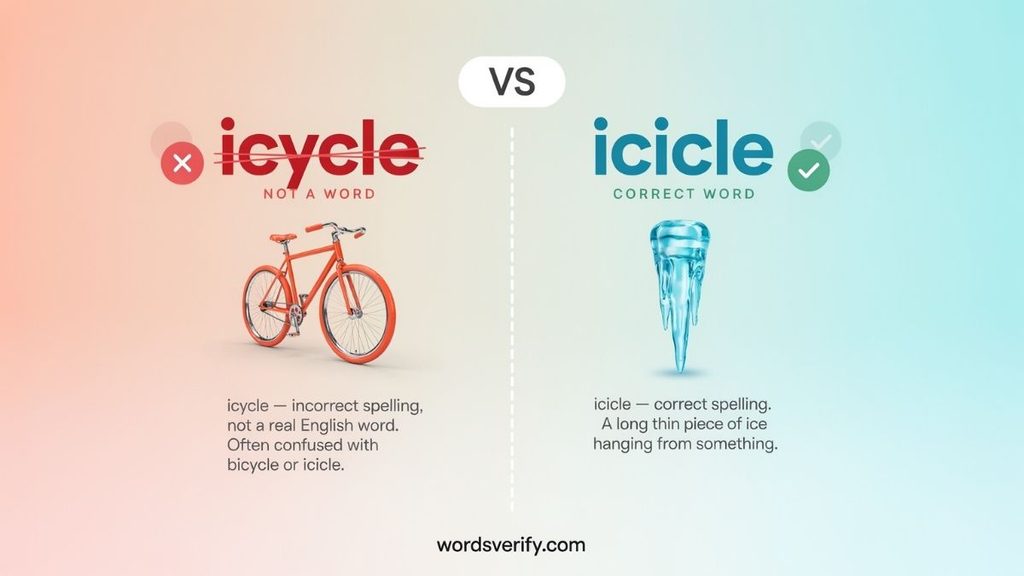
In ordinary English, “icycle” isn’t the standard spelling of the noun for a hanging piece of ice. Standard dictionaries use “icicle” for that meaning. Therefore, if you write “icycle” while describing frozen water, you should generally correct it to “icicle.”
However, an unusual spelling can appear in a brand, username, fictional name, or title without becoming the standard spelling of an ordinary English word.
Does Icycle Have a Meaning in English?
“Icycle” has no established standard meaning as the ordinary noun for a hanging ice formation.
However, the spelling appears in proper names. For example, Icycle: On Thin Ice is a video game title. In this context, “Icycle” is part of the official name, so its spelling should remain unchanged.
Consider these examples:
- Incorrect ordinary usage: A large icycle formed above the front door.
- Correct ordinary usage: A large icicle formed above the front door.
- Proper-name usage: Icycle: On Thin Ice is the title of a video game.
The first sentence contains a spelling mistake. The second uses the correct English word. The third uses a specific title, so changing its spelling would be inappropriate.
Is Icycle in the Dictionary?
For the ordinary meaning of a hanging piece of ice, the standard dictionary entry is “icicle,” not “icycle.”
When you’re unsure about a spelling, check a reliable English dictionary. The important question isn’t whether an unusual spelling appears somewhere online. It’s whether that spelling is accepted for the meaning you intend.
In everyday writing, use “icicle” to describe the ice formation.
Learn the difference between tricky more English words
Rug vs Rag What’s the Difference?
Icycle vs Icicle Key Differences Explained
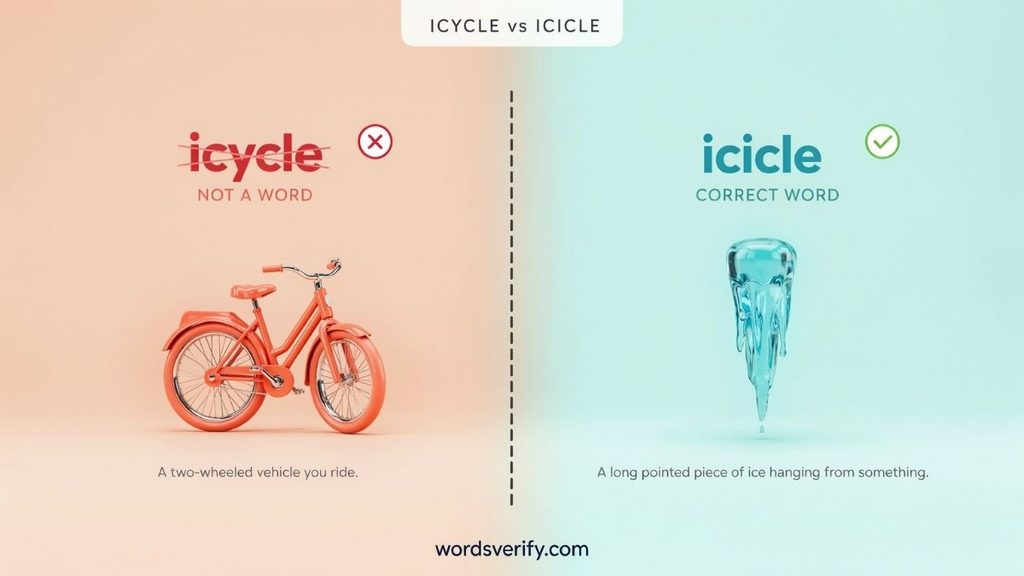
The main difference between these two spellings is correctness. “Icicle” has a clear, established meaning, while “icycle” isn’t an accepted alternative spelling for the same object.
| Feature | Icicle | Icycle |
|---|---|---|
| Correct spelling | Yes | No, when referring to hanging ice |
| Meaning | A hanging, tapering piece of ice | No standard definition for this meaning |
| Common usage | Everyday conversation, stories, and weather descriptions | Occasional misspelling or use in a proper name |
| Grammar | Countable noun | Not a standard form of the noun |
| Formal writing | Appropriate | Should be corrected when used accidentally |
Spelling Icicle vs Icycle
The correct spelling contains seven letters: I-C-I-C-L-E.
The incorrect form “icycle” changes the second “c” to a “y.” Although the two forms look similar, that small change matters.
English has many confusing spelling patterns. Sometimes a familiar word influences how we remember a less familiar one. In this case, the word “cycle” may encourage writers to use a “y” where it doesn’t belong.
Meaning Do Icycle vs Icicle Mean the Same Thing?
No. In standard English, “icicle” has a recognized meaning, while “icycle” isn’t an accepted alternative spelling for that meaning.
For example:
- Correct: The children watched an icicle melt in the sunlight.
- Incorrect: The children watched an icycle melt in the sunlight.
Readers will probably understand the second sentence, but understanding the intended meaning doesn’t make the spelling correct.
Grammar and Part of Speech
“Icicle” is a noun because it names a physical object. You can use it as the subject or object of a sentence.
- Subject: An icicle hung from the roof.
- Direct object: Maya photographed an icicle.
- Object of a preposition: Snow covered the branch beneath the icicle.
The plural form is “icicles.” Since “icycle” isn’t the standard spelling of this noun, it shouldn’t replace “icicle” in these sentences.
Formality and Context
The word “icicle” works in both casual and formal writing. You can use it in a text message, a school assignment, a weather report, or a scientific explanation.
By contrast, “icycle” should be corrected when it appears as an accidental spelling mistake. If it forms part of an official name or title, preserve the original spelling.
The key is to correct spelling errors without changing the official spelling of a name.
Learn the difference between tricky more English words
Bougie vs Boujee which one is correct?
How to Spell Icicle Correctly
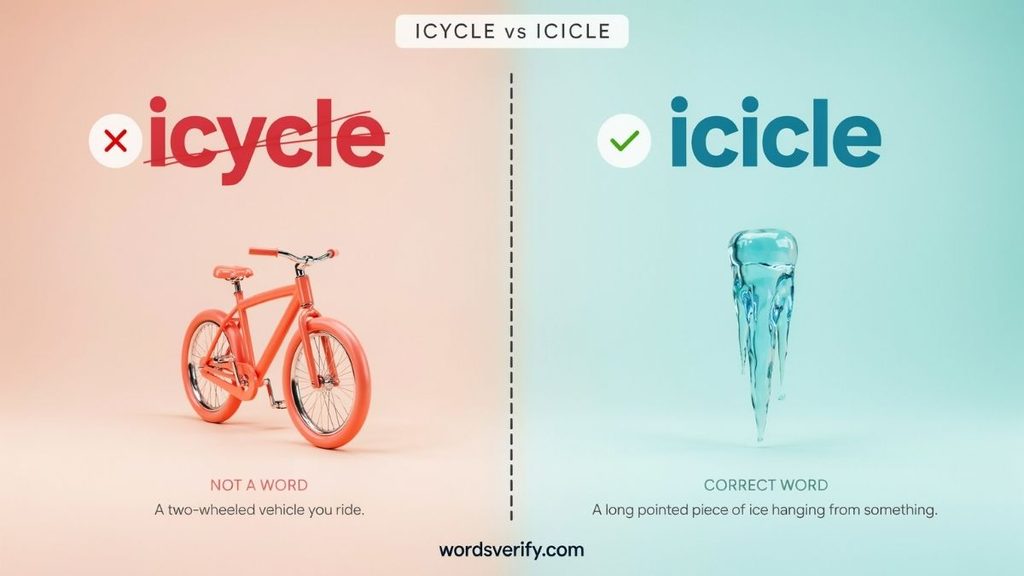
If you often wonder how to spell icicle, focus on the exact sequence of letters instead of relying only on the way the word sounds.
The correct spelling is:
I-C-I-C-L-E
Try breaking the word into smaller parts as you practice. Write it slowly, check the letters, and then use it in a sentence.
Why Is Icicle Spelled With a Second C?
“Icicle” has an established spelling in English. You can’t determine its correct form simply by adding a familiar pattern to the word “ice” or by comparing it with “cycle.”
English spelling often preserves historical patterns that aren’t obvious from pronunciation alone. That’s why learning a word’s standard spelling is sometimes more reliable than trying to work it out from sound.
The second “c” belongs in the word. Replacing it with a “y” creates the incorrect spelling “icycle” when you’re referring to hanging ice.
An Easy Way to Remember Icicle
Try this simple method:
- Picture an icicle hanging from the edge of a roof.
- Write the word slowly: I-C-I-C-L-E.
- Pay attention to the two “c” letters in the middle.
- Write a sentence such as “A clear icicle hung from the gutter.”
- Repeat the exercise until the spelling becomes familiar.
You can also connect the word with the image of a narrow spike of ice. When you picture the object, recall the correct spelling rather than the familiar-looking word “cycle.”
You don’t need a complicated rule. A little practice can make the correct spelling much easier to remember.
Learn the difference between tricky more English words
Excel vs Accel which one is correct?
Examples of Icicle in a Sentence
Examples show how a word works in everyday situations. The following sentences demonstrate the correct use of “icicle” in conversation, schoolwork, stories, and weather descriptions.
Simple Sentences With Icicle
- A small icicle hung from the roof.
- The icicle melted in the afternoon sun.
- An icicle formed beside the window.
- A sharp icicle dangled from the gutter.
- The children admired the icicles on the trees.
- Water froze into an icicle overnight.
- A large icicle hung above the doorway.
- The warm sunlight caused the icicle to drip.
- Several icicles covered the edge of the shed.
- The falling icicle struck the ground.
These examples show how the noun fits naturally into everyday English.
Icicle Example Sentences for Students
Students can use “icicle” in descriptive and informative writing.
- Descriptive: A crystal-clear icicle glittered in the morning sunlight.
- Scientific: An icicle forms when dripping water freezes and gradually adds more ice.
- Narrative: As Leo stepped outside, he noticed a long icicle hanging from the porch.
- Observational: The icicles on the tree branches grew longer as water continued to freeze.
- Explanatory: Icicle formation often occurs when melting snow supplies water that freezes near a roof edge.
Each sentence uses the word correctly while presenting a different kind of information.
Correcting Common Icicle Spelling Mistakes
Here are some common errors and their corrections.
| Incorrect sentence | Correct sentence |
|---|---|
| An icycle hung from the roof. | An icicle hung from the roof. |
| The icycle began to melt. | The icicle began to melt. |
| Several icycle’s formed overnight. | Several icicles formed overnight. |
| A sharp icycle fell from the gutter. | A sharp icicle fell from the gutter. |
| The tree was covered in icycle’s. | The tree was covered in icicles. |
The last two plural examples highlight another common mistake. The plural of “icicle” is “icicles,” without an apostrophe. Apostrophes generally indicate possession or contractions rather than ordinary plural nouns.
Icicle in Everyday Conversation
The word appears naturally in conversations about cold weather and winter conditions.
For example:
- “Look at that enormous icicle hanging from the porch!”
- “Be careful near the gutter because the icicles might fall.”
- “The icicle was gone by lunchtime because the weather warmed up.”
You don’t need complicated vocabulary to use the word correctly. A simple sentence often communicates the idea best.
Icicle in Professional and Academic Writing
In professional and academic settings, use “icicle” when describing the formation, appearance, or potential hazards of hanging ice.
Examples include:
- Weather report: Icicles developed along the roof edges after daytime melting and overnight freezing.
- Science assignment: An icicle grows as liquid water freezes and adds ice to the existing formation.
- Safety notice: Keep clear of areas where large icicles may fall from roofs.
- Descriptive essay: Long icicles hung from the wooden eaves of the abandoned house.
The spelling stays the same whether you’re writing informally or professionally.
Learn the difference between tricky more English words
Bellies vs Bellys Which one Is Correct?
How to Pronounce Icicle
In American English, “icicle” is pronounced /ˈaɪ.sɪ.kəl/. An easy way to say it is “EYE-sih-kuhl.”
The word has three syllables, with the stress on the first syllable.
Icicle Syllable Breakdown
| Syllable | Sound guide | What to notice |
|---|---|---|
| First | EYE | This syllable receives the main stress. |
| Second | sih | The vowel has a short sound. |
| Third | kuhl | The final vowel is reduced in ordinary speech. |
Say the word naturally instead of giving every syllable equal emphasis. The first syllable carries the strongest stress.
Why Pronunciation Can Cause Spelling Confusion
English pronunciation doesn’t always reveal the exact spelling of a word. Different spellings can produce similar sounds, and unstressed vowels may become less distinct in everyday speech.
This can make it difficult to reconstruct “icicle” from memory alone. However, the solution isn’t to treat “icycle” as a pronunciation variant. The standard word remains “icicle,” and learning its written form is the most reliable way to avoid the mistake.
Learn the difference between tricky more English words
Bearer vs Barer which one is correct?
Why Do People Confuse Icycle vs Icicle?
The confusion is understandable. Both forms look plausible, especially to someone who has heard the word many times but rarely written it.
Several factors may contribute to the error.
The Familiar Word Cycle
The word “cycle” appears in many familiar expressions, including “bicycle,” “life cycle,” and “water cycle.”
Because “icycle” resembles “cycle,” a writer may unconsciously substitute a “y” for the second “c.” This is a plausible explanation for the mistake, although it doesn’t establish a single cause for every spelling error.
Remembering the Sound Instead of the Letters
People often remember how a word sounds without remembering its exact spelling. When they try to write it later, they may choose a spelling that looks or sounds reasonable but isn’t correct.
The same problem affects many commonly confused English words. Recognizing the established written form is more reliable than trying to match every sound to a letter.
Typing Too Quickly
A fast typist may produce “icycle” without noticing the missing letter. Familiar-looking mistakes can easily escape a quick review.
A spelling checker can help, but it shouldn’t be your only line of defense. Read the sentence and make sure the word matches the meaning you intend.
Learn the difference between tricky more English words
Panel vs Pannel which one is correct?
How Are Icicles Formed?
Understanding how icicles form makes their meaning easier to remember and helps distinguish them from other types of ice.
The Process of Icicle Formation
Icicles commonly develop through a cycle of melting, dripping, and freezing.
- Water becomes available. Snow on a roof may melt slightly, or water may run across a cold surface.
- Water begins to drip. The liquid travels toward an edge, such as a gutter or roof eave.
- Freezing begins. The surrounding conditions remove enough heat for the water to freeze.
- Ice accumulates. Additional drops freeze onto the existing ice, allowing the formation to grow.
- The icicle changes or melts. Temperature changes and water flow affect its final shape and size.
An icicle doesn’t always form in a single freezing event. Repeated dripping and freezing can gradually extend it.
Why Do Icicles Form on Roofs?
Roofs can experience different temperatures across their surfaces. Heat escaping from a building may melt some snow, while colder roof edges remain exposed to freezing air. Water running toward those edges can freeze and build up into icicles.
Gutters can also collect water and direct it toward a cold edge. When the water freezes repeatedly, hanging ice may develop.
The precise process depends on roof insulation, outdoor temperatures, sunlight, snow cover, and drainage. Not every roof develops icicles under the same conditions.
Why Can Icicles Be Dangerous?
Small icicles may look beautiful, but larger formations can become a safety hazard.
As ice accumulates, it can fall from roofs, gutters, and branches. Falling ice may injure people or damage property.
For safety:
- Avoid walking directly beneath large icicles.
- Keep children and pets away from areas where ice may fall.
- Don’t strike large icicles from a ladder or an unstable surface.
- Seek professional help when removing dangerous ice from a roof or another elevated structure.
An icicle may look harmless, but a large one deserves caution.
Icicle Word Origin Where Does the Word Come From?
The word “icicle” has a long history in English. Its spelling and meaning developed over time, so it isn’t simply a modern combination of the words “ice” and “cycle.”
The word comes from older English forms associated with ice, including the Old English word īs, meaning “ice,” and an older element associated with a small piece or formation of ice.
icycle vs icicle Over time, “icicle” became the established spelling for the hanging ice formation. Modern English dictionaries recognize that spelling, and it remains standard in American and British English.
The spelling “icycle” may appear as a typo or in a proper name, but that doesn’t make it a standard alternative.
This is an important point about English vocabulary: a word’s accepted spelling comes from established usage and dictionary conventions, not simply from whether another spelling looks reasonable.
Learn the difference between tricky more English words
Dysregulated vs Disregulated which one is correct?
Icicle vs Related Ice and Weather Words
“Icicle” belongs to a broader group of words that describe ice, frozen water, and winter weather. These terms relate to one another, but they don’t all mean the same thing icycle vs icicle.
| Word | Meaning | Difference from icicle |
|---|---|---|
| Ice | Water in its solid state | A broad term that includes icicles. |
| Icy | Covered with ice or very cold | An adjective, not the name of an ice formation. |
| Frost | Ice crystals that form on cold surfaces | Usually appears as a coating or layer rather than a hanging spike. |
| Sleet | Frozen precipitation, typically ice pellets in US weather usage | Refers to precipitation, not a hanging formation. |
| Stalactite | A formation hanging from a cave ceiling, often made of minerals | Usually forms through mineral deposition rather than the freezing of dripping water. |
| Icicles | More than one icicle | The plural form of the noun “icicle.” |
Icicle vs Ice
Ice is the general term for frozen water. An icicle is one particular shape that ice can take.
For example, an ice cube in a drink is ice, but it isn’t an icicle. A narrow spike of ice hanging from a roof is an icicle.
Icicle vs Icy
“Icicle” is a noun, while “icy” is an adjective.
- Noun: An icicle hung from the branch.
- Adjective: The branch was icy.
Confusing these words can change the grammar of a sentence, even though both relate to frozen water.
Icicle vs Frost
Frost forms when ice crystals develop on a cold surface under suitable conditions. An icicle, by contrast, usually forms when dripping water freezes and accumulates into a hanging structure.
Frost may coat grass, leaves, or windows. Icicles typically project downward from an edge or surface.
Learn the difference between tricky more English words
Mobil vs Mobile which one is correct?
Practice Session Icycle vs Icicle
Ready to put your spelling skills to the test? This practice session will help you master the difference between “icycle” vs “icicle” while reviewing the word’s meaning, correct usage, and how icicles form.
Fill in the Blanks
Complete each sentence with the correct word or term.
- The correct spelling for a pointed piece of hanging ice is __________.
- “__________” is a common misspelling of the word icicle.
- The plural form of icicle is __________.
- An __________ formed along the roof as melting snow froze.
- Icicles usually form when dripping water __________.
- The main ingredient in an icicle is frozen __________.
- A long, pointed mass of ice hanging from a roof is called an __________.
- The word “icicle” is primarily used as a __________.
- Sunlight can melt snow, allowing water to drip from a __________.
- When dripping water encounters sufficiently cold conditions, it may __________.
- Large icicles can fall and cause injuries or property __________.
- For safety, avoid standing directly __________ large hanging icicles.
- An icicle often develops a narrow, __________ tip.
- The adjective “icy” describes something covered with or made of __________.
- A frost crystal forms when water vapor turns directly into __________.
- Icicles and frost crystals develop through different __________.
- “Icycle” may appear as a creative brand name or a work’s __________.
- In standard English, “icycle” is not the accepted spelling for a hanging piece of __________.
- Repeated dripping and freezing can cause an icicle to grow __________.
- Wind and temperature can affect an icicle’s shape and __________.
- An ice stalactite often grows downward from a cave’s __________.
- The phrase “melting icicles” describes icicles turning back into __________.
- In the sentence “The icicle glistened in the sun,” the word “icicle” names a __________.
- To spell “icicle” correctly, remember its opening letters: __________.
- One effective way to avoid spelling mistakes is to learn the correct spelling and __________ it.
Answers
Check your answers below once you’ve completed all questions.
- Icicle
- Icycle
- Icicles
- Icicle
- Freezes
- Water
- Icicle
- Noun
- Roof
- Freeze
- Damage
- Under
- Pointed
- Ice
- Ice
- Processes
- Title
- Ice
- Longer
- Size
- Ceiling
- Water
- Thing
- I-C-I
- Practice
Here’s a trusted source for clear word meanings:
FAQs
Is “icycle” ever used as a proper name?
Yes. “Icycle” may appear as a brand name, username, title, or creative spelling. However, it isn’t the standard English spelling for a pointed formation of ice.
How can you remember the correct spelling of icicle?
Think of the word “ice” when spelling “icicle.” Connecting the word to frozen water makes it easier to remember and helps you avoid the common mistake of writing “icycle.”
What causes icicles to form on rooftops?
Icicles often form when sunlight or heat melts snow on a roof. As the water drips from the edge and encounters colder air, it freezes. Repeated melting and freezing gradually create the familiar pointed shape.
Are icicles dangerous?
Yes. Large icicles can fall and cause injuries or damage property. They may also indicate ice buildup along a roof’s edge. For safety, avoid standing beneath them and leave removal to a qualified professional when necessary.
Can icicles form when temperatures stay below freezing?
Yes, provided liquid water is available. Sunlight or heat escaping from a building can melt snow even when the outdoor temperature remains below freezing. As the water drips into colder air, it can freeze into an icicle.
What is the difference between an icicle and an ice stalactite?
An icicle usually hangs from an outdoor surface, such as a roof, tree branch, or gutter. An ice stalactite forms on the ceiling of a cave or another cold environment and grows downward as dripping water freezes. Both develop through freezing water, but their settings and formation conditions can differ.
Do icicles always have pointed tips?
No. Although many icicles taper to a point, their shapes vary. Temperature, wind, water flow, and freezing conditions can produce short, thick, curved, or uneven formations.
Can “icicle” be used as an adjective?
“Icicle” is primarily a noun, but it can describe another noun when used attributively. For example, in “an icicle pattern,” the word identifies the type of pattern. In everyday writing, adjectives such as “icy” or “frozen” may sound more natural when describing something covered in ice.
What is the difference between an icicle and a frost crystal?
An icicle forms when liquid water freezes as it drips or flows from a surface. A frost crystal forms when water vapor changes directly into ice on a cold surface. Both are made of ice, but they develop in different ways.
Can “icicle” be used metaphorically?
Yes. Writers sometimes use “icicle” to suggest coldness, sharpness, or emotional distance. For example, “His words felt like icicles” creates an image of a response that sounds painfully cold or cutting.
What phrases commonly use the word “icicle”?
Common phrases include “hanging icicles,” “melting icicles,” “long icicles,” and “icicles along the roof.” These expressions describe an icicle’s appearance, condition, or location.
Why is “icycle” considered a spelling mistake in standard English?
“Icicle” is the established spelling for a pointed mass of ice that hangs from a surface. “Icycle” is not a standard alternative for this meaning, so using it in ordinary writing is considered a spelling error. icycle vs icicle Remember the correct spelling, and you can keep this little grammar problem from becoming a slippery situation!
Learn the difference between tricky more English words
Gummy vs Gummie Which one Is Correct?
Conclusion
Now you can put the icycle vs icicle confusion on ice! Remember, icicle is the correct spelling for the pointed piece of ice that forms when dripping water freezes. Although icycle may look convincing, it isn’t the standard spelling of this word. A simple way to remember the difference is to connect icicle with ice, the very thing it’s made of. With this small spelling tip in mind, you can write with greater confidence and avoid an unnecessary grammar slip. After all, winter already brings enough slippery surprises. Your spelling doesn’t need to add another one! Keep your writing clear, your grammar sharp, and your icicles hanging from rooftops not lurking in your spelling mistakes.

Lisa AJS is an experienced blogger and language enthusiast at Words Verify, dedicated to making grammar simple, practical, and enjoyable. She writes engaging content on commonly confused words, grammar mistakes, word meanings, and everyday language challenges.