
English spelling can be tricky, and the difference between “bellies” vs “bellys” is a perfect example. One is correct, while the other is a common spelling mistake. But don’t worry you don’t need to become a grammar detective to figure it out! If you’ve ever hesitated over which spelling to use, you’re not alone. In this guide, you’ll learn why “bellies” is the correct plural of “belly,” explore the simple spelling rule behind it, and see practical examples that make everything clear. By the end, you’ll know exactly which spelling to choose and avoid this little grammar blunder with confidence.
Bellies vs Bellys Quick Answer
If you’re wondering whether to use “bellies” or “bellys” in an email, school assignment, article, or everyday message, choose bellies. It’s the standard plural of belly in American English and other major varieties of English.
The spelling follows a common rule for plural nouns. When a noun ends in a consonant followed by y, you usually change the y to i and add es.
| Word | Correct? | Meaning or use |
|---|---|---|
| Belly | Yes | Singular form; one belly |
| Bellies | Yes | Plural form; more than one belly |
| Bellys | Generally incorrect | Nonstandard spelling of the plural |
| Belly’s | Yes, in the right context | Possessive form or contraction |
| Bellies’ | Yes, in the right context | Possessive form of the plural noun |
Here are a few examples:
- Correct: The babies have round bellies.
- Incorrect: The babies have round bellys.
- Correct: The baby’s belly is round.
Notice that the apostrophe in baby’s indicates possession, while the ending in bellies indicates more than one belly. These forms serve different grammatical purposes.
Bearer vs Barer which one is correct?
What Does Bellies Mean?
To understand the meaning of bellies, start with the singular word belly. It refers to the front part of a person’s or animal’s body between the chest and pelvis. In everyday conversation, people often use it to describe the stomach area, especially when discussing appearance, fullness, or discomfort.
Bellies simply refers to more than one belly. The plural doesn’t have a completely different meaning from the singular. It expresses the same basic idea but refers to multiple people, animals, or objects.
How Bellies Is Used in Everyday English
People commonly use belly and bellies in casual conversation. The words can describe a body part, a rounded shape, or the underside of certain objects.
Consider these examples:
- Body part: The children held their bellies while laughing.
- Animals: The puppies slept on their bellies.
- Food and fullness: Everyone left the restaurant with full bellies.
- Descriptive language: The boat’s curved belly rested just above the water.
In the final example, belly describes a rounded or curved part of an object. English speakers sometimes use the word this way when an object resembles the shape of a human or animal belly.
Belly, Stomach, and Abdomen What’s the Difference?
Although people often use belly, stomach, and abdomen interchangeably in casual conversation, the words don’t mean exactly the same thing.
| Word | Meaning | Typical use |
|---|---|---|
| Belly | The outside body area around the front of the torso | Everyday conversation |
| Stomach | An organ in the digestive system; also a casual term for the belly area | Everyday and medical contexts |
| Abdomen | The body region between the chest and pelvis | Medical, scientific, and formal writing |
| Tummy | An informal, often child-friendly term for the belly area | Family conversations and children’s language |
For example, someone might say, “My belly hurts,” during a casual conversation. A healthcare professional may instead use “abdominal pain” because it offers a more precise clinical description.
The distinction matters when choosing vocabulary, but it doesn’t change the spelling rule. The standard plural of belly remains bellies.
Panel vs Pannel which one is correct?
Why Is Bellies Correct and Bellys Incorrect?
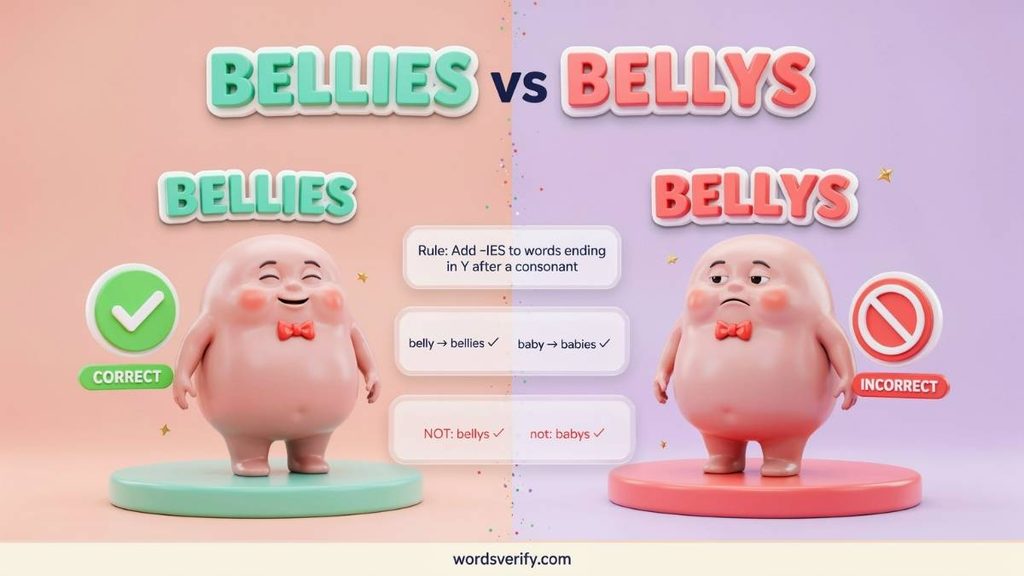
The answer lies in one of the most useful English spelling rules: nouns ending in a consonant followed by y usually change the y to i before adding es.
The word belly ends in y, but the letter immediately before it is l, which is a consonant. Therefore, belly follows the consonant + y pattern.
Here’s how the word changes:
| Step | Spelling |
|---|---|
| Start with the singular noun | Belly |
| Identify the consonant before y | Bell |
| Change the final y to i | Belli |
| Add es | Bellies |
The final result is bellies.
Why not simply add s? English follows established spelling conventions when forming regular plurals. For nouns ending in a consonant + y, adding only s generally produces a nonstandard form.
Compare belly with these familiar words:
- Baby becomes babies.
- City becomes cities.
- Family becomes families.
- Party becomes parties.
- Story becomes stories.
Each word follows the same basic pattern. Learning this rule helps you avoid spelling mistakes without memorizing every plural individually.
Dysregulated vs Disregulated which one is correct?
The Consonant + Y Rule vs. the Vowel + Y Rule
Here’s where spelling can get tricky: not every noun ending in y changes to ies. The letter immediately before the y determines which common rule applies.
When to Change Y to IES
When a noun ends in a consonant followed by y, change the y to i and add es to form the regular plural.
| Singular noun | Plural noun | Consonant before y |
|---|---|---|
| Belly | Bellies | L |
| Baby | Babies | B |
| City | Cities | T |
| Puppy | Puppies | P |
| Party | Parties | T |
| Country | Countries | R |
| Library | Libraries | R |
The pattern is consistent across these examples. Because a consonant comes directly before the final y, the plural takes the ending ies.
For example, you might write, “The library has several new books.” When referring to more than one library, the sentence becomes, “The libraries have several new books.”
The same principle applies to belly. One belly becomes two bellies, not two bellys.
When to Keep Y and Add S
When a noun ends in a vowel followed by y, keep the y and add s. Don’t change the y to i.
| Singular noun | Plural noun | Vowel before y |
|---|---|---|
| Boy | Boys | O |
| Key | Keys | E |
| Day | Days | A |
| Toy | Toys | O |
| Monkey | Monkeys | E |
| Journey | Journeys | E |
This explains why boys is correct while bellies is the correct plural of belly. In boy, the letter before y is a vowel. In belly, it’s a consonant.
A quick check before adding a plural ending can save you from many spelling errors. Look at the letter immediately before the final y rather than assuming every word ending in y follows the same pattern.
How to Apply the Rule to Belly
When you need the plural form of belly, follow these steps:
- Start with the singular noun: belly.
- Identify the letter before the final y: l.
- Recognize that l is a consonant.
- Change the final y to i.
- Add es to complete the plural: bellies.
This is the standard rule for nouns ending in consonant + y. It works in ordinary American English and doesn’t require a different spelling in formal writing.
Keep in mind that this rule describes the usual plural of regular nouns, not every English word. Some nouns have irregular plurals, and certain borrowed words or proper names may follow different conventions.
Mobil vs Mobile which one is correct?
Bellies vs Bellys in Sentences
Spelling rules become easier to remember when you see them in context. These examples show how to use bellies naturally in everyday writing.
Examples of Bellies in a Sentence
Everyday conversation:
- The children laughed and held their bellies.
- We ate so much pizza that our bellies felt full.
- The toddlers lay on their bellies while playing with their toys.
- The puppies rolled onto their backs and exposed their bellies.
Animals and nature:
- The fish had silver bellies and dark green backs.
- The kittens curled up on their bellies in the sunshine.
- The birds showed pale bellies beneath their wings.
Descriptive writing:
- The boat’s rounded belly glided across the water.
- The hikers rested on the grass with their bellies facing the warm sun.
- The children drew smiling faces on their paper figures’ bellies.
These examples show how bellies works in several contexts. You can use the word for people, animals, and figurative descriptions of objects.
Incorrect Examples Using Bellys
The following sentences show common mistakes and their corrections.
| Incorrect sentence | Correct sentence |
|---|---|
| The babies have round bellys. | The babies have round bellies. |
| The puppies rested on their bellys. | The puppies rested on their bellies. |
| Their bellys were full after dinner. | Their bellies were full after dinner. |
| The fish had white bellys. | The fish had white bellies. |
The problem in each sentence is the same: the writer added s without applying the consonant + y rule.
When proofreading an article, assignment, email, or social media caption, look for bellys and replace it with bellies whenever you mean the regular plural of belly.
Bellies vs Bellys in Context
The choice between belly and bellies depends on whether you’re referring to one or more than one.
| Example | Explanation |
|---|---|
| The baby has a small belly. | Singular: one belly |
| The babies have small bellies. | Plural: multiple bellies |
| The dog rolled onto its belly. | Singular: one dog |
| The dogs rolled onto their bellies. | Plural: multiple dogs |
| The belly of the boat was painted blue. | Singular: one boat |
| The bellies of the boats were painted blue. | Plural: multiple boats |
Pay attention to the rest of the sentence, too. Words such as a, one, and each often signal a singular noun. Words such as several, many, and multiple often indicate a plural noun.
However, these surrounding words don’t change the spelling rule. Once you know you’re referring to more than one belly, use bellies.
Gummy vs Gummie Which one Is Correct?
Common Mistakes When Spelling Bellies
Even a simple word can cause confusion when it follows a pattern that doesn’t apply to every word ending in y. Understanding the most common mistakes will help you catch them before they appear in your final draft.
Adding Only S to Belly
The most direct mistake is writing bellys. This happens when someone assumes every noun forms its plural by adding s.
Many English nouns do follow that pattern. For example, book becomes books, and chair becomes chairs. However, nouns ending in a consonant + y usually need a different change.
Incorrect: The children rubbed their bellys.
Correct: The children rubbed their bellies.
Applying the Y-to-IES Rule to Every Word Ending in Y
The opposite mistake occurs when writers change y to i even when a vowel comes before it.
For example:
- Incorrect: keies. Correct: keys.
- Incorrect: boies. Correct: boys.
- Incorrect: daies. Correct: days.
Remember the distinction: consonant + y usually becomes ies, while vowel + y usually takes s.
Confusing Belly’s With Bellies
Apostrophes create another common source of confusion. Belly’s and bellies look similar, but they serve different grammatical purposes.
- Belly is the singular noun.
- Bellies is the plural noun.
- Belly’s usually indicates possession or represents a contraction.
- Bellies’ is the possessive form of the plural noun bellies.
For example:
- The baby’s belly is round.
- The baby’s belly’s shape is unusual.
- The babies’ bellies are round.
- The bellies’ shapes differ.
The second sentence is grammatically possible, but it sounds awkward because it places two possessive constructions close together. A clearer version would be, “The shape of the baby’s belly is unusual.”
Assuming Informal Writing Makes Bellys Correct
You might see bellys in a username, product name, business name, or casual online post. That doesn’t automatically make it the standard plural form.
Writers can intentionally use unusual spellings for creative purposes or branding. However, if you’re writing standard English and mean more than one belly, use bellies.
Adding an Apostrophe to Form a Regular Plural
Apostrophes don’t normally form plurals in English. For instance, belly’s isn’t the correct plural simply because you want to refer to multiple bellies.
Use an apostrophe when the sentence calls for possession or a contraction. Otherwise, the plural is bellies.
Flys vs Flies which one is correct?
Is Bellies Correct in American and British English?
Yes. Bellies is the standard plural of belly in American English, British English, Canadian English, and Australian English. The spelling doesn’t vary by region.
Some English words have different spellings across countries. For example, American English typically uses color, while British English uses colour. Belly doesn’t have that kind of regional spelling difference.
| Variety of English | Correct singular | Correct plural |
|---|---|---|
| American English | Belly | Bellies |
| British English | Belly | Bellies |
| Canadian English | Belly | Bellies |
| Australian English | Belly | Bellies |
Whether you’re writing a school essay in the United States, a report in the United Kingdom, or an article for an international audience, the correct plural remains bellies.
The distinction matters because readers sometimes assume an unfamiliar spelling might belong to another English variety. In this case, there’s no regional exception to learn.
Envision vs Invision which one is correct?
Bellies in Everyday, Medical and Formal Writing
The word bellies works in many types of writing, but the best vocabulary depends on your audience and purpose. Understanding the difference between spelling and word choice will help you write more precisely.
Everyday Conversation
In casual speech, belly is familiar and easy to understand. People use it when talking about food, children, animals, or physical appearance.
For example:
- The kids had full bellies after lunch.
- The puppies were sleeping on their bellies.
- Their bellies hurt after eating too much candy.
These sentences sound natural in informal conversation. There’s no need to replace bellies with a more formal word just to make the writing sound sophisticated.
Medical and Scientific Writing
Medical writing often favors precise anatomical terms. A healthcare professional might use abdomen or abdominal area rather than belly, depending on the context.
For example:
- Everyday wording: The patient reported pain in the belly.
- More clinical wording: The patient reported abdominal pain.
The second version sounds more appropriate for a clinical report. However, belly remains a valid English word and can appear in patient education materials when plain language makes information easier to understand.
Changing belly to abdomen isn’t a spelling correction. It’s a vocabulary choice based on context.
Educational and Professional Writing
In an English lesson, spelling guide, or grammar assignment, bellies is the correct form to use when demonstrating the plural.
For example: The plural of belly is bellies because the noun ends in a consonant followed by y.
That explanation states the rule directly and provides a clear reason for the spelling.
In business writing, use bellies whenever the meaning calls for it. If the word appears in a product description, report, or article, follow standard English spelling unless you’re reproducing a proper name or a deliberate stylistic choice.
Bespectacled vs Bespeckled What’s the Difference?
Bellies vs Bellys What’s the Difference?
The difference between belly’s and bellies deserves special attention because the apostrophe changes the grammatical meaning.
Bellies is a plural noun. Belly’s is usually possessive. An apostrophe doesn’t turn a singular noun into a regular plural.
Belly’s as a Possessive Noun
Use belly’s to indicate that something belongs to or is associated with one belly.
Examples:
- The baby’s belly’s shape changed as the child grew.
- The animal’s belly’s coloring helped researchers identify it.
Both sentences are grammatically possible, but the repeated possessive structure makes them clumsy. More natural alternatives include:
- The shape of the baby’s belly changed as the child grew.
- The coloring on the animal’s belly helped researchers identify it.
These alternatives show that correct grammar involves more than spelling. Sentence structure also affects clarity and readability.
Belly’s as a Contraction
In some contexts, belly’s can represent belly is or belly has. This use is less common than the possessive form because belly doesn’t often function as the subject of those contractions.
For example, someone might write, “The belly’s getting bigger.” Here, belly’s means belly is.
The apostrophe replaces missing letters. It doesn’t mark a plural.
Bellies’ as a Plural Possessive
When several bellies possess or are associated with something, the plural possessive form is bellies’.
For example: The bellies’ different shapes made the illustration more realistic.
This construction is grammatically correct, although writers can often avoid an awkward possessive by rephrasing the sentence.
Here’s the difference at a glance:
| Form | Grammatical function | Example |
|---|---|---|
| Belly | Singular noun | The belly is round. |
| Bellies | Plural noun | The bellies are round. |
| Belly’s | Singular possessive or contraction | The baby’s belly’s shape is unusual. |
| Bellies’ | Plural possessive | The bellies’ shapes differ. |
If you remember only one distinction, remember this: use bellies for the plural, not belly’s or bellys.
Visible vs Visable Which one Is Correct?
Similar Words That Follow the Belly Plural Spelling Rule
Learning the spelling pattern through related words makes it easier to recognize the rule in new situations. English contains many nouns that end in a consonant + y, and their regular plurals generally follow the same pattern.
| Singular | Plural | Example |
|---|---|---|
| Baby | Babies | The babies slept peacefully. |
| City | Cities | The cities attract many visitors. |
| Family | Families | Several families attended the event. |
| Puppy | Puppies | The puppies played outside. |
| Party | Parties | We attended two parties. |
| Story | Stories | The children enjoyed the stories. |
| Country | Countries | The countries signed an agreement. |
| Belly | Bellies | The babies have round bellies. |
The spelling change isn’t unique to belly. It’s part of a broader pattern of plural noun formation in English.
Are These Regular or Irregular Plurals?
Words such as babies, cities, and bellies are generally considered regular plurals because they follow a predictable spelling pattern. They don’t change into entirely different words, as some irregular nouns do.
Compare these forms:
| Singular | Plural | Pattern |
|---|---|---|
| Belly | Bellies | Consonant + y changes to ies |
| Book | Books | Add s |
| Child | Children | Irregular plural |
| Foot | Feet | Irregular plural |
| Boy | Boys | Vowel + y takes s |
This comparison highlights why it helps to learn spelling rules instead of relying on a single approach for every noun.
The correct plural of belly follows a regular pattern. Once you know the rule, you can apply it confidently.
Heros vs Heroes Which one Is Correct?
How to Remember the Correct Spelling of Bellies
If you often hesitate between bellies vs bellys, a simple memory trick can help. Focus on the consonant immediately before the final y.
Think of belly alongside baby and city. All three end in a consonant + y, so their plurals change to ies.
- Belly becomes bellies.
- Baby becomes babies.
- City becomes cities.
Now compare them with boy, key, and day. Each has a vowel before the final y, so you keep the y and add s.
- Boy becomes boys.
- Key becomes keys.
- Day becomes days.
A quick question makes the rule easy to apply: Is the letter before the final y a consonant or a vowel?
If it’s a consonant, the plural usually ends in ies. If it’s a vowel, the plural usually keeps the y and adds s.
A Practical Spelling Check
When proofreading, use this simple checklist:
- Identify whether the noun is singular or plural.
- Check the letter immediately before the final y.
- Apply the correct plural spelling rule.
- Remove any unnecessary apostrophe.
- Read the full sentence to confirm that the noun agrees with the rest of the sentence.
This process takes only a few seconds and works for many common English spelling questions.
Minuscule vs Miniscule which one is correct?
practice session Bellies vs Bellys
Fill in each blank with the correct word Bellies vs Bellys. Check your answers at the end.
fill in the blanks
- My ______ hurts after eating too much.
- The babies have round ______.
- The correct plural of belly is ______.
- The baby touched her ______.
- The children rubbed their ______.
- One baby, two ______.
- One puppy, three ______.
- One city, two ______.
- One lady, two ______.
- One tummy, two ______.
- I have a full ______ after lunch.
- The children laughed and held their ______.
- She has pain in her ______.
- The plural of baby is ______.
- The plural of puppy is ______.
- The plural of toy is ______.
- The plural of key is ______.
- The plural of book is ______.
- The plural of box is ______.
- The plural of bus is ______.
- Which spelling is correct: ______?
- The plural of family is ______.
- The plural of story is ______.
- The plural of boy is ______.
- One belly, two ______.
Answers
- belly
- bellies
- bellies
- belly
- bellies
- babies
- puppies
- cities
- ladies
- tummies
- belly
- bellies
- belly
- babies
- puppies
- toys
- keys
- books
- boxes
- buses
- bellies
- families
- stories
- boys
- bellies
Here’s a trusted source for clear word meanings:
FAQs
Is “bellies” a noun or a verb?
“Bellies” can function as both a noun and a verb. As a noun, it refers to more than one belly. As a verb, it describes something that bulges or swells outward. For example, “The sail bellies in the wind.”
Why does “belly” become “bellies” instead of “bellys”?
English follows a simple plural spelling rule: when a noun ends in a consonant followed by “y,” change the “y” to “ies.” That’s why “belly” becomes “bellies,” just as “baby” becomes “babies.” Writing “bellys” is a common spelling mistake.
What is the difference between “belly,” “bellied,” and “bellying”?
“Belly” is a noun that refers to the abdomen. “Bellied” is the past-tense or past-participle form of the verb “belly,” while “bellying” is its present-participle form. For example, “The boat bellied outward under the pressure of the wind.”
Can “bellies” be used as a verb?
Yes. “Bellies” is the third-person singular form of the verb “belly,” which means to bulge or swell outward. For example, “The sail bellies in the strong wind.”
What does “go belly up” mean?
The expression “go belly up” means to fail, collapse, or stop operating. People often use it when talking about a business that closes down or a plan that falls apart. For example, “The small company went belly up after losing its biggest customer.”
What does “bellyache” mean?
“Bellyache” can refer to stomach pain or discomfort. Informally, it also means to complain too much about something. For example, “Instead of bellyaching about the weather, let’s make the most of the sunny afternoon.”
Is “bellyful” a real word?
Yes. “Bellyful” is a noun that means as much as someone can eat or tolerate. In the expression “I’ve had a bellyful,” it means someone has had enough of a situation and doesn’t want to put up with any more.
What does “belly button” mean?
“Belly button” is the everyday term for the navel, the small indentation or raised area on the abdomen where the umbilical cord was attached before birth.
Is “belly” suitable for formal writing?
Yes, but context matters. “Belly” works well in casual conversations, general writing, and informal descriptions. In medical or scientific writing, “abdomen” is usually more precise and appropriate.
What are some common expressions that use “belly”?
Several common English expressions use the word “belly.” A “belly laugh” is a deep, hearty laugh. “Go belly up” means to fail or collapse. “Fire in the belly” describes strong motivation, ambition, or determination.
Does “belly” always refer to the human stomach?
No. “Belly” commonly refers to the front part of the body around the abdomen, but it can also describe the underside or rounded, bulging part of an object or animal. The exact meaning depends on the context.
What is the easiest way to remember the correct plural of “belly”?
Remember this rule: when a noun ends in a consonant followed by “y,” change the “y” to “ies” to make it plural. For example, “belly” becomes “bellies,” “puppy” becomes “puppies,” and “city” becomes “cities.” Learn this simple pattern, and you’ll avoid many common plural spelling mistakes Bellies vs Bellys.
Conclusion
The spelling mystery of “bellies vs bellys” is finally solved! “Bellies” is the correct plural of “belly,” while “bellys” is a common spelling mistake. Thankfully, remembering the difference is easier than finding the perfect pair of jeans after a big meal!
Here’s the simple rule: when a noun ends in a consonant followed by “y,” change the “y” to “ies” to form the plural. For example, “belly” becomes “bellies,” just as “baby” becomes “babies.”
Now that you know the rule Bellies vs Bellys, you can say goodbye to this little grammar blunder. Keep it in mind whenever you write, and your spelling will stay accurate, your sentences will read smoothly, and your grammar will have one less reason to complain!

Lisa AJS is an experienced blogger and language enthusiast at Words Verify, dedicated to making grammar simple, practical, and enjoyable. She writes engaging content on commonly confused words, grammar mistakes, word meanings, and everyday language challenges.