
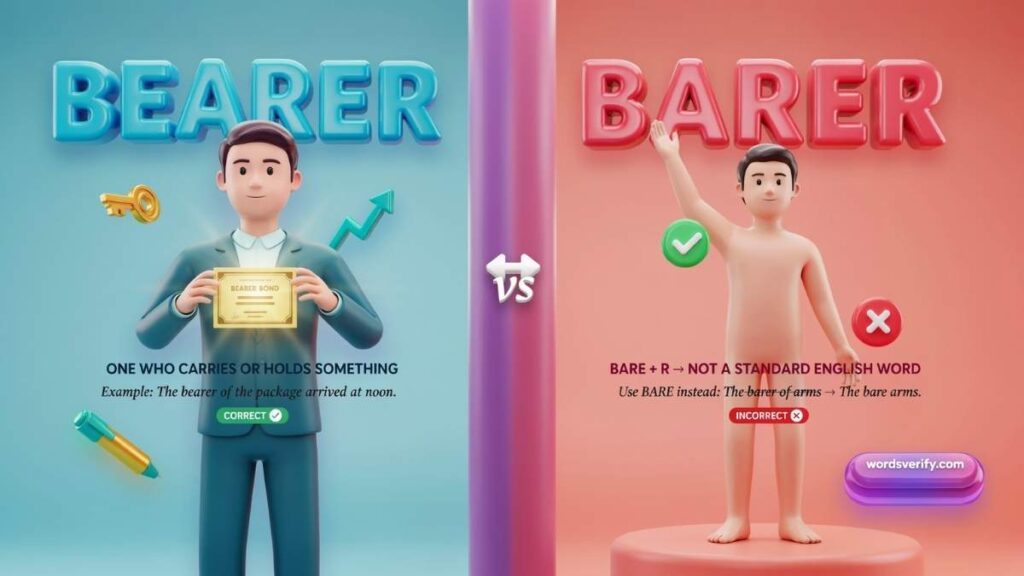
Have you ever stared at a sentence, wondering whether “bearer” vs “barer” is the right choice? You’re not alone! These sound-alike words can confuse even experienced writers, turning a simple sentence into an unexpected grammar puzzle. Although they sound nearly identical, their meanings are quite different. A “bearer” is someone or something that carries or holds something, while “barer” describes something that is more exposed or less covered. The good news? Understanding bearer vs barer doesn’t require a dictionary marathon. In this guide, you’ll learn their meanings, explore clear examples, uncover common mistakes, and discover how to use both words correctly with confidence.
quick answer
The easiest way to understand these words is to look at what each one describes. Bearer names a person or thing that carries, holds, or conveys something. Barer describes something that has less covering, decoration, or vegetation than another thing.
Consider these examples:
- Maria was the bearer of good news. She delivered the news to everyone waiting for an update.
- The garden looked barer after the flowers were removed. It had less vegetation than before.
Notice the difference. In the first sentence, bearer identifies a person. In the second, barer describes the garden’s changing appearance.
Bearer vs Barer Comparison Table
| Feature | Bearer | Barer |
|---|---|---|
| Part of speech | Noun | Comparative adjective |
| Base word | Bear | Bare |
| Main meaning | Someone or something that carries, holds, or conveys | More uncovered, exposed, or sparse |
| Common uses | Bearer of bad news, ring bearer, bond bearer | Barer walls, barer branches, a barer landscape |
| Example | He was the bearer of the letter. | The room looked barer without its furniture. |
Here’s a simple rule to remember: if you’re talking about someone who carries or delivers something, use bearer. If you’re describing something that has become more bare, use barer.
Is It Bearer vs Barer?
When you’re unsure which word to use, ask yourself what you’re trying to say.
If you’re describing a person carrying a flag, delivering a document, or sharing information, bearer is the correct choice. If you’re comparing two surfaces, landscapes, or appearances, barer is usually the right word.
For example, the person carrying wedding rings is the ring bearer. A tree with fewer leaves than another tree has barer branches.
The meaning determines the spelling. Once you understand that distinction, choosing the correct word becomes much easier.
Avoid everyday grammar mistakes with simple tips
Panel vs Pannel which one is correct?
What Does Bearer Mean?
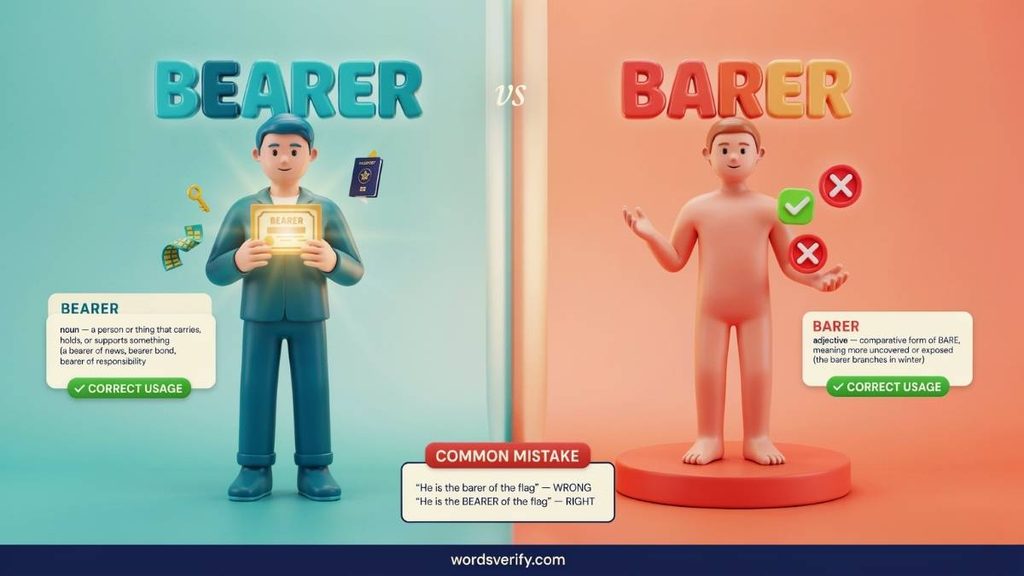
Bearer is a noun that refers to someone or something that carries, holds, supports, or conveys something. The word doesn’t apply only to physical objects. A bearer can also deliver information, represent an idea, or hold a document that grants certain rights.
The word comes from the verb bear, which has several meanings in English. Depending on the context, bear can mean to carry a load, endure a difficult experience, accept responsibility, or support a weight.
Adding the ending -er creates a noun that identifies the person or thing performing an action. For example, a writer writes, a teacher teaches, and a bearer bears something.
Bearer as a Noun
A noun names a person, place, thing, or idea. In the phrase “the bearer of the message,” the word bearer identifies the person who carries or delivers the message.
Here are some common examples:
- A flag bearer carries a flag during a parade or ceremony.
- A bearer of bad news delivers information that someone may find upsetting.
- A ring bearer carries the wedding rings during a ceremony.
- A document bearer carries or presents a document.
- A bond bearer holds a financial instrument that may grant certain rights under its terms and applicable law.
Although these examples involve different situations, they share the same basic idea. The bearer carries, holds, or conveys something. That something might be a physical object, such as a flag, or information, such as an important announcement.
Common Phrases Using Bearer
Several familiar expressions can help you understand how people use bearer in everyday English.
Bearer of good news
A bearer of good news is someone who brings positive information.
Example: The coach was the bearer of good news when she announced that the team had qualified for the finals.
Bearer of bad news
A bearer of bad news delivers information that someone may find disappointing or upsetting.
Example: I hate to be the bearer of bad news, but the concert has been canceled.
People often use this expression when they need to share an unpleasant update. The person delivering the news isn’t necessarily responsible for the problem.
Ring bearer
A ring bearer is someone who carries the wedding rings during a wedding ceremony. The role often goes to a child, although adults can serve in this position too.
The correct expression is always ring bearer, not ring barer.
Bearer of a message
A bearer of a message is someone who carries or communicates information from one person to another.
Example: The messenger arrived as the bearer of an urgent message.
Bearer of a document
This phrase describes someone carrying or presenting a document. Depending on the document, simply possessing it may or may not establish legal rights.
Bond bearer
A bond bearer is someone who holds a bearer bond. Historically, these bonds could grant certain rights to the holder without recording that person’s name on the instrument. Modern laws and financial regulations vary by jurisdiction, and bearer instruments are subject to legal restrictions.
These expressions show how bearer appears in ordinary conversations, weddings, literature, and financial discussions.
Bearer in Legal and Financial Contexts
In legal and financial writing, bearer can have a more specific meaning than simply someone carrying an object.
A bearer instrument is a financial or legal instrument whose terms and applicable law may grant rights to its lawful holder. Depending on the instrument, possession can play an important role in establishing who may present it or claim payment.
For example, the phrase “pay to the bearer” traditionally indicates that payment may be made to the person presenting the instrument, subject to its terms and applicable law.
However, not every document grants rights to whoever carries it. A person holding an ordinary letter, for instance, doesn’t automatically gain ownership of its contents or any property mentioned in it.
This distinction matters because bearer describes a holder or carrier. Writing barer instrument would change the intended meaning and make the expression incorrect in this context.
Avoid everyday grammar mistakes with simple tips
Minuscule vs Miniscule which one is correct?
How to Use Bearer in a Sentence
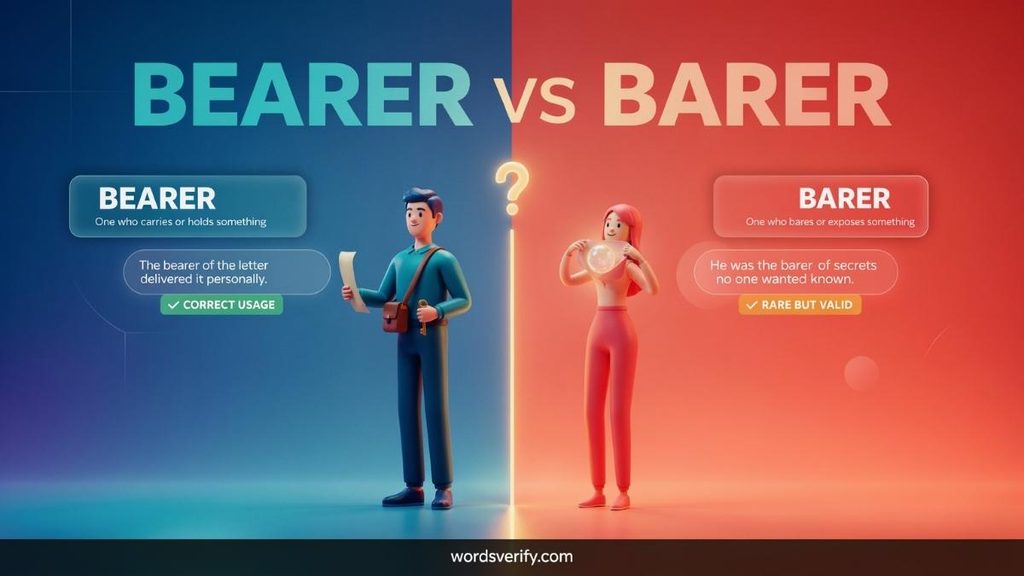
The easiest way to use bearer correctly is to place it where a noun belongs. It can serve as the subject or object of a sentence, or it can follow a word such as a or the.
Here are some examples:
- The bearer delivered the invitation before noon.
- She became the official flag bearer for her school.
- He didn’t want to be the bearer of bad news.
- The bearer of the ticket presented it at the entrance.
- The ring bearer walked carefully toward the altar.
- The document outlined the rights associated with its bearer.
In every example, bearer identifies a person or thing. It doesn’t describe how uncovered or sparse something looks.
Avoid everyday grammar mistakes with simple tips
Dysregulated vs Disregulated which one is correct?
What Does Barer Mean?
Barer is the comparative form of the adjective bare. It means more uncovered, more exposed, less decorated, or less dense with vegetation than something else.
The word follows a common English grammar pattern. Many short adjectives form their comparative degree by adding -er. For example, small becomes smaller, fast becomes faster, and bare becomes barer.
Although barer is less familiar to many readers than bearer, it’s a perfectly valid English word. Writers use it when they want to compare two things or describe a change that leaves something less covered or decorated.
Consider this example: After we removed the curtains and paintings, the living room looked barer.
The room didn’t become a carrier of anything. Instead, it lost some of its decoration and looked more exposed.
Barer as a Comparative Adjective
An adjective describes a noun. A comparative adjective compares two people, places, objects, or conditions.
The forms of bare follow this pattern:
| Form | Word | Meaning |
|---|---|---|
| Base adjective | Bare | Uncovered, exposed, or lacking decoration |
| Comparative adjective | Barer | More uncovered, exposed, or sparse |
| Superlative adjective | Barest | The most uncovered, exposed, or sparse within a comparison |
For example:
- Bare: The wall is bare.
- Barer: This wall is barer than the one in the hallway.
- Barest: Of the three rooms, this one has the barest walls.
The comparative form often appears when a writer makes a direct comparison. However, the other thing being compared doesn’t always need to appear in the same sentence.
For instance, “The room looked barer after the renovation” compares the room’s current appearance with how it looked before.
Common Meanings and Uses of Barer
Although barer always comes from bare, its exact meaning depends on what it describes.
Less covered
A surface becomes barer when someone removes a covering or decoration.
Example: The kitchen walls looked barer after the shelves came down.
More exposed
Barer can describe a part of the body or another surface with less covering.
Example: The sleeveless dress left her shoulders barer than the outfit she wore the previous evening.
Less furnished or decorated
A room may look barer after someone removes furniture, artwork, or ornaments.
Example: The apartment seemed barer after the previous tenant took the furniture.
Less vegetated
A landscape can become barer when plants, grass, or leaves disappear.
Example: The hillside looked barer after the wildfire destroyed much of its vegetation.
Less detailed or elaborate
The word can also describe writing, an explanation, or a presentation that contains fewer details or embellishments.
Example: The revised report offered a barer account of the events, focusing only on the essential facts.
All these uses share the same idea: something has less covering, decoration, vegetation, or detail than it had before or than another thing has.
Why Barer Is a Correct Word
Some readers assume that barer must be a spelling mistake because bearer is more familiar. However, a word doesn’t become incorrect simply because people use it less often.
English uses comparative adjectives to show differences in degree. Since bare is a short adjective, it can form its comparative by adding -er. The result is barer.
Here are a few examples:
- The winter trees looked barer after another week of strong winds.
- The second design was barer than the first.
- The fields grew barer as the dry season continued.
- The walls appeared barer once the decorations were removed.
In each sentence, the writer compares the amount of covering, vegetation, or detail.
Still, barer isn’t always the most natural choice. Depending on the sentence, phrases such as less covered, more exposed, less decorated, or sparser may sound clearer. Good writing depends on choosing the word that communicates your meaning most naturally.
Avoid everyday grammar mistakes with simple tips
Mobil vs Mobile which one is correct?
Bearer vs Barer Examples Compared
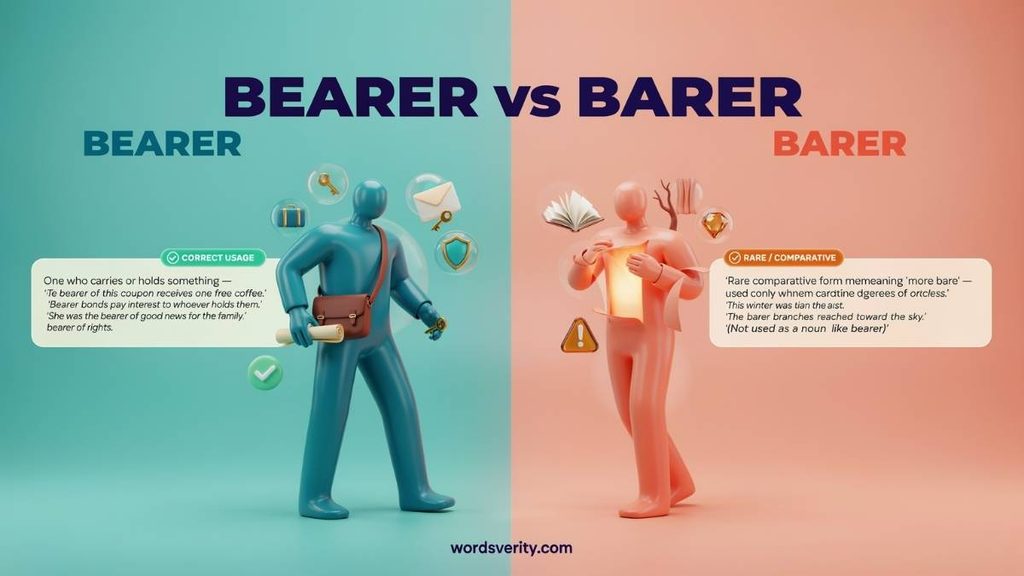
Definitions explain the rule, but examples show how it works in real sentences. Comparing the two words side by side makes their different meanings easier to recognize.
| Bearer example | Barer example |
|---|---|
| The bearer delivered the letter. | The wall looked barer after we removed the pictures. |
| She was the bearer of good news. | The garden looked barer after the flowers died. |
| The ring bearer walked down the aisle. | The trees looked barer after losing their leaves. |
| The bearer presented the document. | The room became barer when the furniture was removed. |
| He was the bearer of bad news. | The hillside looked barer after the vegetation disappeared. |
| The ticket bearer entered the venue. | The second sketch was barer than the first. |
The first column identifies someone who carries, holds, or conveys something. The second describes something that has become less covered or detailed.
Bearer vs Barer Incorrect and Correct Usage
A common spelling mistake occurs when writers choose the more familiar word without checking its meaning. Because bearer and barer sound alike to many speakers, a spell-checker may not flag the error.
Consider these examples.
Incorrect: She was the barer of bad news.
Correct: She was the bearer of bad news.
The corrected sentence uses a noun to identify the person delivering the information.
Incorrect: The room looked bearer after we removed the paintings.
Correct: The room looked barer after we removed the paintings.
The corrected sentence uses a comparative adjective to describe the room’s appearance.
Incorrect: He was the ring barer at the wedding.
Correct: He was the ring bearer at the wedding.
The correct expression identifies the person carrying the rings.
Incorrect: The walls became bearer after the decorations came down.
Correct: The walls became barer after the decorations came down.
Here, barer describes a change in the amount of decoration.
The lesson is simple: don’t choose a spelling based only on how a word sounds. Identify its meaning and grammatical role first.
Avoid everyday grammar mistakes with simple tips
Visible vs Visable Which one Is Correct?
A Practical Example Editing a Short Paragraph
Imagine you’re editing a paragraph about a wedding and a newly renovated home.
The first draft reads:
“The ring barer arrived early. Later that afternoon, the family removed several paintings from their living room, leaving the walls looking bearer than before.”
Both highlighted words are incorrect because the writer has confused a noun with a comparative adjective.
A corrected version reads:
“The ring bearer arrived early. Later that afternoon, the family removed several paintings from their living room, leaving the walls looking barer than before.”
The first correction changes barer to bearer because the wedding attendant carries the rings. The second changes bearer to barer because the walls have less decoration.
This simple editing exercise demonstrates why context matters. The spellings are similar, but their meanings aren’t interchangeable.
Avoid everyday grammar mistakes with simple tips
Gummy vs Gummie Which one Is Correct?
How to Remember the Difference
The best memory tricks connect spelling to meaning. Instead of memorizing two separate definitions, remember the base word behind each form.
Remember Bearer Someone Who Bears Something
Think of the verb bear, which can mean to carry, support, or endure. A bearer is someone or something that performs that action.
For example:
- A flag bearer carries a flag.
- A ring bearer carries wedding rings.
- A bearer of bad news delivers unpleasant information.
- Someone who bears responsibility accepts an obligation.
Memory trick: Bearer has the same base word as bear a burden. Picture someone carrying a heavy box. That person is the bearer of the box.
Remember Barer Something That Is More Bare
Think of the adjective bare, meaning uncovered or lacking decoration. Add -er to compare two things.
For example:
- A bare wall has no decorations.
- A barer wall has fewer decorations than another wall or than it had before.
- Bare branches have little or no foliage.
- Barer branches have even less foliage than the branches used for comparison.
Memory trick: Barer contains the word bare. Imagine removing leaves from a tree or pictures from a wall. As the covering disappears, the surface becomes barer.
A Quick Three-Step Check
Whenever you’re unsure whether to use bearer or barer, follow these steps:
- Identify the meaning. Are you describing a carrier, or are you describing something uncovered?
- Check the grammatical role. Do you need a noun or a comparative adjective?
- Read the sentence again. Make sure the selected word communicates your intended meaning.
For example, in “The bearer carried the flag,” the noun identifies the person. In “The branches looked barer in winter,” the adjective describes the branches’ appearance compared with a fuller or leafier state.
This approach works for proofreading, school assignments, business communication, and creative writing.
Avoid everyday grammar mistakes with simple tips
Flys vs Flies which one is correct?
Bearer vs Barer Pronunciation
In standard American English, bearer and barer are generally pronounced alike. They are commonly treated as homophones because their spoken forms match even though their spellings and meanings differ.
Both words usually have two syllables. Their pronunciation follows the same general pattern, so a listener may not be able to determine which word a speaker intends without context.
This creates a spelling challenge. You might hear someone say “the bearer of the message” or “the barer wall” and understand the intended meaning from the surrounding words. However, when you write the sentence, you must choose the correct spelling.
Pronunciation can vary among speakers and accents. The important point is that standard American English generally doesn’t provide a reliable sound-based distinction between these two words.
Avoid everyday grammar mistakes with simple tips
Envision vs Invision which one is correct?
Bearer vs Barer Word Origins
Understanding word formation makes the difference between bearer and barer easier to remember. Although the words look similar, they come from different base words.
Origin of Bearer
Bearer comes from the verb bear, which has long carried meanings associated with carrying, supporting, enduring, and producing. The suffix -er forms a noun that identifies the person or thing performing an action.
This pattern appears throughout English:
- Teach becomes teacher.
- Write becomes writer.
- Carry becomes carrier.
- Bear becomes bearer.
The meaning of bearer follows naturally from its base verb: a bearer carries, supports, or conveys something.
Origin of Barer
Barer comes from the adjective bare, meaning uncovered, exposed, or lacking decoration. English commonly forms the comparative degree of short adjectives by adding -er.
The same pattern appears in words such as small and smaller, wide and wider, and fine and finer. In the same way, bare becomes barer.
The final e in bare remains in the spelling. The word doesn’t gain an extra syllable simply because it takes the comparative ending.
The difference in word origins provides a useful spelling clue: bearer comes from bear, while barer comes from bare.
Avoid everyday grammar mistakes with simple tips
Bespectacled vs Bespeckled What’s the Difference?
Practice sessions Bearer vs Barer
Fill in each blank with the correct word: bearer vs barer. Read each sentence carefully and consider its meaning before choosing your answer.
fill in the blanks
- The ______ of the wedding ring carefully carried it to the altar.
- After the trees lost their leaves, the garden looked much ______ than before.
- The messenger was the ______ of an important letter from the king.
- Removing the paintings made the walls look ______.
- The ______ of the invitation presented it to the host.
- Without curtains, the windows looked ______ than they had the previous day.
- The official document named the ______ of the certificate.
- After we removed the decorations, the room appeared ______.
- The ______ of the flag led the parade through the town.
- The hillside looked ______ after the thick bushes were cleared away.
- The bank employee asked the ______ of the check to provide identification.
- With fewer plants and flowers, the yard looked ______.
- The ______ of the message delivered it to the intended recipient.
- After the old furniture was removed, the living room looked ______.
- The ticket ______ presented the pass at the entrance.
- The branches appeared ______ after the storm stripped away their leaves.
- The ______ of the package signed the delivery form.
- Without its usual ornaments, the Christmas tree looked ______.
- The ______ of the royal letter entered the palace.
- Once the thick fog disappeared, the landscape looked ______ and more exposed.
- The document identified the ______ as the person authorized to present it.
- The walls looked ______ after we removed the shelves and pictures.
- The ______ of the official notice delivered it to the residents.
- After the snow melted, the mountain slopes looked ______.
- The ______ of the legal document had to show proof of identity.
Answers
- Bearer
- Barer
- Bearer
- Barer
- Bearer
- Barer
- Bearer
- Barer
- Bearer
- Barer
- Bearer
- Barer
- Bearer
- Barer
- Bearer
- Barer
- Bearer
- Barer
- Bearer
- Barer
- Bearer
- Barer
- Bearer
- Barer
- Bearer
Here’s a trusted source for clear word meanings:
fAQs
What is the difference between bearer and barer?
“Bearer” refers to someone or something that carries, holds, or presents something. “Barer” is the comparative form of “bare,” meaning more exposed or less covered. For example, “the bearer of the letter” identifies the person carrying it, while “a barer wall” describes a wall with fewer decorations.
Can bearer and barer be used interchangeably?
No, bearer and barer are not interchangeable because they have different meanings. Use “bearer” when referring to someone or something that carries or presents an item. Use “barer” when comparing two things and describing one as more exposed or less covered.
Is barer the comparative form of bare?
Yes, “barer” is the comparative form of “bare.” It describes something that has less covering, fewer decorations, or greater exposure than something else. For example, “After removing the curtains and pictures, the room looked barer than before.”
What are some examples of bearer and barer in sentences?
Here are two examples that show the difference:
- “The bearer of the certificate walked onto the stage.” Here, “bearer” refers to the person carrying or presenting the certificate.
- “The winter trees looked barer after losing their leaves.” Here, “barer” means the trees had less covering.
Why do people confuse bearer and barer?
People often confuse these words because they sound alike in many varieties of English. However, their spellings and meanings differ. Remember that “bearer” relates to carrying or presenting something, while “barer” relates to being bare or exposed.
What is the plural form of bearer?
The plural form of “bearer” is “bearers.” It refers to multiple people or things that carry, hold, or present something. For example, “The pallbearers carried the casket with care.”
Can barer describe a person?
Yes, “barer” can describe a person when comparing how much of their body is uncovered or how exposed they appear. However, the word often describes objects, spaces, or landscapes. For example, “His arms looked barer without the long sleeves.”
How can I remember when to use bearer or barer?
Use this simple memory trick: bearer carries; barer reveals. A bearer carries or presents something, while barer describes something with less covering. Before choosing a word, check whether your sentence refers to carrying an item or comparing levels of exposure.
Is bearer a noun or a verb?
“Bearer” is a noun. It identifies a person or thing that carries, holds, or presents something. “Barer” is also used as an adjective because it compares one thing with another in terms of how bare or exposed it is.
What common mistakes should I avoid when using bearer and barer?
The most common mistake is using “barer” when you mean someone who carries or presents something. Another is using “bearer” to describe something with less covering. Check the meaning of the sentence rather than relying on sound alone to choose the correct word.
Avoid everyday grammar mistakes with simple tips
Heros vs Heroes Which one Is Correct?
Conclusion
You’ve finally cracked the case of “bearer” vs “barer”! No grammar detective or dictionary marathon required. Although these words sound alike, they serve very different purposes. A bearer is someone or something that carries or holds something, while barer describes something that is more exposed or less covered. In short, one carries the load while the other reveals a little more.
To avoid this common grammar mistake, focus on the meaning of your sentence before choosing a word. When in doubt, pause and double-check rather than letting a tiny spelling difference create a big misunderstanding. With a little practice, you’ll use both words naturally and confidently. After all, good grammar isn’t about making language complicated; it’s about choosing the right words and making your meaning crystal clear.

Lisa AJS is an experienced blogger and language enthusiast at Words Verify, dedicated to making grammar simple, practical, and enjoyable. She writes engaging content on commonly confused words, grammar mistakes, word meanings, and everyday language challenges.