
Have you ever hesitated over signer vs signor, wondering which spelling belongs in your sentence? You’re not alone! These look-alike words can easily trip up even careful writers, but their meanings are worlds apart. A signer is someone who signs a document, while a signor is an Italian title used for a man. Confuse the two, and a simple sentence could take an unexpected trip from the office straight to Italy! Fortunately, the difference is easier to remember than you might think. With clear definitions, practical examples, and a few helpful tips, you’ll learn how to use signer and signor correctly and keep this tricky grammar mistake off your page.
Signer vs Signor Quick Answer
The difference comes down to meaning and context.
- Signer: A person who signs a document, agreement, form, or other written item. The word can also describe someone who communicates through sign language.
- Signor: An Italian title of respect equivalent to Mr. or Sir, traditionally used before a man’s name or surname.
Consider these examples:
- The signer approved the agreement before the deadline.
- Signor Rossi greeted the guests at the entrance.
In the first sentence, signer refers to the person who signed the agreement. In the second, signor is a title used before a person’s name.
Neither word is automatically incorrect. The mistake happens when you use one in place of the other.
Remember this simple rule: A signer signs, while a signor is addressed by an Italian title of respect.
Comparison Table
Although these words share several letters, their meanings, origins, and uses differ.
| Feature | Signer | Signor |
|---|---|---|
| Meaning | A person who signs something or uses sign language | An Italian title of respect for a man |
| Language | English | Italian, also used in English |
| Part of speech | Noun | Noun or title |
| Origin | Sign + -er | Italian signor, related to signore |
| Common context | Contracts, forms, petitions, and sign language | Names, formal address, and literature |
| Example | The signer completed the form. | Signor Bianchi entered the room. |
| Plural | Signers | Signors or Italian signori |
| Related term | Signatory | Signore |
The key distinction is straightforward: signer describes a person’s role or activity, while signor serves as a title. This remains true whether you’re writing an email, completing paperwork, or discussing Italian vocabulary.
Fix common more word mistakes in English
Macaroon vs Macaron which one is correct?
What Does Signer Mean?
A signer is a person who signs something or someone who uses sign language. The intended meaning depends on the situation.
In everyday English, the word often appears in business, legal, financial, and administrative settings. You might encounter it when signing a contract, opening a bank account, approving a transaction, or submitting a petition.
Signer as a Person Who Signs a Document
When someone writes their name or places an accepted signature on a document, that person can be called a signer. The document might be a contract, application, consent form, letter, or official record.
Here are a few examples:
- The signer approved the agreement before the deadline.
- Every signer must sign the final page.
- The bank requires an authorized signer to approve certain transactions.
- She is the only signer on the contract.
- The signer completed the loan documents.
A signature can serve different purposes. It might show that someone accepts an agreement, acknowledges receiving information, confirms a statement, or authorizes a transaction. Its precise meaning depends on the document and the circumstances.
It’s also worth remembering that signing a document doesn’t automatically make someone its owner or a party to every obligation it describes. A person may sign as a witness, representative, or authorized agent. Each role has a different purpose.
Signer as a Person Who Uses Sign Language
The word signer can also describe someone who communicates through a sign language, such as American Sign Language (ASL).
Sign languages use visual and manual communication, including hand movements, facial expressions, and body position. They have their own grammar and structures rather than simply translating spoken English into gestures.
For example:
- The signer uses American Sign Language to communicate.
- The event welcomed Deaf signers from several communities.
- The interpreter relayed the speaker’s message to the signers in the audience.
In this context, signer has nothing to do with signing a contract. The surrounding sentence tells you which meaning applies.
Is Signer a Real English Word?
Yes. Signer is a standard English noun formed from the verb sign and the suffix -er. English often uses this suffix to describe someone who performs an action, as in writer, speaker, and builder.
The same pattern explains the meaning of signer: a person who signs.
The word isn’t slang or a misspelling of signor. It’s an established part of English vocabulary used in everyday conversation, professional writing, and legal documents.
Fix common more word mistakes in English
Withdraw vs Withdrawal which one is correct?
What Does Signor Mean?
Signor is an Italian title of respect traditionally used when addressing or referring to a man. In English, it is commonly understood as the equivalent of Mr. or Sir.
The word often appears before a name or surname, especially in formal, cultural, historical, or literary settings.
For example:
- Signor Rossi greeted the guests.
- Signor Bianchi arrived at the meeting.
- The letter was addressed to Signor Romano.
- Signor is an Italian title of respect for a man.
None of these examples involves signing a document. The word identifies a title rather than an action.
The Italian Meaning of Signor
In Italian, signor is a form associated with signore, a word used for a man and as a courtesy title. Signor commonly appears before a name, as in Signor Rossi.
Its function is similar to Mr. in English, although the two words belong to different languages and follow different conventions.
For example:
- English: Mr. Rossi will attend the meeting.
- Italian: Signor Rossi will attend the meeting.
Both forms can convey respect, but Italian has its own rules for titles and forms of address. The choice between signor and signore depends partly on how the word appears in a sentence.
Is Signor a Real Word in English?
Yes. English dictionaries recognize signor as a word borrowed from Italian. It isn’t a spelling mistake simply because it resembles signer.
However, signor isn’t a general English replacement for Mr. In modern English writing, it often appears when the writer wants to preserve an Italian title or establish a cultural, historical, or literary setting.
For example, a novelist might introduce a character as Signor Bellini. In a business email about a contract, however, signor wouldn’t replace signer.
Is Signor the Same as Mr.?
Not exactly, although the meanings overlap.
Mr. is the standard English courtesy title used before a man’s name or surname. Signor is the corresponding Italian title in appropriate contexts.
Compare these sentences:
- Mr. Rossi will attend the meeting.
- Signor Rossi will attend the meeting.
Both can refer respectfully to the same person. The difference lies in the language and style of the title.
Signor also shouldn’t be confused with the Spanish title señor. Both titles serve similar purposes, but signor belongs to Italian, while señor belongs to Spanish.
Fix common more word mistakes in English
Duchess vs Dutchess Which one Is Correct?
Signer vs Signor Key Differences Explained
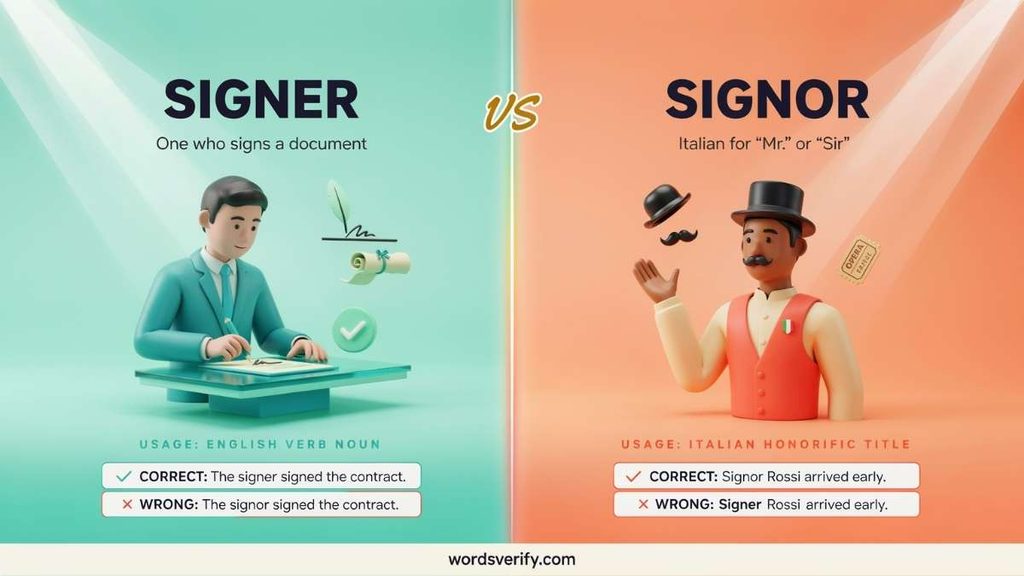
The difference becomes easier to understand when you look at meaning, word origin, and everyday usage.
Difference in Meaning
The most important distinction is what each word communicates.
A signer is identified by an activity or role. A signor is identified by a courtesy title.
Consider these examples:
- The signer approved the contract.
- Signor Romano attended the meeting.
The first sentence focuses on a person’s involvement with a document. The second uses a title before a name.
Replacing one word with the other changes the meaning and may make the sentence confusing or incorrect.
Difference in Language and Origin
Although the words look similar, they have different linguistic backgrounds.
Signer developed from the English verb sign and the suffix -er. The suffix forms a noun for someone who performs an action.
Signor, by contrast, comes from Italian and is related to signore. Its history connects to the Latin word senior, which referred to someone older or elder.
These separate origins explain why the words have different meanings despite their similar spelling.
Difference in Usage
The correct word depends on the situation.
Use signer when discussing:
- A person signing a contract.
- Someone authorized to sign banking documents.
- A person who signs a petition.
- Someone completing a consent form.
- A person who communicates through sign language.
Use signor when discussing:
- An Italian man addressed by a courtesy title.
- A character in Italian literature.
- A formal or traditional Italian name reference.
- A passage in which the Italian title is appropriate.
When you’re unsure, ask yourself one question: Am I describing someone who signs something, or am I using an Italian title before a man’s name? The answer usually settles the spelling.
Difference in Grammar
Both words can function as nouns, but their grammatical roles differ.
Signer is an ordinary countable noun. You can use it with articles and numbers:
- A signer completed the form.
- Two signers approved the document.
- The signer forgot to date the agreement.
Signor can function as a title before a name:
- Signor Rossi arrived early.
- We spoke with Signor Bianchi.
In this usage, signor generally appears directly before the name rather than as an ordinary countable noun. The Italian word signore has broader uses, so its grammar depends on the sentence and language.
Fix common more word mistakes in English
Written vs Writen Which one Is Correct?
Signer vs Signor in Legal and Banking Documents
Legal and financial paperwork is one place where spelling matters. A mistaken title can confuse readers, while an inaccurate description of someone’s signing authority can create more serious problems.
Is Signer the Correct Term for a Person Signing a Contract?
Yes. Signer is the correct everyday English term for a person who signs a contract.
For example:
- Every signer must sign the final page.
- The signer approved the agreement.
- Each signer received a copy of the contract.
A person who signs a contract may also be called a signatory. This term is especially common in formal legal, diplomatic, and business writing.
However, the two terms don’t always emphasize the same thing. Signer highlights the act of signing, while signatory often identifies a person or organization that formally signs an agreement.
The legal effect of a signature depends on the document, the person’s role, and the applicable law. Signing alone doesn’t automatically make every person a contracting party or establish identical obligations in every situation.
Is It Bank Signer or Bank Signor?
The correct phrase is generally bank signer or, more specifically, authorized signer.
An authorized signer is someone who has permission to perform certain signing actions for a bank account. Depending on the account arrangements, this may include signing checks or authorizing specified transactions.
For example:
- The bank requires an authorized signer.
- Only an authorized signer may approve the transaction.
- The account has two authorized signers.
A bank signer isn’t necessarily the account owner. An owner may grant signing authority to another person, subject to the bank’s rules and the relevant account documents.
This distinction matters because signing authority and account ownership aren’t the same thing.
Authorized Signer vs Signatory
These terms overlap, but they serve different purposes.
| Term | Meaning | Example |
|---|---|---|
| Signer | Someone who signs a document | The signer dated the form. |
| Authorized signer | Someone permitted to sign in a specified capacity | The authorized signer approved the payment. |
| Signatory | A person or entity that formally signs an agreement | Each signatory received a copy. |
| Account holder | A person or entity that owns or holds a bank account | The account holder updated the details. |
| Witness | Someone who observes a signature or signing event | The witness signed the designated section. |
The terms aren’t interchangeable in every situation. A witness may sign a document without becoming a party to the agreement. An authorized signer may act for an organization without personally owning it.
What About Loan Signing and Notary Documents?
Loan paperwork often involves several roles, so precise terminology helps.
A loan signing agent typically facilitates the signing of loan documents and helps ensure that the required paperwork is completed and returned according to the applicable process. The exact duties depend on the jurisdiction and assignment.
A notary public is an official authorized to perform specified notarial acts under applicable law. Depending on the jurisdiction, these acts may include verifying identity, witnessing signatures, or administering oaths.
Neither term is simply another word for signer. A borrower who signs a loan agreement is a signer. The professional who facilitates the signing or performs a notarial act has a different role.
For example:
The borrower signed the loan documents in the presence of the notary public.
In this sentence, the borrower is the signer, while the notary performs a separate function.
Fix common more word mistakes in English
Icycle vs Icicle Which one Is Correct?
Signer vs Signor Pronunciation
Pronunciation can help you recognize the difference between signer and signor, although spelling and context remain essential.
How to Pronounce Signer
In American English, signer is commonly pronounced /ˈsaɪnər/.
The first syllable rhymes with fine, while the second has a relaxed sound similar to the ending of writer in many American accents.
For example: The signer completed the form.
When saying the word aloud, place the main stress on the first syllable.
How to Pronounce Signor
A common English pronunciation of signor is /ˈsiːnjɔːr/, although pronunciations can vary by accent and context.
The word is associated with the Italian title, so its pronunciation differs from that of signer. Speakers familiar with Italian may follow Italian pronunciation conventions when using the title.
For formal writing, don’t assume that a word’s pronunciation tells you which spelling to use. If you’re writing about a person signing a document, choose signer. If you’re using the Italian title, choose signor where appropriate.
Are Signer and Signor Pronounced the Same?
No. Their standard pronunciations differ, although unfamiliarity with the Italian title or variations in speech can cause confusion.
The safest approach is to connect each spelling with its meaning rather than relying on sound alone.
Fix common more word mistakes in English
Excelerate vs Accelerate Which one Is Correct?
Signer vs Signor Examples How to Use Each Word in a Sentence
Examples make the difference easier to remember. These sentences show how the words work in everyday, professional, and cultural contexts.
10 Examples Using Signer
- The signer approved the agreement before the deadline.
- Every signer must sign the final page.
- The bank requires an authorized signer to approve certain transactions.
- The signer completed the loan documents.
- She is the only signer on the contract.
- The signer uses American Sign Language to communicate.
- All signers must provide valid identification.
- The petition needs more signers before submission.
- Each signer received a copy of the completed agreement.
- The company updated its records after adding a new authorized signer.
In each example, signer identifies someone who signs something or someone who uses sign language. The sentence determines which meaning applies.
10 Examples Using Signor
- Signor Rossi greeted the guests at the entrance.
- Signor Bianchi arrived at the meeting early.
- The letter was addressed to Signor Romano.
- Signor is an Italian title of respect for a man.
- The novel introduces Signor Bellini as a wealthy merchant.
- Signor Conti welcomed the visitors into his office.
- The historical account refers to Signor Verdi.
- The translator retained the title Signor in the English edition.
- Signor Moretti joined the family for dinner.
- The guide explained how the Italian title signor relates to the word signore.
These examples show that signor appears in names, titles, and cultural or literary contexts. It doesn’t mean someone has signed a document.
A Practical Example Choosing the Right Word at Work
Imagine that an employee is preparing an agreement for a business partner named Marco Rossi. The employee needs to mention both the person signing the contract and the partner’s Italian title in a short report.
Consider these three sentences:
| Sentence | Correct? | Explanation |
|---|---|---|
| The signor approved the contract. | Usually incorrect for the intended meaning | Use signer if the sentence refers to the person who signed the contract. |
| The signer approved the contract. | Correct | Signer identifies the person who signed the document. |
| Signor Rossi attended the meeting. | Correct when the title is appropriate | Signor is used as an Italian courtesy title before the name. |
A clearer report might say:
Signor Rossi attended the meeting and reviewed the proposed agreement. He later signed the contract as an authorized representative of his company.
This version separates the two roles. Signor is the title, while signing describes an action. The phrase authorized representative also avoids assuming that every person who signs a document has the same legal status.
The lesson is simple: a person can be both a signor and a signer, but the words describe different things.
Fix common more word mistakes in English
Rug vs Rag What’s the Difference?
Common Mistakes With Signer vs Signor
Because the spellings differ by only one letter, mistakes are easy to make. Understanding common errors helps you avoid them.
Using Signor for Someone Who Signs a Contract
Incorrect: The signor must date the agreement.
Correct: The signer must date the agreement.
If the sentence refers to a person signing a document, signer is the right choice.
Using Signer as a Courtesy Title
Incorrect: Signer Rossi welcomed the visitors.
Correct: Signor Rossi welcomed the visitors.
Use signor when the Italian title is intended. Signer doesn’t function as a courtesy title.
Assuming Signor Is Always a Misspelling
Signor is a legitimate word. It simply has a different meaning and use.
For example, the sentence Signor Rossi arrived at noon may be perfectly correct. Changing signor to signer would alter the intended meaning.
Relying Only on Spell-Check
Spell-check tools may accept both words because both exist. They don’t always know whether you’re discussing a contract or addressing an Italian man.
For example, a document containing The signor approved the agreement might pass a basic spelling check even though the writer intended signer.
Always review the sentence’s meaning. A correctly spelled word can still be the wrong word.
Confusing Signer With Signatory
A signer is someone who signs a document. A signatory is a person or entity that formally signs an agreement.
These terms often overlap, but the best choice depends on context. Signer usually sounds more straightforward, while signatory often suits formal or legal writing.
Fix common more word mistakes in English
Bougie vs Boujee which one is correct?
Signer vs Signor Grammar Plurals and Related Forms
Understanding the grammar behind these words makes them easier to use correctly.
What Is the Plural of Signer?
The plural of signer is signers.
Examples:
- The signers approved the agreement.
- All signers must complete the form.
- Two additional signers joined the petition.
The word follows the regular English pattern of adding -s to form the plural.
What Is the Plural of Signor?
The English plural of signor is commonly signors. The Italian plural signori is also used, particularly when the writer follows Italian usage or includes an Italian expression.
For example:
- The novel introduces several Italian signors.
- The Italian phrase signori e signore means “honored guests”
Use the form that fits the language and context. In ordinary English prose, signors may be appropriate. When reproducing an Italian expression, retain the correct Italian form.
Possessive Forms
Both words can take possessive forms.
For signer:
- The signer’s signature was missing.
- The signers’ documents were filed together.
For signor:
- Signor Rossi’s invitation arrived yesterday.
- The signors’ names appeared in the historical account.
The apostrophe follows standard English possessive conventions. Singular nouns usually take apostrophe + s, while regular plural nouns ending in s usually take an apostrophe after the final s.
Fix common more word mistakes in English
Excel vs Accel which one is correct?
Word Origins of Signer vs Signor
The history of each word explains why the spellings look similar but carry different meanings.
Origin of Signer
Signer comes from the English verb sign and the suffix -er. English commonly uses this suffix to form nouns that identify people performing actions.
Consider these familiar examples:
- Write becomes writer.
- Sing becomes singer.
- Teach becomes teacher.
- Sign becomes signer.
The word sign has a longer history connected to marks, signs, and symbols. Over time, the verb developed the familiar meaning of writing or placing a signature on a document.
Origin of Signor
Signor comes from Italian and is closely related to signore. Its history connects to the Latin word senior, which referred to someone older or elder.
The word developed into a form of respectful address. English adopted it from Italian, retaining its association with Italian names and cultural contexts.
Why the Words Look Similar
The resemblance between signer and signor can confuse readers, especially those learning English. However, their similar appearance doesn’t mean one is a variant of the other.
Their origins and meanings developed along different paths. Remembering those separate histories can help you avoid treating them as alternative spellings.
Fix common more word mistakes in English
Bellies vs Bellys Which one Is Correct?
Related Words Signer vs Signatory, Signor vs Signore
A few related terms can create additional confusion. Knowing how they differ helps you choose more precise words in business writing and everyday English.
Signer vs Signatory
Both words can refer to someone who signs a document, but they emphasize slightly different things.
- Signer is a straightforward term for a person who signs a document.
- Signatory is a formal term for a person or organization that signs an agreement or other official document.
The sentence The signer completed the form is direct and conversational. The sentence The signatories to the agreement accepted the terms sounds more formal.
Signor vs Signore
Signor and signore are related Italian forms and Signor commonly appears before a name, while signore has broader uses in Italian, including as a noun and a form of address.
The correct form depends on the sentence and Italian usage. Neither word is an alternative spelling of the English word signer.
Signor vs Señor
These words come from different languages:
- Signor is Italian.
- Señor is Spanish.
Both can function as courtesy titles for men, roughly corresponding to Mr. in English. However, the spelling and language matter. Use señor in Spanish contexts and signor in Italian contexts.
Signor vs Signora
Signora is the feminine Italian courtesy title traditionally used for a woman. Signor is associated with a man.
For example, Signor Rossi and Signora Rossi use different titles. Neither word describes someone signing a document.
Practice session Signer vs Signor
Complete these 25 sentences by filling each blank with the correct word: signer vs signor.
fill in the blanks
1. The bank requires every authorized account ______ to provide identification.
2. We addressed the Italian gentleman as ______ Rossi.
3. Please ask the final ______ to sign the contract before submitting it.
4. ______ Bianchi greeted the guests at the entrance.
5. Each ______ must read the agreement carefully before signing.
6. The letter began with the words “Dear ______ Moretti.”
7. The bank confirmed that my name was listed as an authorized ______ on the account.
8. In the Italian story, ______ Ferrari was a respected businessman.
9. The last ______ forgot to date the document.
10. The receptionist welcomed ______ Romano into the office.
11. Every ______ on the agreement must provide a valid signature.
12. The Italian gentleman introduced himself as ______ Conti.
13. The legal team checked whether each required ______ had signed the form.
14. ______ Ricci was invited to speak at the formal dinner.
15. A missing signature meant that one ______ had not completed the paperwork.
16. The author used the title ______ before the Italian character’s surname.
17. The bank asked the account holder to add another authorized ______.
18. In the novel, ______ De Luca arrived shortly before the meeting began.
19. The final ______ signed the document electronically.
20. We respectfully referred to the Italian gentleman as ______ Marino.
21. The lawyer confirmed that every required ______ had signed the contract.
22. ______ Gallo thanked the visitors for attending the ceremony.
23. The application cannot be processed until the last ______ signs it.
24. The Italian letter addressed ______ Greco before introducing the main subject.
25. Before sending the agreement, check that every ______ has signed in the correct place.
Answers
- signer
- Signor
- signer
- Signor
- signer
- Signor
- signer
- Signor
- signer
- Signor
- signer
- Signor
- signer
- Signor
- signer
- Signor
- signer
- Signor
- signer
- Signor
- signer
- Signor
- signer
- Signor
- signer
Here’s a trusted source for clear word meanings:
FAQs
What is the difference between a signer and a signatory?
A signer is someone who signs a document, while a signatory is a person or organization that formally signs an agreement. Both terms can describe someone who signs, but signatory is more common in formal, legal, and contractual contexts.
Can someone be both a signer and a witness?
Yes, in some situations. However, certain documents require an independent witness who isn’t a party to the agreement. Always check the document’s requirements and applicable laws before allowing one person to fill both roles.
Should Signor appear before or after a man’s name?
In Italian, Signor typically appears before a man’s name or surname, much like Mr. in English. For example, Signor Rossi means Mr. Rossi. The related form signore is also used to address a man politely, often meaning “sir.”
What is the plural of Signor?
The standard Italian plural of signore is signori. The shortened form Signor is generally used as a title before a singular man’s name. When addressing or referring to multiple men, signori is the usual form.
Is Signor still used in modern Italian?
Yes. Signor remains recognizable, particularly in formal introductions, traditional writing, and titles before surnames. In everyday conversation, Italians commonly use signore when addressing a man respectfully.
What does Signor mean in English literature?
In English literature, signor usually refers to an Italian gentleman or serves as a courtesy title similar to “Mr.” Authors may use it to establish an Italian setting, convey a character’s background, or create a formal atmosphere.
What is the difference between a signer and an endorser?
A signer is anyone who signs a document. An endorser typically signs a check or another financial instrument to transfer rights, authorize a transaction, or support an obligation. The precise meaning depends on the document and the person’s role.
Can someone be a signer when using an electronic signature?
Yes. A person who signs a document electronically can be considered a signer. Electronic signatures are legally recognized in many circumstances, although their validity depends on the applicable law, the type of document, and any specific signing requirements.
What is the difference between a co-signer and an authorized signer?
A co-signer generally agrees to share responsibility for a financial obligation, such as repaying a loan. An authorized signer has permission to perform specified transactions or sign documents on an account holder’s behalf. An authorized signer doesn’t automatically become responsible for the account’s debts.
Is Signor a correct English word?
Yes. Signor is an English word borrowed from Italian. It refers to an Italian courtesy title for a man. However, when describing someone who signs a contract, form, or other document, signer is the correct term.
What does Signorina mean in Italian?
Signorina is a traditional Italian title for an unmarried woman, similar to “Miss” in English. Signora is commonly used as a courtesy title for a woman, similar to “Mrs.” or “Madam.” Modern preferences and usage may vary.
What is an easy way to remember Signer vs Signor?
Keep this simple rule in mind: a signer signs, while a signor is an Italian title. If you’re discussing contracts, paperwork, or bank accounts, signer is usually the right choice. If you’re referring to an Italian man using a courtesy title, signor may be appropriate.
Conclusion
Although signer vs signor differ by just one letter, their meanings couldn’t be more different. A signer is someone who signs a document, while a signor is an Italian title for a man. Confuse the two, and your sentence might take an unexpected detour to Italy!
Fortunately, remembering the difference is simple: a signer signs, while a signor is a title. Once you understand how each word works, you’ll find it much easier to choose the correct spelling. Whether you’re completing legal paperwork, signing a contract, or writing a professional email, take a moment to check your word choice. After all, one little letter can make a big difference. Keep this distinction in mind, and you’ll avoid an unnecessary grammar mix-up with confidence and ease.

Lisa AJS is an experienced blogger and language enthusiast at Words Verify, dedicated to making grammar simple, practical, and enjoyable. She writes engaging content on commonly confused words, grammar mistakes, word meanings, and everyday language challenges.