
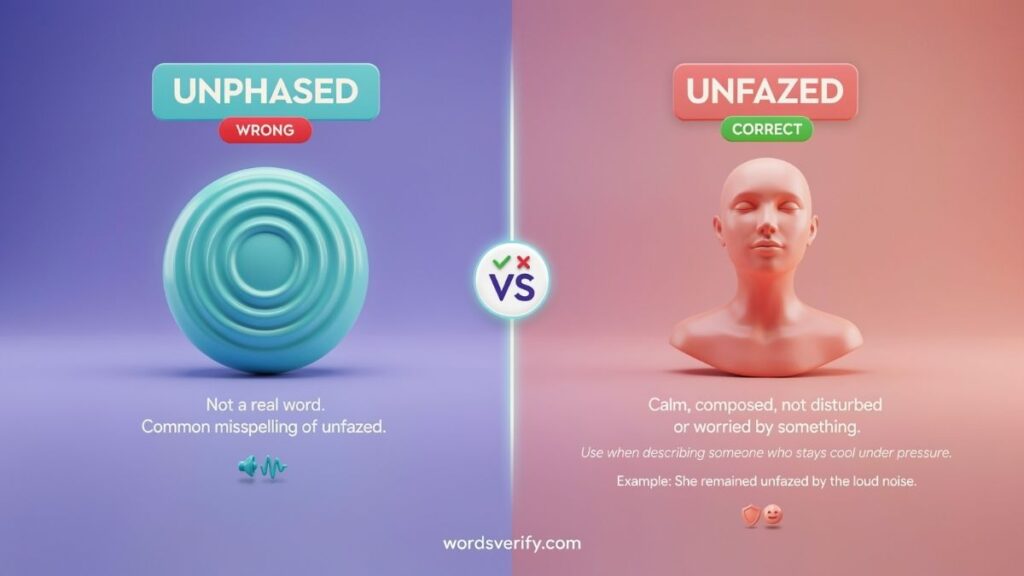
English can be tricky, especially when two words sound identical but carry different meanings. The confusion between unphased vs unfazed is a classic example. One extra letter can leave even confident writers second-guessing themselves. So, which spelling should you use when someone remains calm under pressure? The correct choice is unfazed, meaning undisturbed or untroubled. Unphased, on the other hand, relates to phases or stages and appears mainly in specialized contexts. Although these words may look interchangeable, using the wrong one can weaken your message. Let’s explore their meanings, examine clear examples, and learn a simple trick to remember the difference.
Quick Answer Unphased vs Unfazed
“Unfazed” means calm, untroubled, or not intimidated. “Unphased” relates to phases and may be appropriate in certain technical contexts.
For example, a student who receives a disappointing grade but continues studying confidently remains unfazed. An engineer discussing signals, however, might use terminology related to phase relationships.
Ask yourself one question: Am I describing someone’s reaction, or am I talking about a phase-related concept? The answer will usually guide you to the correct word.
Which Spelling Is Correct?
The correct spelling depends on what you want to say. When describing someone who stays calm despite criticism, pressure, or an unexpected event, use “unfazed.”
Consider these examples:
- Correct: “Maya remained unfazed by the harsh criticism.”
- Incorrect for the intended meaning: “Maya remained unphased by the harsh criticism.”
- Technical context: “The engineer examined the phase relationship between the two signals.”
The first sentence describes Maya’s emotional response. The second uses the wrong word for that meaning. The third discusses a technical concept involving phases.
Here’s a quick comparison:
| Feature | Unfazed | Unphased |
|---|---|---|
| Root word | Faze | Phase |
| Meaning | Not disturbed, upset, or intimidated | Related to phases or phase relationships |
| Common context | Everyday and professional writing | Specialized or technical writing |
| Example | She was unfazed by the news. | The report examined the signals’ phase relationship. |
| Used to describe emotional composure? | Yes | Generally no |
| Pronunciation | /ʌnˈfeɪzd/ | /ʌnˈfeɪzd/ |
The main rule is straightforward: use “unfazed” when you mean that something didn’t bother or unsettle someone.
Learn the difference between tricky more English words
Signer vs Signor which one is correct?
What Does Unfazed Mean?
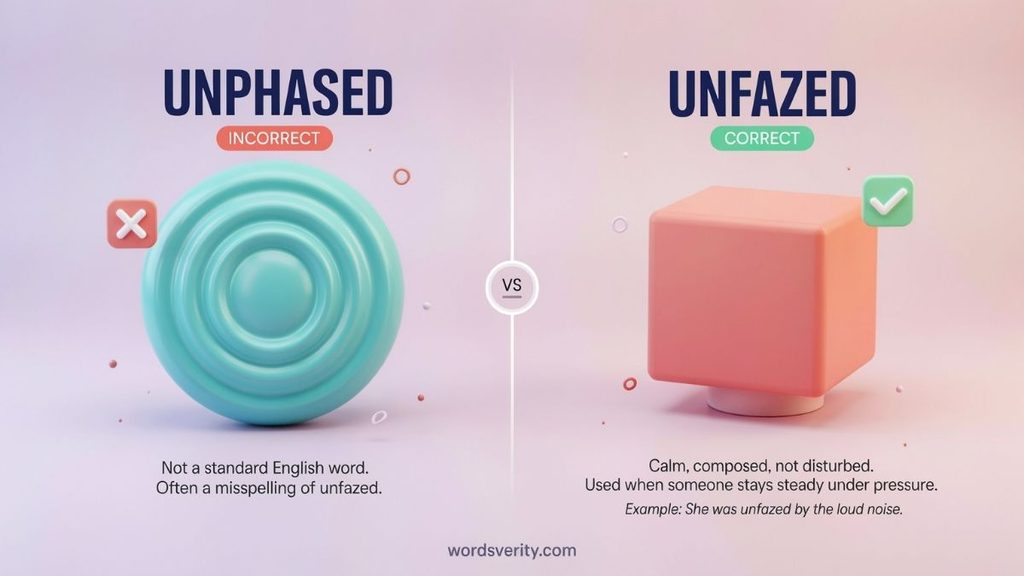
“Unfazed” is an adjective that describes someone who remains calm or undisturbed by something that might otherwise cause worry, embarrassment, fear, or frustration.
An unfazed person doesn’t let a difficult situation visibly throw them off balance. They might face challenging questions, receive negative feedback, or encounter an unexpected problem without losing their composure.
For example:
“Despite the audience’s difficult questions, the speaker remained unfazed.”
This sentence suggests that the questions didn’t unsettle the speaker or prevent them from responding confidently. The speaker might still feel nervous internally, but the situation didn’t overwhelm them.
Being unfazed doesn’t mean feeling absolutely nothing. It means remaining composed despite circumstances that could cause an emotional reaction.
What Does Unfazed Mean in Everyday English?
In everyday conversation, “unfazed” often describes someone who handles difficulties without becoming visibly upset.
Imagine a restaurant server working during a busy dinner shift. Several tables need attention, one order arrives late, and a customer complains. Instead of panicking, the server listens, fixes the problem, and continues working.
You could say, “The server remained unfazed despite the hectic dinner rush.”
The word works in many situations:
- Criticism: Someone accepts negative feedback without becoming visibly upset.
- Surprise: A person handles unexpected news calmly.
- Pressure: An athlete stays focused during a close game.
- Embarrassment: A speaker recovers smoothly after making a mistake.
- Difficulties: An employee looks for solutions when a project encounters a setback.
In each case, the person remains composed instead of allowing the situation to overwhelm them.
What Does It Mean to Be an Unfazed Person?
An unfazed person often appears calm, confident, and resilient. However, the word describes how someone responds to a particular situation, not necessarily their entire personality.
Someone might remain unfazed during a job interview but feel nervous when speaking to a large audience. Another person might handle criticism comfortably but struggle when plans change unexpectedly.
Being unfazed also doesn’t mean being careless or indifferent. A doctor can remain unfazed during an emergency while taking the situation extremely seriously. Likewise, a teacher can stay calm in a noisy classroom while still addressing disruptive behavior.
In other words, staying calm doesn’t mean you don’t care. It means you can respond thoughtfully without letting your emotions take control.
Learn the difference between tricky more English words
Macaroon vs Macaron which one is correct?
What Does Unphased Mean?
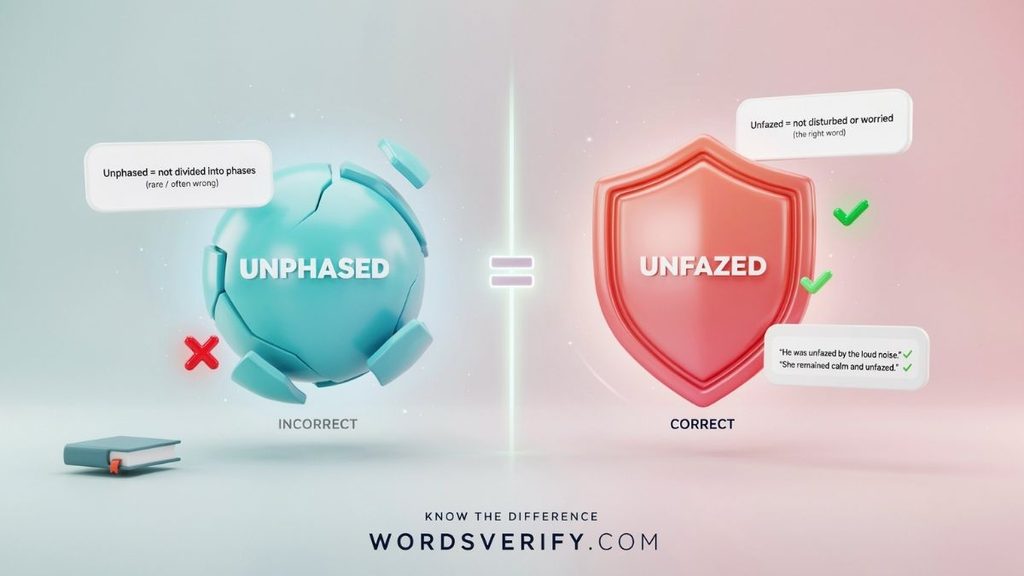
“Unphased” comes from “phase,” which can mean a stage in a process, a period in a cycle, or a technical relationship involving waves and signals.
The word may appear in specialized contexts where a phase distinction or relationship matters. However, it isn’t the standard choice when describing someone who remains calm or emotionally unaffected.
For example, “He was unphased by the criticism” is generally a spelling mistake if the writer means that the criticism didn’t bother him.
The correct sentence is:
“He was unfazed by the criticism.”
Although “unphased” may be appropriate in certain technical contexts, writers should check the terminology used in their particular field. In scientific writing, expressions such as “in phase,” “out of phase,” or “without a phase shift” may communicate the intended meaning more clearly.
Is Unphased a Real Word?
Yes, “unphased” can appear as a legitimate word in specialized contexts. However, that doesn’t make it interchangeable with “unfazed.”
English contains many words that sound alike but have different meanings. For example, “brake” refers to a device used to slow a vehicle, while “break” can mean to separate something into pieces. The pronunciation is the same, but the words serve different purposes.
The same principle applies here.
- “The sudden announcement left him unfazed.” This describes an emotional reaction.
- “The two signals were in phase.” This describes a technical relationship.
- “The components remained unphased.” This may be understandable in a specialized context, but the writer should confirm that the term accurately describes the system.
The important point is to choose the word that expresses your intended meaning rather than assuming that a familiar spelling will always work.
What Does Unphased Mean in Everyday Writing?
In everyday writing, “unphased” often appears when someone intends to write “unfazed.”
For example:
Incorrect: “She was unphased by the negative review.”
Correct: “She was unfazed by the negative review.”
The negative review could upset or discourage someone. Because the sentence describes an emotional response rather than a phase-related concept, “unfazed” is the appropriate choice.
When proofreading, don’t automatically replace every occurrence of “unphased.” First, check the context. If the sentence discusses someone’s reaction to stress, criticism, or surprise, “unfazed” is almost certainly the intended word.
Learn the difference between tricky more English words
Withdraw vs Withdrawal which one is correct?
The Difference Between Faze and Phase
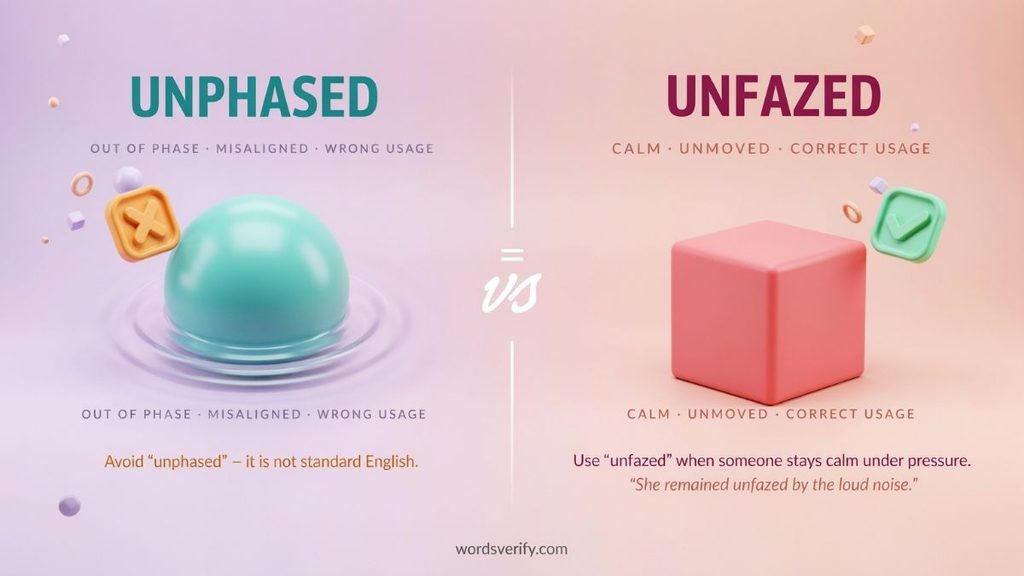
To understand the difference between “unphased” vs “unfazed,” start with their root words: “faze” and “phase.” They sound alike but have different meanings.
What Does Faze Mean?
“Faze” is a verb that means to disturb, unsettle, disconcert, or intimidate someone. It often describes a reaction to something unexpected or challenging.
Examples include:
- The difficult questions didn’t faze the experienced lawyer.
- Loud noises tend to faze the nervous puppy.
- Nobody could faze the confident performer.
- The unexpected delay failed to faze the project manager.
Notice the connection between “faze” and “unfazed.” The verb describes the act of disturbing someone, while the adjective describes someone who remains undisturbed.
Compare these sentences:
- “The criticism fazed him.” The criticism disturbed him.
- “The criticism didn’t faze him.” The criticism didn’t disturb him.
- “He remained unfazed by the criticism.” He stayed composed despite the criticism.
Understanding the meaning of “faze” makes the correct spelling much easier to remember.
What Does Phase Mean?
“Phase” is both a noun and a verb. As a noun, it usually refers to a stage or period in a larger process. As a verb, it can mean to arrange something into stages or introduce or remove something gradually.
Examples include:
- The company entered a new phase of development.
- The project has three distinct phases.
- The school will phase in the new curriculum over two semesters.
- The team plans to phase out the outdated equipment.
In science and engineering, “phase” also describes the position of a point within a cycle or the relationship between periodic signals or waves.
Because “phase” refers to stages and technical relationships, it isn’t the correct root for describing someone who isn’t bothered by criticism.
What Is the Difference Between Fazed and Phased?
The distinction between “fazed” and “phased” follows the same rule.
| Word | Meaning | Example |
|---|---|---|
| Fazed | Disturbed or unsettled | She wasn’t fazed by the difficult questions. |
| Phased | Arranged or introduced in stages | The company phased in the new policy gradually. |
| Unfazed | Not disturbed or intimidated | He remained unfazed by the setback. |
| Unphased | Related to phases in a suitable context | The report examined the phase relationship between the signals. |
A simple memory trick helps: if something fazes you, it gets under your skin. If something happens in phases, it unfolds in stages.
Learn the difference between tricky more English words
Duchess vs Dutchess Which one Is Correct?
Unphased vs Unfazed Examples in Sentences
Examples make the distinction between unphased vs unfazed easier to understand. The following sentences show how to use each word correctly in everyday writing and specialized contexts, helping you avoid common spelling mistakes and choose the right word with confidence..
Correct Examples of Unfazed in a Sentence
Use “unfazed” when someone remains calm, confident, or undisturbed by a situation.
- Despite the unexpected questions, the candidate remained unfazed during the interview.
- She was completely unfazed by the bad news and immediately began looking for solutions.
- The goalkeeper looked unfazed as the opposing team prepared for the penalty kick.
- He remained unfazed by criticism from people who disagreed with his decision.
- The teacher was unfazed by the noisy classroom and continued the lesson.
- Even after missing the first shot, the basketball player appeared unfazed.
- My colleague seemed unfazed when the meeting schedule changed at the last minute.
- The experienced pilot remained calm and unfazed while handling the unexpected situation.
- Although the presentation equipment failed, the speaker was unfazed and continued without slides.
- She looked unfazed by the challenge, but she had spent weeks preparing for it.
These examples show that “unfazed” works in personal, academic, professional, and everyday situations. The word doesn’t require a dramatic event. Even a minor inconvenience can leave someone unfazed.
Incorrect Examples Using Unphased for Emotional Reactions
The following sentences use “unphased” incorrectly when the intended meaning is emotional composure.
| Incorrect sentence | Correct sentence |
|---|---|
| He was unphased by the criticism. | He was unfazed by the criticism. |
| She remained unphased during the interview. | She remained unfazed during the interview. |
| The bad news left him unphased. | The bad news left him unfazed. |
| I was completely unphased by the unexpected delay. | I was completely unfazed by the unexpected delay. |
| The coach appeared unphased by the team’s defeat. | The coach appeared unfazed by the team’s defeat. |
The problem isn’t sentence structure. Each sentence follows a recognizable grammatical pattern. The issue is word choice: “unphased” doesn’t express the intended meaning of being untroubled or undisturbed.
Examples of Unphased in a Sentence
“Unphased” may be appropriate when the context genuinely concerns phases. However, technical writers should confirm that the term matches the terminology used in their field.
For example:
- The report examined whether the signals maintained the intended phase relationship.
- The engineer compared the phase positions of two periodic waveforms.
- The system’s documentation described the components as unphased under the specified operating conditions.
These examples illustrate technical contexts, but they don’t establish that “unphased” is the best term in every case. Expressions such as “in phase,” “out of phase,” or “without a phase shift” may be more precise.
If you’re writing about a scientific process, choose the established term that accurately describes the measurements. If you’re writing about a person’s response to a difficult situation, use “unfazed.”
A Practical Example Choosing the Correct Word
Consider a workplace scenario. Jordan, a project manager, presents a new plan to a team of executives. One executive questions the budget, another points out a scheduling problem, and a third challenges the project’s expected results.
Jordan listens carefully, answers the questions, and adjusts the timeline where necessary. Jordan doesn’t become defensive or lose focus.
A writer might describe the meeting in three ways:
- “Jordan was unfazed by the executives’ criticism.”
- “Jordan was unphased by the executives’ criticism.”
- “Jordan was unaffected by the executives’ criticism.”
The first sentence is the best choice if the writer wants to emphasize Jordan’s composure. The second uses the wrong word for the intended meaning. The third is grammatically correct, but it can suggest that the criticism had no effect at all.
The distinction between “ “unphased vs unfazed” ” is subtle. Jordan might take the feedback seriously and change the project plan without becoming emotionally unsettled. In that situation, “unfazed” describes the reaction more precisely.
Now imagine an engineer discussing the phase relationship between two signals. The same spelling choice wouldn’t apply because the sentence concerns a technical property rather than an emotional response. This example highlights the difference between unphased vs unfazed: one relates to phases or phase relationships, while the other describes someone who remains calm under pressure.
The lesson is simple: choose words according to what they mean in context, not simply according to how they sound. Understanding the difference between unphased vs unfazed helps you avoid common spelling mistakes and communicate your meaning clearly.
Learn the difference between tricky more English words
Written vs Writen Which one Is Correct?
Synonyms and Antonyms of Unfazed
Synonyms help you avoid repetition, but they don’t always mean exactly the same thing. The best alternative depends on the situation you’re describing.
Common Synonyms of Unfazed
| Synonym | Meaning | Example |
|---|---|---|
| Unbothered | Not troubled or annoyed | She was unbothered by the minor delay. |
| Unperturbed | Not worried or disturbed | He remained unperturbed during the discussion. |
| Untroubled | Free from worry or distress | She appeared untroubled by the uncertainty. |
| Composed | Calm and in control of one’s emotions | The speaker stayed composed under pressure. |
| Calm | Not agitated or anxious | He remained calm during the emergency. |
| Collected | Able to think and act clearly | She gave a collected response to the complaint. |
| Unshaken | Not weakened or disturbed by an event | His confidence remained unshaken. |
| Unruffled | Not visibly upset or irritated | The manager stayed unruffled throughout the dispute. |
| Undaunted | Not discouraged or intimidated | The team remained undaunted by the challenge. |
| Imperturbable | Extremely difficult to disturb or upset | Her imperturbable manner impressed the audience. |
| Poised | Calm, confident, and self-assured | The presenter looked poised on stage. |
| Nonchalant | Appearing casual or unconcerned | He gave a nonchalant shrug. |
Although these words overlap with “unfazed,” each carries a slightly different emphasis.
For example, “unperturbed” often sounds more formal. “Unbothered” is common in casual conversation. “Undaunted” emphasizes courage in the face of difficulty, while “nonchalant” can suggest a casual or indifferent attitude.
Choose the synonym that matches the tone and meaning of your sentence.
What Is the Opposite of Unfazed?
The opposite of “unfazed” describes someone who becomes disturbed, worried, upset, or unsettled.
Common antonyms include:
- Fazed: Disturbed or unsettled by something.
- Bothered: Troubled, annoyed, or concerned.
- Perturbed: Worried or disturbed.
- Rattled: Shaken or thrown off balance.
- Flustered: Confused, nervous, or agitated.
- Unnerved: Made anxious or less confident.
- Distressed: Experiencing significant worry or emotional pain.
- Shaken: Emotionally affected by a troubling event.
- Anxious: Feeling worry or nervousness.
- Disconcerted: Made confused, uneasy, or embarrassed.
Consider these contrasting examples:
- Unfazed: “She remained unfazed by the unexpected question.”
- Flustered: “She became flustered when she couldn’t answer the unexpected question.”
- Rattled: “The early mistake rattled the player.”
- Unshaken: “The player remained unshaken after the early mistake.”
The right antonym depends on the emotional reaction. Someone can feel anxious without becoming visibly flustered, so these words aren’t interchangeable in every sentence.
Learn the difference between tricky more English words
Icycle vs Icicle Which one Is Correct?
Unfazed Grammar How to Use Unfazed Correctly
Understanding the grammar behind “unfazed” makes it easier to use the word naturally.
Part of Speech and Sentence Structure
“Unfazed” functions primarily as an adjective. It often follows a linking verb such as “be,” “remain,” “seem,” or “stay.”
Examples:
- She was unfazed by the announcement.
- He remained unfazed throughout the interview.
- The team seemed unfazed by the setback.
- They stayed unfazed despite the difficult conditions.
You can also place the word before a noun when the sentence calls for it.
For example: “The unfazed candidate answered every question confidently.”
The adjective describes the candidate’s apparent reaction to the situation.
Common Expressions With Unfazed
The word frequently appears in expressions such as:
- Unfazed by criticism
- Unfazed by pressure
- Unfazed by the news
- Unfazed by challenges
- Unfazed by failure
- Unfazed by unexpected events
- Completely unfazed
- Seemingly unfazed
- Remained unfazed
The preposition “by” often introduces the event or circumstance that fails to disturb someone.
For example, “He was unfazed by the criticism” identifies the criticism as the thing that didn’t unsettle him.
You can also use “unfazed” without specifying the cause: “Despite the confusion around her, she remained unfazed.”
Is Unphased Grammatically Correct?
“Unphased” can be grammatically valid when it carries a meaning related to “phase.” However, grammar and word choice are separate issues.
A sentence can follow English grammar rules and still use the wrong word. “She was unphased by the criticism” has a recognizable adjective construction, but it doesn’t use the standard spelling for the intended meaning.
When editing, check two things:
- Does the sentence follow English grammar rules?
- Does the chosen word express the intended meaning?
Answering both questions helps you catch spelling and word-choice errors.
Learn the difference between tricky more English words
Excelerate vs Accelerate Which one Is Correct?
Unphased vs Unfazed in American and British English
Writers sometimes wonder whether “unphased” is preferred in one variety of English and “unfazed” in another. For the everyday meaning of remaining calm or undisturbed, “unfazed” is the standard spelling in both American and British English.
The distinction isn’t a regional spelling difference like “color” and “colour.” It comes from the different meanings of “faze” and “phase.”
| Context | American English | British English |
|---|---|---|
| Not disturbed by criticism | Unfazed | Unfazed |
| Remaining calm under pressure | Unfazed | Unfazed |
| A stage in a process | Phase | Phase |
| Introducing something gradually | Phase in | Phase in |
The same basic rule applies to Canadian and Australian English.
If you’re writing a formal report, academic paper, news story, or business email, use “unfazed” when describing someone who remains composed. Don’t treat “unphased” as an alternative regional spelling.
Learn the difference between tricky more English words
Rug vs Rag What’s the Difference?
Why Do People Spell Unfazed as Unphased?
The confusion largely comes from homophones: words that sound alike but have different spellings and meanings.
In standard English, “faze” and “phase” share the same pronunciation. Adding the prefix “un-” doesn’t change that.
Three factors make the mistake understandable.
First, “phase” is a familiar word. People regularly encounter it in phrases such as “a new phase of life,” “the final phase of a project,” and “phases of the moon.” The spelling may therefore seem more familiar when someone tries to write an unfamiliar word.
Second, both words follow recognizable word patterns. English often forms words by adding prefixes such as “un-” to existing words. Both “unfazed” and “unphased” look plausible at first glance.
Third, spell-checking doesn’t always catch word-choice errors. A spell-checker may accept a correctly spelled word even when it doesn’t fit the sentence. Grammar and spelling tools can help, but they can’t always determine the writer’s intended meaning.
These factors explain why the error appears, but they don’t make the two words interchangeable.
How to Remember the Correct Spelling of Unfazed
Use this simple memory trick:
Faze means disturb. Unfazed means not disturbed.
Connect the two words directly:
- Something can faze you.
- Something can leave you unfazed.
- A phase is a stage or a technical concept.
You can also remember this sentence: “Nothing could faze her, so she remained unfazed.”
The repetition reinforces the connection between the verb and the adjective. Once you remember the meaning of “faze,” the correct spelling becomes much easier to recognize.
Learn the difference between tricky more English words
Bougie vs Boujee which one is correct?
practice session Unphased vs Unfazed
Complete each sentence with the correct word: unphased vs unfazed fazed, or phased. The answers are provided in a separate section below, so you can practice first and check your work afterward.
fill in the blanks
- Despite the unexpected criticism, Mia remained __________ and continued her presentation.
- The manager was not __________ by the difficult questions during the interview.
- The company __________ in its new training program over three months.
- Nothing seems to __________ Daniel, not even a last-minute change of plans.
- The engineer checked whether the two signals were in __________.
- Although everyone else panicked, Sara appeared completely __________ by the sudden announcement.
- The new safety rules were __________ into the workplace gradually.
- The loud noise __________ the nervous puppy, causing it to hide.
- The technician adjusted the equipment to correct the __________ difference between the signals.
- He stayed __________ when his team lost the first round.
- The unexpected delay didn’t __________ the experienced pilot.
- The project will be introduced in several __________ to make the transition easier.
- The speaker seemed __________ by the audience’s challenging questions.
- The teacher explained how sound waves can be out of __________.
- The harsh review __________ the young writer more than she expected.
- The organization has __________ out its updated policies across all departments.
- Despite the pressure, the athlete remained __________ before the final race.
- The technician discovered that the two electrical signals were out of __________.
- The sudden change in schedule didn’t __________ the well-prepared team.
- The hospital __________ its new procedures over several weeks.
- I thought the rude comment would upset him, but he seemed completely __________.
- The scientist studied the relationship between the __________ of the two waves.
- The unexpected question __________ the student, who struggled to finish the answer.
- The company introduced the software in __________ to avoid disrupting daily work.
- Even when things went wrong, the calm team leader remained __________ and focused on finding a solution.
Answers
- unfazed
- fazed
- phased
- faze
- phase
- unfazed
- phased
- fazed
- phase
- unfazed
- faze
- phases
- unfazed
- phase
- fazed
- phased
- unfazed
- phase
- faze
- phased
- unfazed
- phases
- fazed
- phases
- unfazed
Here’s a trusted source for clear word meanings:
FAQs
Is it spelled unphased vs unfazed?
Both spellings exist, but they have different meanings. “Unfazed” is the correct choice when describing someone who remains calm or unbothered. “Unphased” relates to phases or stages, particularly in technical contexts.
What does unfazed mean?
“Unfazed” means calm, composed, or unaffected by something that might upset, worry, or surprise someone. For example, “She remained unfazed by the unexpected criticism.”
What is the difference between unphased vs unfazed ?
“Unfazed” describes someone who isn’t disturbed or intimidated. “Unphased” relates to a phase or stage and may appear in technical discussions about phase relationships. If you mean that someone stays calm under pressure, use “unfazed.”
What does unphased mean?
“Unphased” generally relates to phases or stages, although its precise meaning depends on the context. In technical writing, more specific expressions such as “in phase,” “out of phase,” or “without a phase shift” may communicate the intended meaning more clearly.
Is it fazed or phased?
Both words are correct, but they aren’t interchangeable. “Fazed” means disturbed or unsettled, while “phased” relates to stages, phases, or a gradual process. For example, “The criticism didn’t faze him” and “The company phased in the new policy.”
What are five synonyms for unfazed?
Five useful synonyms for “unfazed” are:
- Unbothered
- Unperturbed
- Unruffled
- Composed
- Undisturbed
The best choice depends on the context. “Composed” emphasizes self-control, while “unperturbed” suggests that something hasn’t disturbed you.
What is the opposite of unfazed?
Common opposites of “unfazed” include “rattled,” “flustered,” “disturbed,” “unsettled,” and “intimidated.” These words describe someone who feels troubled, nervous, or shaken by a situation.
What word means unbothered?
“Unfazed” is a close synonym for “unbothered.” Other alternatives include “unperturbed,” “untroubled,” and “unruffled.” However, “indifferent” often suggests a lack of interest or concern rather than simply remaining calm.
What does the phrase “don’t faze me” mean?
“Don’t faze me” means that something doesn’t upset, intimidate, or disturb you. For example, “Negative comments don’t faze me” means those comments don’t shake your confidence or peace of mind.
What does “you faze me” mean?
“You faze me” means that you make me feel unsettled, nervous, or uncomfortable. By contrast, “you don’t faze me” means that you don’t disturb or intimidate me.
What is the origin of the word unfazed?
“Unfazed” combines the prefix “un-,” meaning “not,” with “fazed,” the past participle of “faze.” The verb “faze” emerged in English during the 19th century and is associated with the older word “feeze.” Its modern meaning centers on disturbing, unsettling, or intimidating someone.
Is unfaze a real word?
“Unfaze” occasionally appears as an informal verb meaning to restore someone’s composure or make them feel unbothered again. However, it isn’t common in standard usage. In formal writing, expressions such as “reassure,” “calm,” or “help someone regain composure” are usually clearer choices.
What is another word for unphased?
The best alternative depends on the intended meaning. In technical contexts, terms such as “in phase,” “phase-aligned,” or “without a phase shift” may be more precise. If you mean that someone isn’t bothered, use “unfazed,” “unbothered,” or “unperturbed.”
When did faze become a word?
“Faze” entered English usage in the 19th century and developed the meaning of disturbing or unsettling someone. Today, it commonly appears in expressions such as “Nothing fazes her” and “He wasn’t fazed by the challenge.”
What does unfazed mean in Odia?
In Odia, “unfazed” can be translated as ଅପ୍ରଭାବିତ (unaffected) or described as ଅବିଚଳିତ (steadfast or unshaken), depending on the context. The most suitable translation depends on whether the sentence emphasizes calmness, confidence, or a lack of emotional reaction.
What is another way to say “can’t be bothered”?
Depending on the context, alternatives include “uninterested,” “reluctant,” “unmotivated,” “indifferent,” and “not inclined.” These expressions have slightly different meanings. Someone who is unfazed may still care about a situation but simply refuse to let it upset them.
Learn the difference between tricky more English words
Excel vs Accel which one is correct?
Conclusion:
English has plenty of spelling surprises, and the confusion between unphased vs unfazed is a perfect example. Thankfully, you don’t need to lose your cool over one little letter! Remember, unfazed describes someone who remains calm and untroubled, even when faced with criticism, unexpected news, or a stressful situation. Unphased, by contrast, relates to phases or stages and is mainly used in specialized contexts. The next time you’re describing someone who stays cool under pressure, choose unfazed and leave the spelling confusion behind. With this simple distinction in mind, you’ll write more clearly and avoid a common mistake. After all, good grammar doesn’t have to be complicated; sometimes, getting one word right makes all the difference.

Lisa AJS is an experienced blogger and language enthusiast at Words Verify, dedicated to making grammar simple, practical, and enjoyable. She writes engaging content on commonly confused words, grammar mistakes, word meanings, and everyday language challenges.