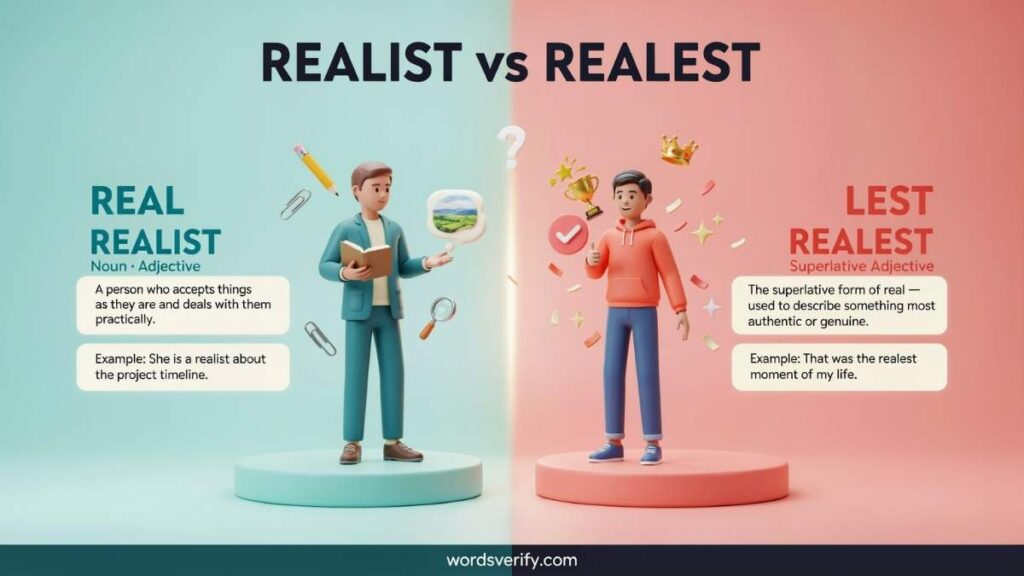
Ever get stuck choosing between two words that look almost identical but mean entirely different things? Realist vs realest can leave even confident writers scratching their heads. A realist takes a practical approach to life, focusing on facts rather than wishful thinking. The realest person, however, is usually someone who’s genuinely honest, loyal, and authentic. Confuse the two, and you might end up describing someone’s outlook when you mean their character. The good news? Clearing up this grammar mix-up is easier than you think. Let’s explore their meanings, differences, examples, and common mistakes so you can use both words correctly.
Realist vs Realest The Quick Answer
Realist is a noun that describes someone who looks at situations practically and accepts facts rather than relying on wishful thinking. It can also describe a person who follows realism in philosophy or art.
Realest is the superlative form of the adjective real. In informal English, it often describes someone who is exceptionally honest, genuine, loyal, or authentic.
Here are two simple examples of Realist vs realest:
- “I’m a realist, so I know we need more time to finish this project.”
- “She’s the realest friend I’ve ever had because she always tells me the truth.”
The first sentence describes a person’s practical outlook. The second praises someone’s honesty and authenticity.
Avoid everyday grammar mistakes with simple tips
Unphased vs Unfazed which one is correct?
What Does Realist Mean?
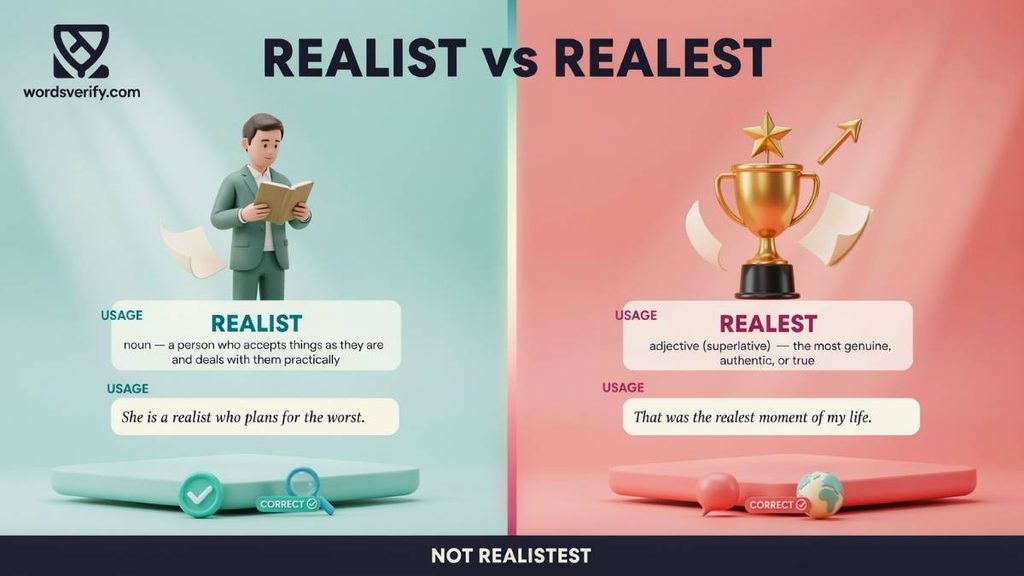
A realist is someone who looks at the world as it is rather than as they wish it would be. Realists consider facts, limitations, and practical possibilities before making decisions.
For example, imagine that you want to start a business. An optimist might focus on how successful it could become, while a realist would also consider the costs, competition, risks, and time required to build it.
Being a realist doesn’t mean being negative. It means balancing hope with a clear understanding of reality.
Realist as a Noun
In everyday English, realist is most commonly used as a noun. It identifies a person who tends to think practically.
Examples:
- “My brother is a realist who always checks the facts before making a decision.”
- “As a realist, she understands that success takes time and effort.”
- “The coach is a realist who knows the team needs more practice.”
- “I’m a realist, but I still believe we can achieve our goals.”
- “A realist considers both the opportunities and the risks.”
In each example, the word describes a person’s approach to life or decision-making.
Realist in Philosophy and Art
The word realist also appears in philosophy, literature, politics, and art.
In philosophy, realism generally refers to the view that reality exists independently of our thoughts or beliefs, although the exact meaning depends on the philosophical debate.
In literature, a realist writer portrays people, relationships, and everyday life in ways that reflect recognizable human experiences. Rather than relying on exaggerated characters or extraordinary events, realist writing often focuses on ordinary situations and believable details.
In visual art, realism aims to represent subjects in a recognizable way, paying attention to their appearance and the world around them.
Examples:
- “The novelist is a realist who writes about ordinary families and their struggles.”
- “The painter became known as a realist because his portraits closely resembled their subjects.”
- “In international relations, a realist often emphasizes national interests and practical considerations.”
Although these uses differ slightly, they share an interest in reality rather than an idealized version of it.
Avoid everyday grammar mistakes with simple tips
Signer vs Signor which one is correct?
What Does Realest Mean?
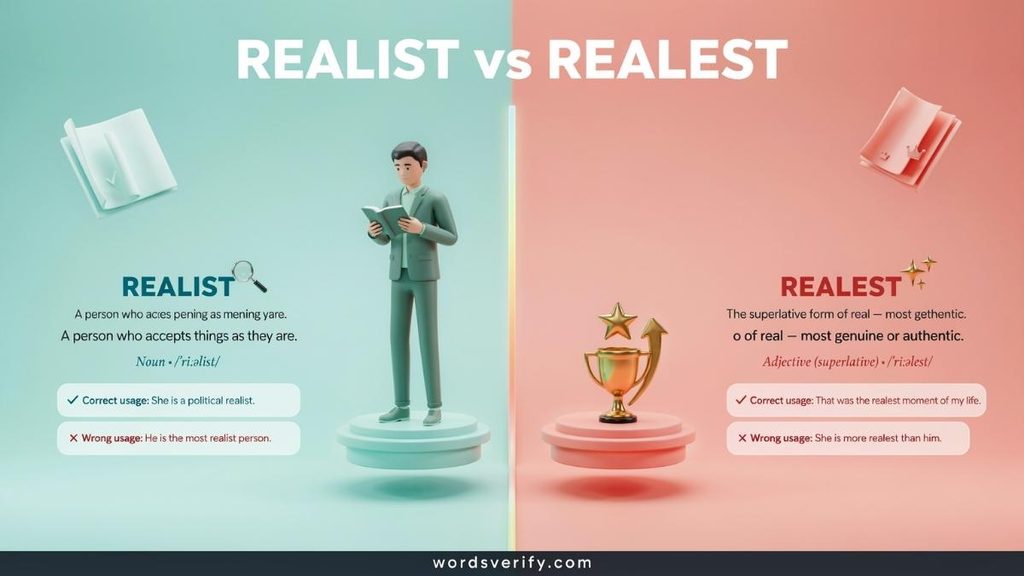
Realest is the superlative form of the adjective real. The word real means genuine, actual, or not false. Its superlative form suggests that someone or something is the most genuine or authentic among the options being compared.
In informal English, especially in conversations and social media, realest often describes a person who is honest, trustworthy, loyal, or unapologetically themselves.
For example, when someone says, “She’s the realest person I know,” they usually mean that she is genuine and doesn’t pretend to be someone she’s not.
Realest as an Adjective
The word realest can describe a person, feeling, experience, or quality. Its meaning depends on the context.
Examples:
- “He’s the realest person in our group because he never pretends to agree with everyone.”
- “That was the realest conversation we’ve had in years.”
- “She’s one of the realest people I’ve ever met.”
- “His advice was the realest thing I heard all week.”
- “They have one of the realest friendships I’ve seen.”
In these sentences, realest emphasizes genuineness or sincerity.
Is Realest a Real Word?
Yes, realest is a legitimate English word. It’s formed by adding the superlative ending -est to the adjective real.
However, its suitability depends on the situation. In casual conversation, “He’s the realest guy I know” sounds natural to many speakers. In formal writing, a phrase such as “He’s one of the most genuine people I know” may be more appropriate.
The word also appears in literal comparisons. For example, if several objects are being evaluated for authenticity, someone might describe one as the realest representation of an original design. In everyday use, however, people more commonly choose clearer expressions such as “the most authentic.”
Avoid everyday grammar mistakes with simple tips
Macaroon vs Macaron which one is correct?
Realist vs Realest The Main Differences
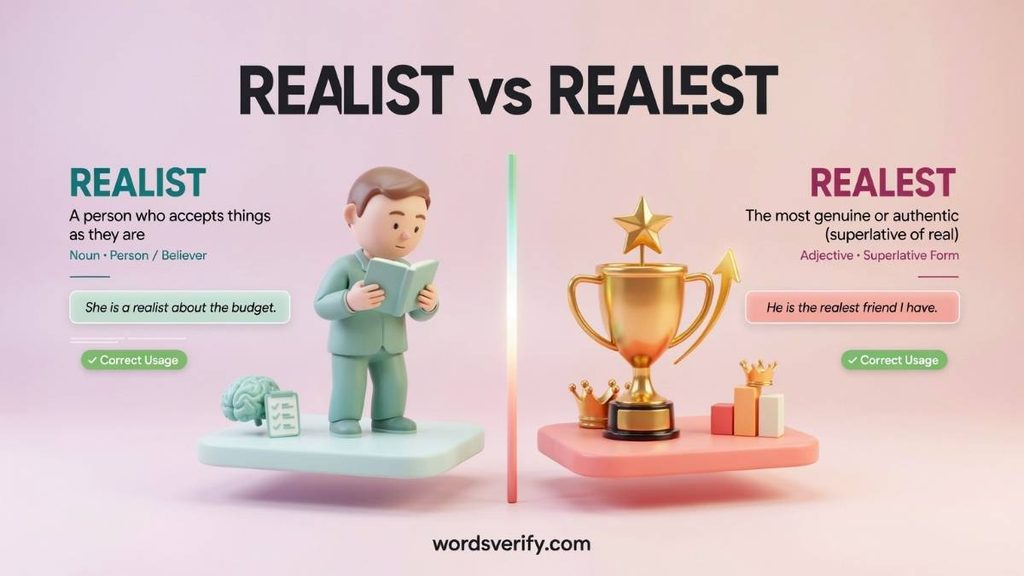
Although the words share the letters real, they aren’t interchangeable. The easiest way to remember the distinction is to focus on what each word describes.
| Feature | Realist | Realest |
|---|---|---|
| Part of speech | Noun | Superlative adjective |
| Root word | Realism or realist | Real |
| Main meaning | A person who thinks practically | The most genuine or authentic |
| Common use | Describing a practical outlook | Praising honesty or authenticity |
| Tone | Neutral or descriptive | Often informal and expressive |
| Example | “He’s a realist.” | “He’s the realest.” |
Consider these examples:
- “Maya is a realist.” This means Maya tends to judge situations based on facts and practical considerations.
- “Maya is the realest.” This usually means Maya is especially honest, genuine, or authentic.
The difference is small in spelling but significant in meaning. One describes a way of thinking, while the other emphasizes a quality.
Avoid everyday grammar mistakes with simple tips
Withdraw vs Withdrawal which one is correct?
When Should You Use Realist?
Use realist when you want to describe someone who takes a practical, fact-based approach to life. It’s particularly useful when discussing plans, expectations, challenges, and decisions.
Here are some situations where the word fits naturally.
When Discussing Practical Decisions
A realist considers what can reasonably be achieved instead of relying entirely on hope.
Examples:
- “We need a realist on the team who can help us set achievable deadlines.”
- “She’s a realist, so she knows the project will require additional funding.”
- “A realist would consider the risks before investing all their savings.”
When Talking About Expectations
Realists understand that not everything will go according to plan. They prepare for obstacles while still recognizing opportunities.
Examples:
- “I’m a realist, so I know learning a new language takes consistent practice.”
- “He’s a realist who understands that rebuilding trust takes time.”
- “Being a realist helped her prepare for the challenges of moving abroad.”
When Describing a Person’s Outlook
The word can also describe someone’s general attitude toward life.
Examples:
- “My sister is an optimist, but I’m more of a realist.”
- “As a realist, he prefers evidence over assumptions.”
- “She’s a realist who believes hard work matters more than luck alone.”
Remember that realism doesn’t automatically make someone pessimistic. A realist can be hopeful, ambitious, and confident while remaining aware of practical limitations.
Avoid everyday grammar mistakes with simple tips
Duchess vs Dutchess Which one Is Correct?
When Should You Use Realest?
Use realest when you want to emphasize that someone or something is exceptionally genuine. The word is particularly common in casual conversations, personal messages, and informal writing.
When Praising Honesty
Someone who tells the truth, even when it’s uncomfortable, may be described as the realest person in a group.
Examples:
- “You’re the realest friend I could ask for.”
- “She gave me the realest advice when I needed it most.”
- “He’s the realest person on the team because he speaks honestly about problems.”
When Talking About Loyalty
In slang, realest can suggest loyalty and dependability. It often describes someone who stays supportive during difficult times.
Examples:
- “My cousin is the realest because she always shows up when I need help.”
- “He’s been there for me through everything. He’s the realest.”
- “They proved they were the realest friends when life got difficult.”
When Describing Authenticity
The word can also praise people who don’t change their personalities simply to impress others.
Examples:
- “She’s the realest person I know because she’s always herself.”
- “His interview felt like the realest conversation of the entire event.”
- “That creator is one of the realest people online because she speaks openly about her experiences.”
The word is informal, so consider your audience. In a business report or academic essay, genuine, honest, or authentic may communicate the idea more clearly.
Avoid everyday grammar mistakes with simple tips
Written vs Writen Which one Is Correct?
Realist vs Realistic What’s the Difference?
Realist vs realistic are related, but they serve different grammatical purposes.
A realist is a person who tends to view situations practically. Realistic is an adjective that describes something based on reality or reasonable expectations.
Examples:
- “Jordan is a realist.” Here, realist identifies a person.
- “Jordan has a realistic plan.” Here, realistic describes the plan.
- “As a realist, Priya sets realistic goals.” The sentence uses both words correctly.
You wouldn’t normally say, “She’s a realistic” when you mean that she’s a practical person. Instead, say “She’s a realist.”
Likewise, if you’re describing a plan, expectation, or estimate, realistic is usually the appropriate choice.
Realist vs Idealist
A realist and an idealist approach situations from different perspectives.
A realist focuses on existing conditions, practical limitations, and what is likely to happen. An idealist emphasizes values, principles, possibilities, or how things should be.
Neither outlook is automatically better. Realism can help people plan effectively, while idealism can inspire meaningful change.
For example:
- A realist might say, “We need to understand the budget before expanding the program.”
- An idealist might say, “Everyone deserves access to the program, regardless of cost.”
- A balanced approach would consider both the available resources and the goal of making the program accessible.
The distinction matters because realist describes a person’s outlook, whereas realest generally emphasizes genuineness or authenticity.
Avoid everyday grammar mistakes with simple tips
Icycle vs Icicle Which one Is Correct?
Common Mistakes When Using Realist vs Realest
These words Realist vs realest are easy to confuse because they share the same root. A few simple reminders can help you use them correctly.
Using Realest When You Mean Realist
Incorrect: “I’m a realest, so I know the plan won’t work.”
Better: “I’m a realist, so I know the plan may not work.”
The sentence describes a practical outlook, so realist is the correct word.
Using Realist When You Mean Realest
Incorrect for the intended meaning: “She’s the realist friend I’ve ever had.”
Better: “She’s the realest friend I’ve ever had.”
If you’re praising someone’s honesty or authenticity, realest is the more natural choice in informal English.
You could also write, “She’s the most genuine friend I’ve ever had.”
Confusing Realest With Realistic
Incorrect: “We need a realest budget for this project.”
Better: “We need a realistic budget for this project.”
The sentence describes a budget that reflects practical circumstances. It doesn’t compare levels of authenticity, so realistic fits better.
Assuming Realist Always Means Pessimist
A realist doesn’t necessarily expect everything to go wrong. Realists simply consider the available evidence and likely outcomes.
For example, a realist might believe a project can succeed while recognizing that the team needs more time and resources.
Being realistic about a challenge doesn’t mean giving up on it.
Using Realest in Every Situation
Although realest works well in casual conversation, it may sound too informal in professional or academic writing.
Instead of writing, “She gave the realest explanation of the issue,” you might choose “She gave the most honest explanation of the issue.”
The best wording depends on your audience and the tone you want to establish.
Avoid everyday grammar mistakes with simple tips
Excelerate vs Accelerate Which one Is Correct?
Synonyms and Related Words
Knowing related words can make the distinction even easier to understand.
Words Related to Realist
Depending on the context, related terms include:
- Practical: Focused on what works in real situations.
- Pragmatic: Concerned with practical results and effective solutions.
- Levelheaded: Calm and sensible when making decisions.
- Down-to-earth: Sensible, approachable, and not overly idealistic.
- Realistic thinker: Someone who considers facts and practical limitations.
These words aren’t perfect substitutes in every sentence, but they can express similar ideas.
Words Related to Realest
When realest means especially genuine or honest, possible alternatives include:
- Most genuine: Emphasizes sincerity and authenticity.
- Most authentic: Suggests that someone or something is true to its nature.
- Most honest: Focuses on truthfulness.
- Most sincere: Emphasizes genuine feelings or intentions.
- Most loyal: Highlights commitment and dependability.
For example, “He’s the realest friend I know” could become “He’s the most genuine friend I know” or “He’s the most loyal friend I have,” depending on the intended meaning.
Avoid everyday grammar mistakes with simple tips
Rug vs Rag What’s the Difference?
Realist vs Realest in Everyday Conversation
The words often appear in conversations about personality, friendships, work, and personal decisions.
Imagine two friends discussing a career change.
Alex says, “I’m a realist. I know switching careers will take time, money, and patience.”
Sam replies, “That’s fair, but you’re also the realest person I know because you always tell me what I need to hear.”
Both words work because they describe different qualities. Alex uses realist to explain a practical approach to a challenge. Sam uses realest to praise honesty and sincerity.
Here are a few more everyday examples:
- At work: “We need a realist who can help us estimate the project’s actual costs.”
- In friendship: “She’s the realest friend I have because she never pretends everything is fine.”
- In personal planning: “I’m a realist, so I always leave extra time for unexpected problems.”
- On social media: “That was the realest post I’ve read all week.”
- In a family conversation: “Dad is a realist, but he still encourages us to aim high.”
These examples show how context determines which word fits.
Avoid everyday grammar mistakes with simple tips
Bougie vs Boujee which one is correct?
practice session Realist vs Realest
Complete each sentence with the correct word: realist vs realest. The practice set includes everyday examples, grammar tips, and a few tricky sentences to help you remember the difference.
fill in the blanks
1. Sarah is a ______ who considers the risks before making important decisions.
2. You’re the ______ friend I’ve ever had because you always tell me the truth.
3. As a ______, Mark knows that success takes time, effort, and patience.
4. She proved she was the ______ person in the group by staying honest during a difficult situation.
5. My brother is a ______ who prefers practical solutions over unrealistic expectations.
6. That was the ______ conversation we’ve had in years because nobody pretended everything was fine.
7. A ______ looks at the facts before deciding whether a plan is achievable.
8. He’s one of the ______ people I know because he never pretends to be someone else.
9. Although Emma is an optimist, her business partner is a ______ who carefully examines every expense.
10. My best friend is the ______ because she supports me and tells me when I’m wrong.
11. The coach is a ______ who understands that the team needs more training before the championship.
12. Everyone trusts Daniel because he’s the ______ guy in our circle.
13. Being a ______ doesn’t mean expecting the worst; it means understanding the situation clearly.
14. Of all the people I’ve met, Maya is the ______ when it comes to honesty and loyalty.
15. A ______ considers both the benefits and the drawbacks before making a decision.
16. He gave me the ______ advice I’ve received all week, even though it wasn’t easy to hear.
17. As a ______, she knows that reaching her goals will require careful planning.
18. You’re the ______ for sticking by me when things got difficult.
19. The manager is a ______ who sets achievable deadlines instead of making unrealistic promises.
Answers
- realist
- realest
- realist
- realest
- realist
- realest
- realist
- realest
- realist
- realest
- realist
- realest
- realist
- realest
- realist
- realest
- realist
- realest
- realist
Here’s a trusted source for clear word meanings:
FAQs
Is realest a real word?
Yes, realest is a correct English word. It’s the superlative form of real and often describes someone who is exceptionally honest, genuine, or authentic. For example, “She’s the realest friend I have” means she’s trustworthy and sincere.
Can a realist believe in God?
Yes. Being a realist doesn’t determine someone’s religious beliefs. A realist can believe in God, follow a religion, identify as an atheist, or hold agnostic views. Realism is about how someone understands and approaches reality, not whether they believe in a higher power.
Is it better to be a realist or an idealist?
Neither is inherently better. Realists focus on facts, practical limitations, and likely outcomes, while idealists emphasize possibilities, values, and how things could be improved. Combining both perspectives can help you pursue ambitious goals while making sensible decisions.
What is a realist person?
A realist is someone who evaluates situations practically and considers facts, evidence, and limitations before making decisions. Rather than relying entirely on wishful thinking, a realist weighs both opportunities and challenges. This doesn’t mean being negative; it means having a balanced view of reality.
Is it Realist vs realest?
Both words are correct, but they have different meanings. Use realist to describe someone who takes a practical approach to life. Use realest when describing someone or something as especially genuine, honest, or authentic.
For example, “He’s a realist” describes his outlook, while “He’s the realest” praises his authenticity.
What does realest mean?
Realest is the superlative form of real. In informal English, it often describes someone who is especially honest, loyal, sincere, or true to themselves. For example, “She’s the realest person I know” means she’s exceptionally genuine.
Are most people with high IQs atheists?
No. It’s inaccurate to claim that most people with high IQs are atheists. Research has explored possible connections between intelligence and religious belief, but findings vary. Intelligence alone doesn’t determine a person’s religious views, and people with high IQs can hold many different beliefs.
Which religion is the most realistic?
There is no universally accepted, objective way to identify one religion as the most realistic. People assess religious beliefs through different perspectives, including faith, philosophy, historical evidence, personal experience, and cultural traditions. The answer depends on the criteria someone uses to evaluate religious claims.
Is Elon Musk an agnostic?
Elon Musk has made public comments about God and religion, but his views shouldn’t be reduced to a single label without clear, current evidence. The most reliable approach is to consider his own direct statements rather than assume that he identifies definitively as an agnostic.
How can you tell if you’re a realist?
You may have a realist outlook if you tend to:
- Consider facts and evidence before making decisions.
- Set goals based on your available time and resources.
- Weigh risks alongside potential benefits.
- Adjust your plans when circumstances change.
- Recognize challenges without automatically expecting failure.
These habits can indicate practical thinking, although they don’t define your entire personality.
Was Karl Marx a realist or an idealist?
Karl Marx is primarily associated with materialist philosophy, particularly historical materialism. He emphasized how economic conditions, social relationships, and class conflict influence historical change. He criticized philosophical idealism that gives ideas primary importance in explaining reality, although his own work also explored ideals of social transformation.
What is the opposite of a realist?
An idealist is often considered the closest opposite of a realist. Realists focus on existing conditions and practical limitations, while idealists emphasize possibilities, principles, and how things should be. However, the distinction depends on context, and an idealist isn’t necessarily impractical.
What personality type is a realist?
Realist isn’t a formal personality type in popular systems such as the Myers-Briggs Type Indicator. The term generally describes someone who values practical thinking, evidence, and reasonable expectations. People with different personality types can all have a realist outlook.
What is another word for a realist?
Depending on the context, similar terms include pragmatist, practical thinker, levelheaded person, and down-to-earth person. Each has a slightly different meaning, so choose the word that best describes the person’s approach to decisions and everyday situations.
Is being a realist a good thing?
Being a realist can help you make sensible decisions, manage expectations, and prepare for challenges. However, focusing too much on limitations can cause you to overlook opportunities. The healthiest approach combines realistic planning with enough optimism to keep working toward your goals.
What does a realist believe in?
A realist generally believes that people should consider facts, evidence, and actual circumstances when understanding situations or making decisions. Beyond that, a realist’s beliefs can vary widely. Realism in philosophy, politics, and everyday life can also have different meanings.
Is Donald Trump considered a realist?
Some political analysts describe aspects of Donald Trump’s foreign policy as realist, particularly its emphasis on national interests, military strength, and transactional international relationships. Others argue that his approach differs from traditional realist principles. Whether the label fits depends on which policies and aspects of realism are being examined.
What are three qualities of a realist?
Three common qualities of a realist are:
- Practical thinking: Understanding what can reasonably be achieved.
- Evidence-based judgment: Using facts and information to make decisions.
- Adaptability: Changing plans when circumstances or new evidence require it.
These qualities help realists approach challenges with a clear head while remaining open to better solutions.
Conclusion
Although realist vs realest look almost identical, they serve different purposes. A realist faces life with a practical mindset, while the realest person is often the one who’s honest, genuine, and unapologetically themselves. Mixing them up can turn a perfectly good sentence into a little grammar mishap! The easiest way to remember the difference is simple: a realist focuses on reality, while the realest stands out for authenticity. Once you understand how each word works, choosing the right one becomes second nature. So, the next time these tricky words cross your path, you’ll know exactly which to use. Your grammar can breathe easy!

Lisa AJS is an experienced blogger and language enthusiast at Words Verify, dedicated to making grammar simple, practical, and enjoyable. She writes engaging content on commonly confused words, grammar mistakes, word meanings, and everyday language challenges.