
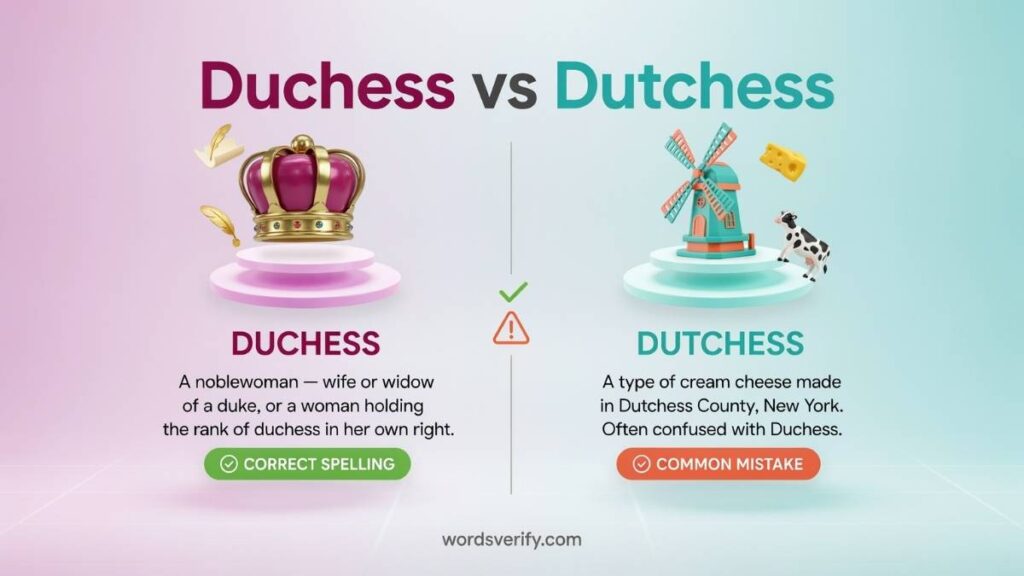
English spelling can be tricky, and “Duchess vs Dutchess” is a perfect example of how one letter can cause confusion. These words look almost identical, yet they serve different purposes. So, is Dutchess a royal title, or does duchess belong in a place name? Mixing them up is an easy mistake, but there’s no need to let one extra letter spoil your writing. In this guide, you’ll learn what each spelling means, discover how to use it correctly, and explore practical examples that make the difference easy to remember. By the end, you’ll have this confusing spelling pair sorted out for good!
Duchess vs Dutchess The Key Difference
The main difference between duchess vs Dutchess comes down to meaning and context. If you’re writing about nobility or a woman who holds a ducal title, use “duchess.” If you’re referring to a place or another proper name that officially uses “Dutchess,” keep that spelling.
Although the words differ by just one letter, they aren’t interchangeable.
| Feature | Duchess | Dutchess |
|---|---|---|
| Standard spelling of the noble title | Yes | No |
| Refers to a woman with a ducal title | Yes | No, not in standard modern English |
| Grammatical use | Common noun | Primarily used in proper names |
| Example | The duchess attended the ceremony. | Dutchess County is in New York. |
| Capitalization | Usually lowercase as a common noun | Capitalized in official names |
The simplest way to remember the distinction is to connect each spelling with its purpose:
- Duchess refers to a noble title.
- Dutchess appears in certain proper names, including Dutchess County, New York.
For example, when understanding Dutchess vs Duchess, you might write, “The duchess attended a formal ceremony at the palace.” However, if you’re discussing a location, you would write, “My relatives live in Dutchess County, New York.”
Both spellings are correct in these sentences because they serve different purposes. Duchess refers to a noble title, while Dutchess is the official spelling used in the place name Dutchess County. Understanding the difference between Dutchess and Duchess helps you use each spelling correctly according to its context.
Which Spelling Is Correct, Duchess vs Dutchess?
If you’re referring to the noble title, “duchess” is correct. Writing “Dutchess” when you mean the title is a spelling mistake in standard modern English.
However, Dutchess is correct when it forms part of an established proper name. The extra letter doesn’t make the place name incorrect; it reflects the name’s historical spelling.
This distinction matters because proper nouns don’t always follow the spelling of related dictionary words. Place names can preserve older forms, unusual spellings, and historical naming decisions.
Learn the difference between confusing more English words
Written vs Writen Which one Is Correct?
What Does Duchess Mean?
The word “duchess” refers to a woman who holds the rank of duke in her own right or who receives the title through marriage to a duke. It belongs to the vocabulary of nobility, aristocracy, and traditional social ranks.
A duchess may be a member of a royal family, but the title doesn’t automatically make her a queen or princess. Its exact status depends on the country, the history of the title, and the rules governing the relevant nobility system.
Duchess Definition and Word Meaning
A duchess is traditionally one of the following:
- A woman who holds a ducal title in her own right.
- The wife of a duke who holds the corresponding feminine title.
- In certain circumstances, a widow who retains a ducal title under the applicable rules.
The arrangements differ between countries and individual titles. In the British peerage, for example, a dukedom may pass according to the succession rules attached to it. A woman who inherits a title in her own right occupies a different position from a woman who receives the title through marriage.
This distinction is important because people often assume that every duchess is simply a duke’s wife. Although that description applies to many duchesses, it doesn’t cover every situation.
What Does the Duchess Title Mean in Royalty?
A duchess holds a high-ranking aristocratic title. In the traditional British peerage, a duke generally ranks above a marquess, an earl, a viscount, and a baron.
The feminine counterpart is duchess, although the title’s legal and social implications depend on how it is held.
A duchess may attend official events, support charitable organizations, carry out public duties, or represent an aristocratic household. These activities depend on the individual and institution rather than on the definition of the title itself.
It’s also important to distinguish nobility from royalty. A royal family member may hold a ducal title, but not every duchess belongs to a reigning royal family. Some duchesses are members of the hereditary aristocracy rather than the immediate royal household.
Is a Duchess the Female Equivalent of a Duke?
Yes. Duchess is the feminine counterpart of duke.
However, the titles don’t always describe identical circumstances. A duke may inherit a title under established succession rules, while a duchess may inherit a title herself or receive it through marriage. The exact position depends on the particular title and its rules.
For example:
“The duke and duchess welcomed their guests to the estate.”
Here, “duke” identifies the masculine title, while “duchess” identifies the corresponding feminine title. The sentence doesn’t tell you whether the duchess holds her title independently or through marriage.
Duchess in a Sentence Examples and Explanations
Examples make the meaning of duchess easier to understand.
- “The duchess attended the royal ceremony with her husband.”The word identifies a woman who holds a ducal title.
- “The duchess supported a local children’s charity.”Here, the sentence describes the charitable work of a noblewoman.
- “The duke and duchess welcomed visitors to their historic residence.”The two words identify corresponding aristocratic titles.
- “Historians studied letters written by the duchess during the eighteenth century.”The word refers to a historical noblewoman.
- “The duchess’s official duties included attending public events.”The sentence uses the possessive form to show that the duties belong to the duchess.
These examples demonstrate why “duchess” is the correct spelling when referring to the title.
Learn the difference between confusing more English words
Icycle vs Icicle Which one Is Correct?
Is Dutchess a Word?
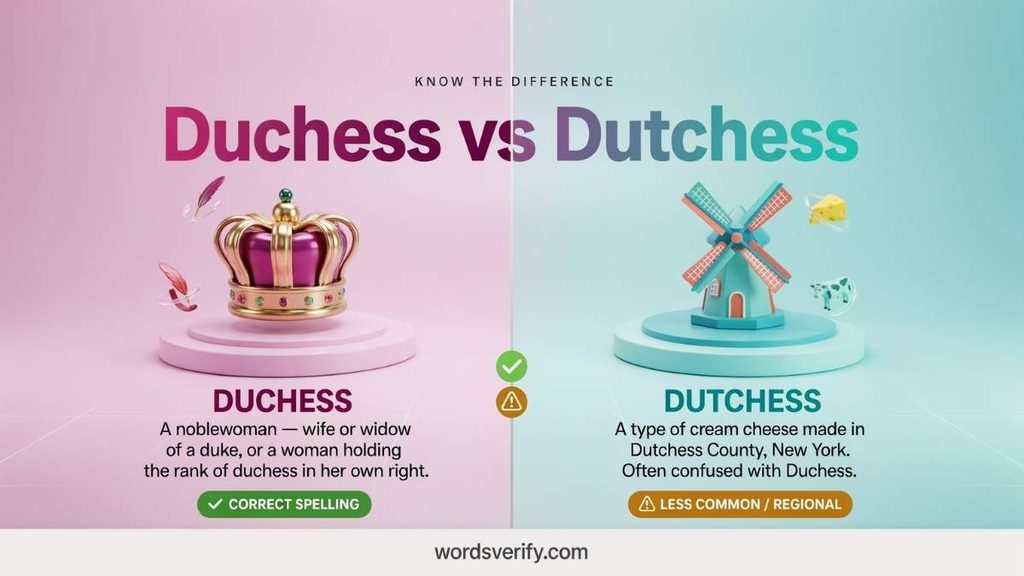
Yes, Dutchess is a real spelling used in modern English, but its meaning depends on context. The important question isn’t simply whether the spelling exists. It’s whether it suits the meaning you intend.
When people encounter the word, they may assume it is another accepted spelling of the noble title. That assumption causes much of the confusion. Dutchess is not the standard modern spelling of the title, but it appears in proper names, especially Dutchess County in New York.
Dutchess Meaning and Modern Usage
In modern writing, Dutchess most commonly appears in proper names. A proper noun identifies a specific person, place, organization, or other named entity. Its spelling may reflect a historical naming decision rather than the usual spelling of a related word.
Dutchess County is the clearest example. Located in New York’s Hudson Valley, the county lies north of New York City. Its name preserves an older spelling associated with the title “duchess.”
This doesn’t mean writers can add a “t” whenever they want to spell the noble title. Proper names retain their established spellings, while ordinary words follow standard spelling conventions.
Consider these examples:
- Correct: “She became a duchess after marrying the duke.”
- Correct: “Dutchess County is known for its Hudson Valley scenery.”
- Incorrect in standard usage: “She became a dutchess after marrying the duke.”
The third example uses the wrong spelling for the noble title. The correct word is “duchess.”
Is Dutchess Correct or a Misspelling?
The answer depends on the context.
| Context | Is Dutchess correct? | Explanation |
|---|---|---|
| A woman with a ducal title | No | Use “duchess.” |
| Dutchess County, New York | Yes | This is the official place-name spelling. |
| A business or organization named Dutchess | Potentially | Follow the entity’s established name. |
| An ordinary sentence about nobility | No | Use “duchess.” |
| A historical quotation or document | Sometimes | Preserve the original spelling when accuracy requires it. |
So, is Dutchess a real word? It is a real spelling used in proper names, but it isn’t an accepted alternative spelling of the modern noble title in standard English.
The distinction answers several common questions. Dutchess can be correct in a name without being correct as a substitute for “duchess.”
Learn the difference between confusing more English words
Excelerate vs Accelerate Which one Is Correct?
Why Is Dutchess County Spelled With a T?
Dutchess County, New York, provides a useful real-world example of the difference between the two spellings. Its name isn’t a random typo. It reflects the history of the county’s establishment.
New York established Dutchess County in 1683 and named it in honor of Mary of Modena, who was then the Duchess of York. The county retained the older spelling in its name, even though “duchess” became the standard modern spelling of the title.
The Historical Story Behind the Spelling
Mary of Modena was the second wife of James, Duke of York. James later became King James II of England and Ireland and King James VII of Scotland. When the county received its name, Mary held the title Duchess of York.
The county’s name reflects the spelling used when the place name was established. Over time, “duchess” became the standard modern spelling of the ordinary English title, while the county retained “Dutchess.”
This is a useful reminder that historical place names don’t always change when spelling conventions evolve. Names often remain stable because they identify specific places and form part of their legal and historical identity.
Learn the difference between confusing more English words
Dysregulated vs Disregulated which one is correct?
Dutchess County vs the Duchess Title
The distinction becomes clear when you compare the two uses.
Dutchess County
Dutchess County is a geographic location in New York State. Its name uses the spelling “Dutchess” for historical reasons.
Example: “Dutchess County is known for its Hudson Valley scenery.”
Duchess
A duchess is a woman who holds a ducal title in her own right or receives the title through marriage.
Example: “The duchess attended the state reception.”
The comparison shows why spelling must follow meaning. If you’re writing about a New York county, use Dutchess. If you’re writing about an aristocratic title, use duchess.
Why Place Names Preserve Unusual Spellings
Place names often preserve forms that look unusual to modern readers. They may reflect older spellings, local traditions, historical figures, or decisions made when a settlement was established.
The same principle applies to surnames, street names, and institutional names. You shouldn’t automatically change an official name just because its spelling differs from a common dictionary word.
For example, a writer discussing Dutchess County shouldn’t change the name to “Duchess County” in an attempt to correct the spelling. That would alter the official place name rather than fix an error.
The lesson is straightforward: identify whether you’re writing a common noun or a proper noun before correcting an unfamiliar spelling.
Learn the difference between confusing more English words
Rug vs Rag What’s the Difference?
Duchess vs Dutchess Pronunciation and Spelling Rules
One reason the confusion persists is that “duchess” and “Dutchess” are generally pronounced alike in English. When two spellings share the same pronunciation, your ears may not help you choose the right one.
How Do You Pronounce Duchess?
The standard US pronunciation of “duchess” is /ˈdʌtʃəs/.
You can break it down into three parts:
- The first syllable sounds like “duh.”
- The middle consonant sound is “ch,” as in “church.”
- The final syllable has a short, unstressed sound similar to “iss.”
The stress falls on the first syllable. Dutchess County’s name is also commonly pronounced the same way.
Because the pronunciation includes the sound /tʃ/, some writers assume that the word must contain a “t” before the “ch.” However, the letters “ch” already represent that sound. Adding a separate “t” to the standard spelling of the title isn’t necessary.
Why Is Duchess Spelled Without a T?
The modern English spelling developed through the word’s historical forms. English inherited “duchess” through French, where the related word is “duchesse.” The modern English spelling doesn’t require a separate “t” before “ch.”
The spelling “Dutchess” survives in the New York place name, but that historical exception doesn’t change the standard spelling rule.
A useful way to remember the distinction is to focus on the word’s purpose:
- If it names a noble title, write “duchess.”
- If it names Dutchess County or another entity whose official name includes the extra letter, retain “Dutchess.”
A Simple Spelling Memory Trick
Think of “duchess” as the feminine counterpart of “duke.” Both titles begin with “du,” and neither requires an extra “t” in its standard spelling.
You can also remember this short rule: a duchess holds a title, while Dutchess names a place.
This isn’t a complete rule for every possible proper name, but it works well for the most common spelling question.
Learn the difference between confusing more English words
Bougie vs Boujee which one is correct?
Duchess vs Dutchess Examples Correct and Incorrect Usage
The best way to understand Dutchess vs Duchess is to see how each spelling works in context. A sentence may look grammatically sound while still using the wrong spelling for its intended meaning. “Duchess” refers to a woman who holds a noble title or is the wife of a duke, while “Dutchess” appears in proper names, such as Dutchess County, New York. Understanding this distinction helps you choose the correct spelling and avoid common writing mistakes.
Correct Use of Duchess
Use “duchess” when you mean the noble title.
| Example sentence | Why it is correct |
|---|---|
| The duchess attended the royal ceremony with her husband. | “Duchess” identifies a woman holding the title. |
| The duke and duchess welcomed guests to their estate. | The sentence uses corresponding noble titles. |
| The duchess donated money to restore the historic library. | The word refers to a noblewoman. |
| Historians examined the duchess’s correspondence. | “Duchess’s” is the singular possessive form. |
| Several duchesses attended the formal reception. | “Duchesses” is the correct plural form. |
Notice that “duchess” remains lowercase in these sentences because it functions as a common noun. Capitalization may change when the word appears in a formal title or at the beginning of a sentence.
Correct Use of Dutchess
Use “Dutchess” when writing an official name that uses this spelling.
| Example sentence | Why it is correct |
|---|---|
| Dutchess County is located in New York State. | The sentence uses the county’s official name. |
| The family moved to Dutchess County several years ago. | The spelling identifies a specific geographic location. |
| She researched the history of Dutchess County. | The proper noun retains its established spelling. |
These examples show that Dutchess isn’t simply an alternative spelling you can substitute for “duchess.” Its correctness depends on the name being used.
Common Incorrect Examples
Here are a few mistakes to watch for.
| Incorrect sentence | Corrected sentence |
|---|---|
| The dutchess attended the ceremony. | The duchess attended the ceremony. |
| The duke and dutchess welcomed their guests. | The duke and duchess welcomed their guests. |
| She became a dutchess after marrying the duke. | She became a duchess after marrying the duke. |
| The family moved to Duchess County, New York. | The family moved to Dutchess County, New York. |
The first three examples confuse the noble title with the historical spelling found in a proper name. The final example makes the opposite mistake by changing the spelling of an official place name.
Learn the difference between confusing more English words
Excel vs Accel which one is correct?
Duchess Grammar Plurals, Possessives and Capitalization
Knowing the correct spelling is only part of using the word accurately. You also need to understand how “duchess” behaves in a sentence.
What Is the Plural of Duchess?
The plural form is “duchesses.”
English commonly forms the plurals of nouns ending in “-ss” by adding “-es.” The same pattern appears in words such as “classes” and “dresses.”
Examples:
- The duchesses gathered for the annual ceremony.
- Two duchesses attended the historical exhibition.
- The book describes several duchesses who influenced European politics.
“Duchesses” is the appropriate plural when referring to multiple women with the title.
What Is the Possessive Form of Duchess?
Use “duchess’s” for the singular possessive and “duchesses’” for the plural possessive.
- Singular: The duchess’s residence overlooks the gardens.
- Plural: The duchesses’ portraits hung in the gallery.
The singular possessive refers to something belonging to one duchess. The plural possessive refers to something belonging to multiple duchesses.
Should Duchess Be Capitalized?
In ordinary sentences, “duchess” is generally lowercase when it functions as a common noun.
For example:
- The duchess visited the museum.
- A duchess attended the reception.
Capitalization can depend on formal title conventions, a person’s full title, and the style guide being followed. When exploring Dutchess vs Duchess, remember that “duchess” is generally lowercase when used as a common noun but may be capitalized when it forms part of a formal title, depending on the style guide. At the beginning of a sentence, the word naturally takes an initial capital.
By contrast, “Dutchess” begins with a capital letter in “Dutchess County” because it forms part of a proper name. This is a grammatical distinction, not a different spelling rule for the noble title.
Learn the difference between confusing more English words
Bellies vs Bellys Which one Is Correct?
Duchess vs Countess, Princess, Queen and Duke
The word “duchess” can also cause confusion because people sometimes treat all noble and royal titles as though they mean the same thing. They don’t. Each title has its own history and place within a system of rank.
| Title | General meaning |
|---|---|
| Duke | A high-ranking male noble title in many European traditions. |
| Duchess | The feminine counterpart of duke, held in its own right or through marriage, depending on the title. |
| Countess | A woman who holds the title corresponding to a count or earl, or receives it through marriage. |
| Princess | A title associated with certain members of royal families; its exact meaning varies by monarchy. |
| Queen | A woman who reigns as monarch or holds the title of queen through marriage, depending on the context. |
| Dame | A title or honor used in certain countries, including the United Kingdom; it isn’t the feminine equivalent of duchess. |
In the traditional British peerage, a duke ranks above an earl, who is the British equivalent of a count in many continental European systems. A duchess’s position depends on the ducal title she holds or through which she receives the title.
A princess, on the other hand, may belong to a royal family without holding a ducal title. Likewise, a duchess isn’t automatically a princess or queen.
These distinctions help explain the meaning of “duchess,” but they don’t change its spelling. Whether you’re discussing British nobility, European aristocracy, or a historical royal family, the standard English title remains “duchess.”
Learn the difference between confusing more English words
Bearer vs Barer which one is correct?
practice session Duchess vs Dutchess
Complete the following sentences using the correct spelling Duchess vs Dutchess
fill in the blanks
- Meghan Markle is the ________ of Sussex.
- ________ County is located in New York State.
- The ________ attended the royal ceremony.
- We visited ________ County last summer.
- The king welcomed the ________ to the palace.
- Hyde Park is located in ________ County.
- A ________ is the female equivalent of a duke.
- The historic home is in ________ County, New York.
- The ________ greeted the guests warmly.
- We explored the beautiful scenery of ________ County.
- The duke and the ________ hosted a dinner.
- The name ________ County has an unusual spelling.
- The young ________ learned royal manners.
- Many historic towns are found in ________ County.
- The ________ wore a beautiful crown.
- Franklin D. Roosevelt’s home is in ________ County.
- A ________ can hold a noble title in her own right.
- The guide recommended places to visit in ________ County.
- The ________ met the visiting monarch.
- Visitors enjoy the countryside in ________ County.
- The ________ received praise for her charity work.
- The historic estate is located in ________ County.
- The newspaper interviewed the ________.
- We studied the history of ________ County in class.
- The title ________ is associated with nobility.
Answers
- duchess
- Dutchess
- duchess
- Dutchess
- duchess
- Dutchess
- duchess
- Dutchess
- duchess
- Dutchess
- duchess
- Dutchess
- duchess
- Dutchess
- duchess
- Dutchess
- duchess
- Dutchess
- duchess
- Dutchess
- duchess
- Dutchess
- duchess
- Dutchess
- duchess
Here’s a trusted source for clear word meanings:
FAQs
Why is Dutchess County spelled with a “t”?
Dutchess County, New York, retains an older spelling of “duchess.” Established in 1683, the county was named in honor of Mary of Modena, the Duchess of York. The historical spelling stuck, giving the county a name that looks different from the standard word for the noble title.
Is a duchess higher in rank than a princess?
Not necessarily. Royal rank depends on the monarchy, the person’s family connections, and the rules of precedence. A princess who belongs to a royal family may outrank a duchess, but the titles don’t follow one universal ranking system.
What is a female duke called?
A female duke is called a duchess. The title may belong to a woman who holds the rank in her own right or to the wife of a duke.
What is a duke’s wife called?
A duke’s wife is traditionally called a duchess. For example, the wife of a man holding the title Duke of Example would generally be known as the Duchess of Example.
What is the male equivalent of a duchess?
The male equivalent of a duchess is a duke. In the traditional British peerage, duke is the highest of the five main ranks, followed by marquess, earl, viscount, and baron.
What is Dutchess County, New York, famous for?
Dutchess County is known for its scenic Hudson River views, historic estates, farms, and cultural attractions. Hyde Park is home to Franklin D. Roosevelt’s historic residence and presidential library, making the area a popular destination for history enthusiasts.
Is Dutchess County Republican or Democratic?
Dutchess County has both Democratic and Republican voters, and its political leanings can change between elections. The most reliable way to understand its current political makeup is to review official results from recent local, state, and national elections.
Is Meghan Markle technically a duchess?
Yes. Meghan Markle became the Duchess of Sussex when she married Prince Harry in 2018. Although the couple stepped back from their roles as working members of the British royal family in 2020, the title remains associated with Meghan.
Is Kate Middleton a princess or a duchess?
Catherine, commonly known as Kate Middleton, holds the title Princess of Wales through her marriage to Prince William. She is also associated with the title Duchess of Cornwall because William holds the title Duke of Cornwall. However, she is most widely known as the Princess of Wales.
What is the highest title a woman can hold in the British monarchy?
A reigning queen holds the sovereign’s title. Other royal women may hold titles such as queen consort, princess, or duchess, depending on their position and circumstances. These titles serve different purposes, so their precedence doesn’t always follow a simple hierarchy.
What title ranks above a duchess?
In the traditional British peerage, a duke is the highest-ranking noble, and a duchess is the female equivalent. Royal titles, including queen and princess, operate under different rules, so they cannot always be compared directly with peerage ranks.
How should you formally address a duchess?
In traditional British etiquette, a duchess may be addressed as “Your Grace.” However, the correct form of address depends on her specific title and the relevant royal or social protocol. When writing a formal letter, check the official guidance for that individual.
How do you greet a member of the British royal family?
The appropriate greeting depends on the royal’s title. “Your Majesty” is used when addressing the king or queen, while “Your Royal Highness” is used for certain other members of the royal family. When in doubt, a polite greeting and respectful behavior are usually the safest choices.
What do British royals say instead of “toilet”?
In formal British English, people may use words such as “lavatory” or “bathroom.” However, there’s no single word that every royal uses. Many popular claims about royal vocabulary exaggerate etiquette rules or confuse tradition with personal preference.
What does Princess Anne call King Charles?
Princess Anne is King Charles III’s younger sister. She may use a familiar family name in private, but the exact words she uses in personal conversations shouldn’t be presented as fact without reliable evidence.
Is there an official royal bedtime rule?
No single bedtime rule applies to every member of the British royal family. Their routines vary according to age, personal preferences, health, and official duties. Stories about royal schedules often describe individual habits rather than formal royal rules.
What is the lowest aristocratic title in the British peerage?
Baron is the lowest of the five traditional ranks in the British peerage. The order is duke, marquess, earl, viscount, and baron. A baron’s wife is traditionally known as a baroness.
Does a duchess outrank a princess?
Not automatically. A princess’s precedence depends on her royal status and the monarchy’s rules, while a duchess’s position depends on her title and circumstances. Royal precedence is more complicated than simply comparing two titles.
Who ranks higher, Queen Camilla or Prince William?
Queen Camilla is the queen consort, while Prince William is the Prince of Wales and heir to the British throne. Their roles differ, and formal precedence depends on the occasion. Camilla’s title reflects her position as the king’s wife, while William’s title reflects his status as heir to the throne.
Learn the difference between confusing more English words
Panel vs Pannel which one is correct?
conclusion
The Dutchess vs Duchess confusion proves that even one extra letter can cause a surprising amount of trouble. Remember, “duchess” refers to a woman who holds a noble title, while “Dutchess” appears in proper names, such as Dutchess County in New York. Choose the wrong spelling, and your sentence might accidentally trade a royal title for a place on the map! The trick is simple: pay attention to the context before you write. English spelling may have its share of unexpected twists, but this pair doesn’t have to leave you puzzled. Keep the difference in mind, use each word correctly, and let your writing shine without any royal spelling blunders.

Lisa AJS is an experienced blogger and language enthusiast at Words Verify, dedicated to making grammar simple, practical, and enjoyable. She writes engaging content on commonly confused words, grammar mistakes, word meanings, and everyday language challenges.