
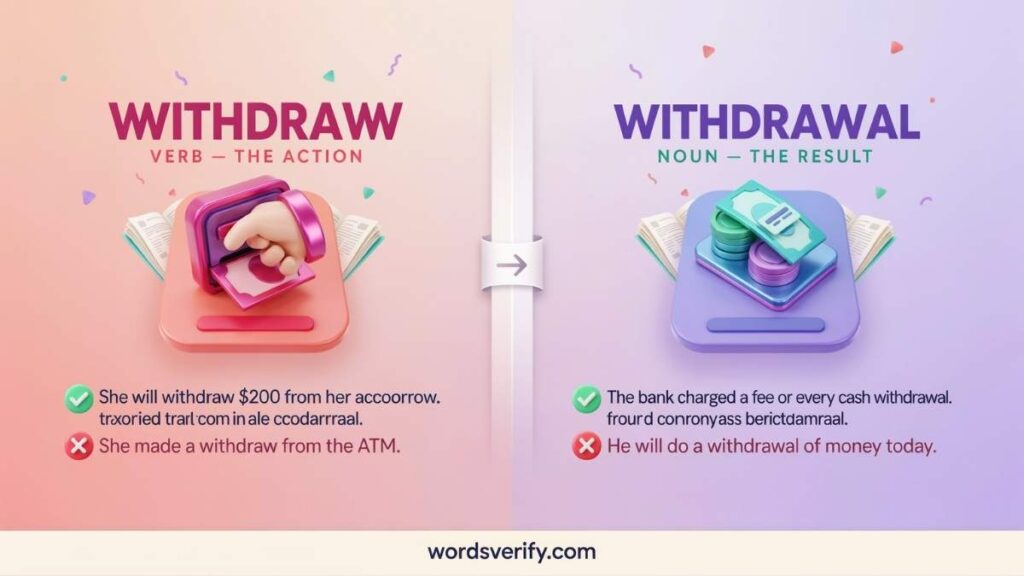
Have you ever stopped mid-sentence, wondering whether to use “withdraw” vs “withdrawal”? You’re not alone! These similar-looking words often cause confusion, even for confident English speakers. Although they share a meaning, they don’t serve the same purpose in a sentence. Using the wrong one can turn a perfectly good sentence into a grammar hiccup. The good news? Telling them apart is easier than you think. In this guide to withdraw vs. withdrawal, you’ll discover their meanings, understand the key grammatical differences, and learn through simple, practical examples. By the end, you’ll know exactly which word to use and when.
Withdraw vs Withdrawal Quick Answer
The easiest way to distinguish these words is to look at their grammatical roles.
| Feature | Withdraw | Withdrawal |
|---|---|---|
| Part of speech | Verb | Noun |
| Meaning | To take something out, take something back, or leave a situation | The act, process, or result of withdrawing |
| Common uses | Money, applications, offers, support, competitions | Bank transactions, departures, cancellations, medical conditions |
| Example | I need to withdraw cash. | I made a cash withdrawal. |
The basic rule is simple: use “withdraw” to describe an action and “withdrawal” to name the action, event, or result.
Consider these examples:
- Correct: “She plans to withdraw her application.”
- Correct: “Her withdrawal surprised the admissions committee.”
- Incorrect: “She plans to withdrawal her application.”
- Incorrect: “Her withdraw surprised the admissions committee.”
Both words are correct English. The right choice depends on how you use the word in your sentence.
Learn how to use confusing more words correctly
Duchess vs Dutchess Which one Is Correct?
What Does Withdraw Mean?
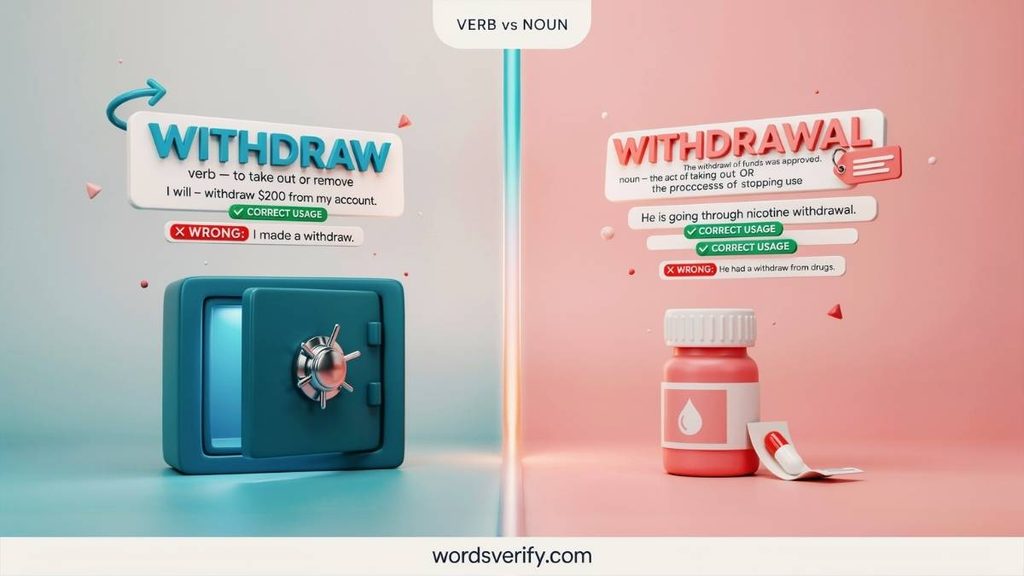
“Withdraw” is a verb that means to remove something, take something back, stop participating, or move away from a person, place, or situation.
Its exact meaning depends on the context. In banking, you withdraw money. In business, you might withdraw an offer. During a competition, an athlete may withdraw because of an injury.
The central idea remains the same: someone removes, takes back, or pulls away from something.
Common Uses of Withdraw
Here are several ways to use the word in everyday English.
- To take money out of an account: “I need to withdraw $100 from my checking account.”
- To remove an application or request: “The applicant decided to withdraw her application.”
- To take back a statement or offer: “The company withdrew its offer after reviewing the contract.”
- To stop participating: “The runner had to withdraw from the race.”
- To retreat or pull back: “The troops began to withdraw from the area.”
- To stop providing support: “Several members threatened to withdraw their support.”
- To become less socially involved: “He began to withdraw from conversations with his colleagues.”
Notice that “withdraw” often takes a direct object, such as “money,” “an offer,” or “support.” In other cases, it appears with “from,” as in “withdraw from a course” or “withdraw from a competition.”
The sentence structure depends on what you want to express.
How to Use Withdraw as a Verb
When you use “withdraw” as a verb, it describes an action performed by a person, organization, or another subject.
For example:
- “I withdraw cash every Friday.”
- “She withdraws her complaint.”
- “They withdrew their proposal yesterday.”
- “The company has withdrawn the product from the market.”
- “He is withdrawing from the competition.”
The verb changes form to show tense and agree with the subject. These changes are part of English grammar.
For instance, “withdraw” becomes “withdraws” with a third-person singular subject in the simple present. Its simple past form is “withdrew,” and its past participle is “withdrawn.”
Learning these forms will help you avoid mistakes when writing about past actions or ongoing events.
Withdraw Something vs Withdraw From Something
One common source of confusion is knowing when to use “withdraw” by itself and when to follow it with “from.”
Use “withdraw” with a direct object when you want to identify the thing being removed or taken back.
- “She withdrew her application.”
- “The bank withdrew the incorrect charge.”
- “The candidate withdrew his statement.”
- “The organization withdrew its support.”
Use “withdraw from” when describing someone leaving an activity, place, group, or situation.
- “She withdrew from the course.”
- “The player withdrew from the tournament.”
- “The company withdrew from negotiations.”
- “He withdrew from the discussion.”
Compare “withdraw an application” with “withdraw from a course.” In the first sentence, the application is the thing being removed. In the second, the course is the activity the person is leaving.
Once you understand this difference, choosing the right sentence structure becomes much easier.
Learn how to use confusing more words correctly
Written vs Writen Which one Is Correct?
What Does Withdrawal Mean?
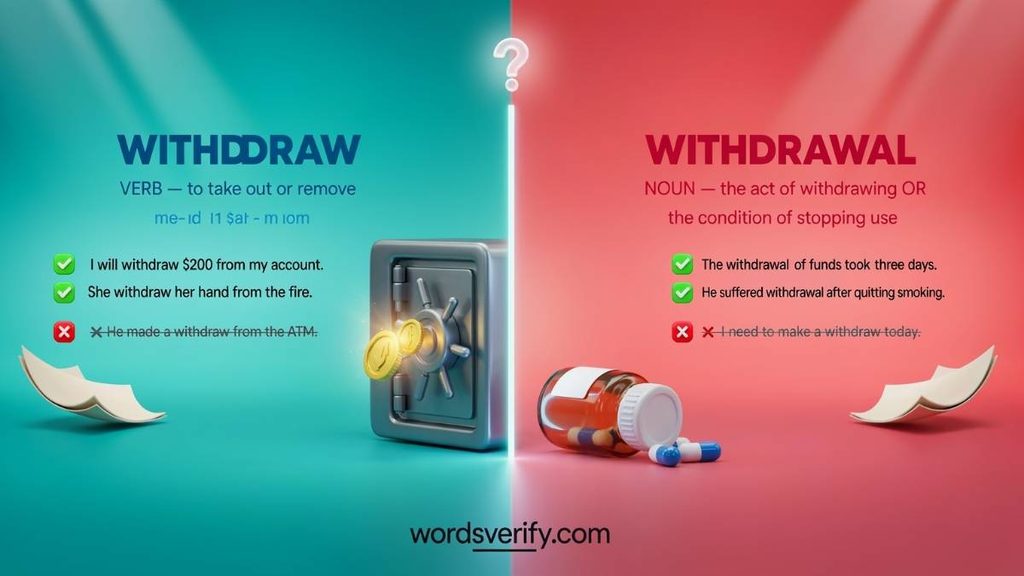
“Withdrawal” is a noun that describes the act, process, or result of withdrawing. It can refer to a financial transaction, a decision to leave an activity, the removal of an offer, or symptoms that occur after stopping certain substances.
The meaning changes slightly depending on the context, but its grammatical role remains the same. Withdrawal names an action, event, process, or condition.
For example:
- “The withdrawal of the application was voluntary.”
- “The bank processed my withdrawal.”
- “Her withdrawal from the competition came as a surprise.”
- “The patient experienced withdrawal symptoms.”
In each sentence, “withdrawal” identifies something rather than directly expressing an action.
Withdrawal as a Noun
“Withdrawal” is a noun in standard English. It can appear in several common sentence structures.
an article:
- “The withdrawal was approved.”
- “A withdrawal fee applies to this transaction.”
with a possessive:
- “His withdrawal surprised the team.”
- “Their withdrawal from the agreement changed the negotiations.”
With a preposition:
- “The withdrawal of the offer caused confusion.”
- “She requested a withdrawal from the program.”
As part of a compound noun:
- “The ATM withdrawal appeared on my statement.”
- “The withdrawal request needs approval.”
- “The withdrawal notice arrived yesterday.”
These structures are especially useful in formal writing because they let you discuss an action without making the person performing it the main focus.
For example, “The company withdrew its offer” emphasizes what the company did. By contrast, “The withdrawal of the offer took everyone by surprise” emphasizes the event itself.
Both sentences are correct, but they focus on different aspects of the same situation.
Withdrawal in Banking and Finance
Banking is one of the most common contexts for “withdrawal.” A bank withdrawal occurs when money leaves a bank account through an authorized transaction. You might receive physical cash or move funds through another permitted method.
Suppose you visit an ATM and take $80 from your checking account. You withdraw $80, and the transaction is a cash withdrawal.
Here are several common banking expressions:
| Expression | Meaning | Example |
|---|---|---|
| Withdraw money | Take money out of an account | I need to withdraw money before the trip. |
| Cash withdrawal | A transaction involving cash taken out of an account | The ATM cash withdrawal was successful. |
| Withdrawal amount | The amount removed from an account | Enter the withdrawal amount. |
| Withdrawal fee | A charge associated with a withdrawal | The ATM may charge a withdrawal fee. |
| Withdrawal request | A request to remove funds | The bank received my withdrawal request. |
| Withdrawal transaction | A recorded movement of money out of an account | The withdrawal transaction appears on my statement. |
A withdrawal doesn’t always involve paper money. Depending on the account and financial product, it may involve taking cash from a savings account, accessing eligible investment funds, or transferring money through an approved process.
The rules, fees, and processing times depend on the financial institution and account terms.
Withdraw vs Withdrawal When Taking Out Money?
The difference becomes clear when you compare complete sentences.
- “I want to withdraw money from my bank account.”
- “I want to make a withdrawal from my bank account.”
- “The bank processed my withdrawal this morning.”
- “You can withdraw funds after completing the required verification.”
The first and fourth sentences use a verb to describe an action. The second and third use a noun to refer to the action or transaction.
So, should you say “withdraw money” or “withdrawal money”?
Use “withdraw money.” The verb “withdraw” acts on the noun “money.” In standard English, “withdrawal money” doesn’t work as a direct replacement for that construction.
You can also say “make a withdrawal” or “make a cash withdrawal.” Both expressions are correct because “withdrawal” functions as a noun.
Withdrawal From School or a Course
Education offers another practical example of the difference between withdraw and withdrawal.
A student may withdraw from a class, program, or school for personal, academic, or financial reasons. The verb describes the action, while the noun refers to the formal process or event.
Consider these examples:
- “Maya decided to withdraw from her biology course.”
- “Maya submitted a withdrawal request.”
- “The college approved her withdrawal.”
- “The withdrawal deadline is Friday.”
The phrase “withdrawal from a course” often refers to a formal administrative process. Depending on the institution’s policies, withdrawing may affect tuition refunds, academic records, financial aid, or progress toward a degree.
It’s also important to distinguish withdrawal from dropping a class. Some schools treat these as separate administrative actions, particularly when deadlines or academic records are involved. The exact consequences depend on the institution’s rules.
Withdrawal From a Competition, Job, or Agreement
The same grammatical distinction applies when someone stops participating in an activity or ends a commitment.
Examples using “withdraw”:
- “The athlete withdrew from the marathon.”
- “The employee decided to withdraw from the selection process.”
- “The company withdrew its offer.”
- “The parties agreed to withdraw from negotiations.”
Examples using “withdrawal”:
- “The athlete’s withdrawal changed the competition.”
- “The employee announced her withdrawal from the selection process.”
- “The withdrawal of the offer disappointed the candidate.”
- “The withdrawal from negotiations delayed the agreement.”
The choice depends on whether you’re describing the action or naming the event.
One important distinction is worth remembering: withdrawing from an agreement doesn’t automatically cancel every legal obligation. Contracts, regulations, and applicable laws may set conditions for withdrawal. The word alone doesn’t determine the legal effect.
Withdrawal in Medical and Health Contexts
In health-related writing, “withdrawal” can refer to symptoms that occur when someone stops using or significantly reduces exposure to certain substances after the body has adapted to them.
Depending on the substance and circumstances, withdrawal symptoms may include anxiety, nausea, sweating, tremors, sleep problems, or other physical and psychological effects. The symptoms, timing, and severity vary considerably.
For example:
- “The patient experienced withdrawal symptoms.”
- “The clinician discussed the risks of medication withdrawal.”
- “The treatment plan addressed alcohol withdrawal.”
Medication withdrawal deserves particular care. Stopping some prescription medicines suddenly can cause significant symptoms or other health risks. Anyone considering a change to prescribed medication should consult an appropriate health professional rather than assume that stopping immediately is safe.
The verb can still describe an action in health-related contexts:
- “The patient plans to withdraw from the study.”
- “The clinician advised against stopping the medication without guidance.”
However, “withdrawal from medication” and “withdrawal symptoms” aren’t interchangeable. The first may refer to stopping or discontinuing treatment, while the second describes the symptoms associated with that change.
Social Withdrawal
“Social withdrawal” refers to a pattern of reducing contact with other people or participating less in social activities.
For example:
- “His social withdrawal worried his friends.”
- “She began to withdraw from social gatherings.”
- “The counselor discussed the student’s withdrawal from group activities.”
Notice the grammatical difference. “Social withdrawal” names a pattern or condition, while “withdraw from social gatherings” describes an action.
Social withdrawal can happen for many reasons, including stress, personal preference, life changes, or health concerns. The phrase alone doesn’t establish a diagnosis or explain why someone has become less socially active.
Learn how to use confusing more words correctly
Icycle vs Icicle Which one Is Correct?
Withdraw vs Withdrawal The Main Grammar Rules
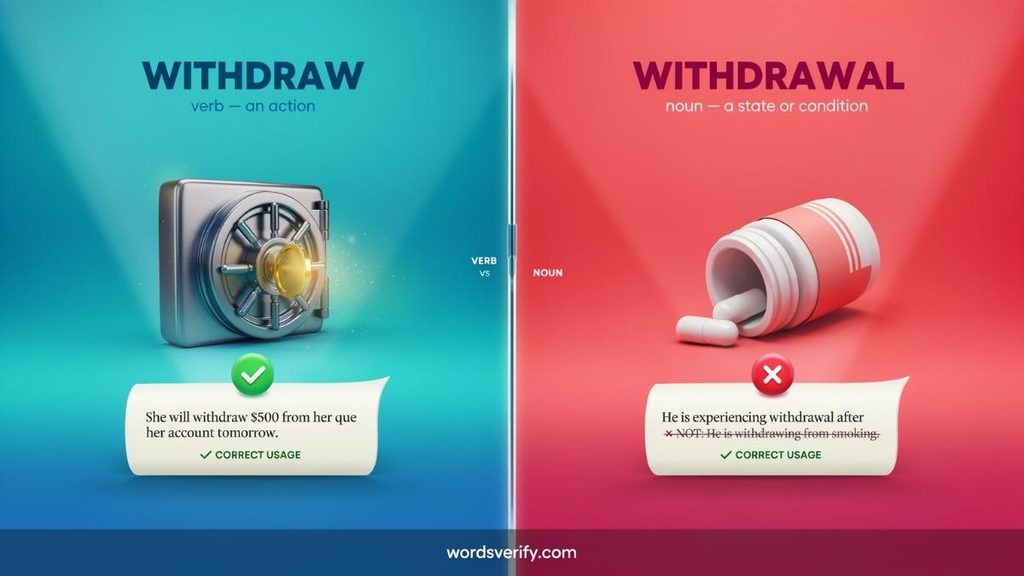
Understanding the grammatical difference between these words makes the correct choice much easier. You don’t need a separate rule for every situation. Start by identifying whether the sentence needs a verb or a noun.
Is Withdraw a Verb or a Noun?
“Withdraw” is a verb in standard contemporary English when used with its ordinary meaning of removing, taking back, or retreating.
A verb describes an action or state. In these examples, “withdraw” tells you what the subject does.
- “I withdraw funds from my account.”
- “He withdrew his complaint.”
- “They will withdraw the proposal.”
- “She is withdrawing from the course.”
Although words can have specialized uses in certain contexts, “withdraw” isn’t the standard noun for the act of removing money or leaving a competition. Use “withdrawal” for that purpose.
Is Withdrawal a Verb or a Noun?
“Withdrawal” is a noun in standard English. It names an action, event, process, or condition.
Examples include:
- “The withdrawal was completed.”
- “A withdrawal fee may apply.”
- “His withdrawal from the race was unexpected.”
- “The withdrawal of support weakened the proposal.”
If you need a verb, use “withdraw.” If you need a noun, use “withdrawal.”
This distinction is the foundation of correct usage.
Withdraw vs Withdrawal in a Sentence
Compare these pairs to see how the words change a sentence’s structure.
| Verb: Withdraw | Noun: Withdrawal |
|---|---|
| I will withdraw my application. | I submitted a withdrawal request. |
| She withdrew from the race. | Her withdrawal from the race was unexpected. |
| The company withdrew its offer. | The withdrawal of the offer caused confusion. |
| He wants to withdraw cash. | He wants to make a cash withdrawal. |
| They withdrew their support. | Their withdrawal of support changed the outcome. |
Each pair expresses a related idea, but the grammatical structure differs.
The verb often identifies who performs the action. The noun lets you discuss the action as an event or concept.
When to Use Withdraw vs Withdrawal
Use this simple method when editing a sentence.
- Look for the action. If the sentence describes what a person or organization does, you probably need “withdraw” or one of its verb forms.
- Look for an event or process being named. If the sentence refers to the action, transaction, process, or condition itself, you probably need “withdrawal.”
- Check the surrounding words. Phrases such as “to withdraw,” “will withdraw,” and “has withdrawn” signal a verb construction. Phrases such as “a withdrawal,” “the withdrawal,” and “her withdrawal” use a noun.
- Read the complete sentence. If the wording sounds wrong, check whether you’ve used a noun where the sentence needs a verb.
For example, “She wants to withdrawal her application” is incorrect because “to” introduces the base form of a verb in this construction. The correct sentence is “She wants to withdraw her application.”
By contrast, “She requested a withdraw” is incorrect because the sentence needs a noun after “a.” The correct form is “She requested a withdrawal.”
Learn how to use confusing more words correctly
Excelerate vs Accelerate Which one Is Correct?
Withdraw, Withdrew, Withdrawn, and Withdrawing
The difference between withdraw and withdrawal becomes even clearer when you learn the related word forms. These forms are especially important because English doesn’t build every tense by simply adding “-ed.”
The verb “withdraw” is irregular. Its past tense and past participle have different forms.
| Word form | Grammatical role | Example |
|---|---|---|
| Withdraw | Base form | I need to withdraw my application. |
| Withdraws | Third-person singular present | She withdraws cash every week. |
| Withdrew | Simple past tense | He withdrew his application yesterday. |
| Withdrawn | Past participle | They have withdrawn their offer. |
| Withdrawing | Present participle or gerund | She is withdrawing from the program. |
| Withdrawal | Noun | Her withdrawal was approved. |
| Withdrawals | Plural noun | The account shows three withdrawals. |
Withdraw Past Tense: Withdrew vs Withdrawal
The simple past tense of “withdraw” is “withdrew,” not “withdrawal.”
Use “withdrew” to describe an action that happened in the past.
- “I withdrew $50 yesterday.”
- “She withdrew her application last week.”
- “The team withdrew from the competition.”
Use “withdrawal” when naming the action or event.
- “My withdrawal was recorded yesterday.”
- “Her withdrawal from the program surprised the committee.”
- “The team’s withdrawal affected the competition.”
The difference between “withdrew” and “withdrawal” is grammatical, not simply a matter of spelling. One is a verb form, while the other is a noun.
A useful way to remember this distinction is to ask whether the sentence needs an action word or a noun. In “She withdrew her application,” the word describes what she did. In “Her withdrawal was approved,” the word names the event.
Withdrawn vs Withdrawal
“Withdrawn” is the past participle of “withdraw.” It usually appears with a helping verb, such as “has,” “have,” or “had,” or functions as an adjective.
Examples:
- “The company has withdrawn its offer.”
- “They had withdrawn their support before the meeting.”
- “The withdrawn application cannot be processed further.”
“Withdrawal,” on the other hand, is the noun.
- “The withdrawal of the offer came as a surprise.”
- “The application withdrawal was recorded in the system.”
Remember the distinction:
- Correct: “She has withdrawn her application.”
- Correct: “Her withdrawal was voluntary.”
- Incorrect: “She has withdrawal her application.”
- Incorrect: “Her withdrawn was voluntary.”
Withdrawing vs Withdrawal
“Withdrawing” is the present participle of “withdraw.” It can appear in continuous verb tenses or function as a gerund, which is a verb form used as a noun.
Examples:
- Continuous verb: “He is withdrawing his application.”
- Gerund: “Withdrawing an application may affect your eligibility.”
- Noun: “The withdrawal affected her eligibility.”
Although a gerund can perform a noun’s job, “withdrawing” and “withdrawal” don’t always sound natural in the same sentence. Their use depends on the construction.
For instance, both of these sentences are correct:
- “Withdrawing from the course requires approval.”
- “Withdrawal from the course requires approval.”
The first emphasizes the action, while the second names the process.
Learn how to use confusing more words correctly
Rug vs Rag What’s the Difference?
Common Mistakes With Withdraw vs Withdrawal
Even experienced writers can confuse these words, particularly when writing quickly or discussing financial transactions. Here are the mistakes worth avoiding.
Using Withdrawal as a Verb
Incorrect: “I need to withdrawal $200.”
Correct: “I need to withdraw $200.”
The phrase “need to” requires the base form of a verb. “Withdrawal” is a noun, so it doesn’t fit after “to” in this construction.
Other incorrect examples include:
- “She wants to withdrawal her application.”
- “They will withdrawal their support.”
- “He decided to withdrawal from the race.”
Use “withdraw” in each sentence.
Using Withdraw as a Noun
Incorrect: “The withdraw was approved.”
Correct: “The withdrawal was approved.”
The article “the” introduces a noun phrase here. Since the sentence refers to an event or process, “withdrawal” is the correct choice.
Likewise, write “a cash withdrawal,” not “a cash withdraw,” when referring to a banking transaction.
Confusing Withdrew and Withdrawn
Incorrect: “She has withdrew from the course.”
Correct: “She has withdrawn from the course.”
The helping verb “has” requires the past participle “withdrawn” in this construction.
Without the helping verb, the simple past tense works:
- “She withdrew from the course.”
- “She has withdrawn from the course.”
Both sentences are correct. They use different verb forms because their grammatical structures differ.
Writing “Withdrawal Money”
Incorrect: “I want to withdrawal money from my bank account.”
Correct: “I want to withdraw money from my bank account.”
You can also say, “I want to make a withdrawal from my bank account.”
The first sentence uses the verb “withdraw” with “money” as its object. The second uses “withdrawal” as a noun after the phrase “make a.”
Forgetting “From” After Withdraw
Some sentences require “from” to identify what a person leaves.
Correct examples:
- “She withdrew from the course.”
- “He withdrew from the negotiations.”
- “They withdrew from the competition.”
Other sentences take a direct object:
- “She withdrew her application.”
- “He withdrew his support.”
- “They withdrew the offer.”
Don’t add “from” automatically. Choose the construction that matches the meaning.
Treating Withdraw and Withdrawal as Interchangeable
Incorrect: “The company announced it would withdrawal the offer.”
Correct: “The company announced it would withdraw the offer.”
Alternatively, write, “The company announced the withdrawal of the offer.”
Both correct versions convey related information, but their grammar differs. The first describes an action the company would take. The second names the event.
Learn how to use confusing more words correctly
Bougie vs Boujee which one is correct?
Withdraw vs Withdrawal in Formal and Informal Writing
Although the meanings of these words remain the same in casual conversation and formal writing, their usage may vary depending on the sentence structure and the level of detail required.
In everyday conversation, you might say:
- “I need to withdraw some cash.”
- “He withdrew from the race.”
- “She wants to withdraw her application.”
In formal writing, the same ideas might appear as:
- “The account holder requested a cash withdrawal.”
- “The athlete announced his withdrawal from the race.”
- “The applicant submitted a formal withdrawal request.”
Formal writing often uses nouns such as “withdrawal,” “approval,” and “submission” because they let writers focus on procedures and outcomes. However, the noun isn’t always the better choice.
For example, “The applicant withdrew the application” is direct and clear. “The withdrawal of the application was undertaken by the applicant” is unnecessarily wordy.
Good writing uses the correct grammatical form without adding complexity just to sound formal.
A Workplace Example
Imagine a company offers a position to a candidate, then discovers that the role’s budget has changed.
The hiring manager writes:
“The company has decided to withdraw the offer because the position is no longer funded.”
Later, the human resources department records the event:
““The withdrawal of the funds was documented in the transaction record.”
Both sentences are grammatically correct. The first emphasizes the action of withdrawing funds, while the second presents the withdrawal as a recorded financial transaction.
Understanding this distinction helps make financial communication clearer and more precise.
Learn how to use confusing more words correctly
Excel vs Accel which one is correct?
Withdraw and Withdrawal Synonyms and Related Words
Both words have synonyms, but you shouldn’t replace them without considering the context. A synonym that works for a bank transaction may sound strange when discussing a competition or medical condition.
Synonyms for Withdraw
| Synonym | Typical meaning | Example |
|---|---|---|
| Remove | Take something away | Remove the incorrect entry. |
| Retract | Take back a statement or claim | The spokesperson retracted the claim. |
| Revoke | Officially cancel permission or authority | The agency revoked the license. |
| Retreat | Move back or away | The troops retreated. |
| Leave | Stop being part of a place or activity | She left the committee. |
| Pull out | Stop participating or supporting something | The sponsor pulled out of the event. |
| Discontinue | Stop an activity or service | The company discontinued the service. |
These words overlap with “withdraw,” but they don’t always carry the same meaning. For example, withdrawing a statement often means retracting it, while withdrawing money means removing funds from an account. “Retract money” wouldn’t normally express that financial action.
Synonyms for Withdrawal
| Synonym | Typical context | Example |
|---|---|---|
| Removal | Taking something away | The removal of the entry corrected the record. |
| Retraction | Taking back a statement | The retraction appeared in the next edition. |
| Revocation | Official cancellation | The revocation took effect immediately. |
| Departure | Leaving a place or group | Her departure surprised the team. |
| Retreat | Moving back from a position | The retreat began at dawn. |
| Pullout | Ending participation or involvement | The pullout affected the project. |
| Discontinuation | Ending a service or activity | The discontinuation was announced last month. |
For financial transactions, “cash withdrawal” is generally more precise than “cash removal.” In medical writing, “withdrawal symptoms” has a specific meaning that ordinary alternatives cannot convey.
Learn how to use confusing more words correctly
Bellies vs Bellys Which one Is Correct?
Withdraw vs Withdrawal Pronunciation and Word Origin
The two words share a common base, which helps explain their similar spelling and related meanings.
Withdraw Pronunciation
In American English, “withdraw” is commonly pronounced /wɪðˈdrɔː/ or /wɪθˈdrɔː/, depending on the speaker. The main stress falls on the second syllable.
The middle consonant may sound like the “th” in “this” for many speakers, although pronunciation varies.
Withdrawal Pronunciation
“Withdrawal” is commonly pronounced /wɪðˈdrɔːəl/ in American English, with stress on the second syllable.
The extra ending turns the verb into a noun. Although the words share their first syllables, “withdrawal” has an additional sound sequence at the end.
Word Origin
“Withdraw” developed from older English elements associated with pulling or drawing something back. “Withdrawal” formed from the verb with the noun-forming ending “-al.”
This relationship is reflected in modern English: the verb describes the action, while the noun names the action or its result.
The spelling may look complicated, but understanding the relationship between the two words makes them easier to remember.
Learn how to use confusing more words correctly
Bearer vs Barer which one is correct?
Practice session Withdraw vs Withdrawal
Ready to put your grammar skills to the test? These sentences will help you master the difference between “withdraw” vs “withdrawal,” along with related forms such as “withdrew,” “withdrawn,” and “withdrawing.” Fill in each blank with the correct word, then check your answers below.
fill in the blanks
1. I need to _____ $100 from my bank account before shopping.
2. The ATM _____ fee was higher than I expected.
3. She _____ all her savings last Friday.
4. The bank recorded three cash _____ yesterday.
5. He has _____ money from his account several times this month.
6. Please complete the form before making a _____.
7. You can _____ cash from an ATM using your debit card.
8. Her sudden _____ from the competition surprised everyone.
9. They decided to _____ their application before the deadline.
10. The account statement shows a cash _____ of $200.
11. I _____ my application after accepting another job offer.
12. The funds have been _____ from the account.
13. Frequent cash _____ can make budgeting more difficult.
14. He plans to _____ from the club next month.
15. The bank notified me about an unusual _____.
16. She is _____ money to cover her monthly expenses.
17. The candidate announced his _____ from the election.
18. We _____ enough cash to pay the bill yesterday.
19. You must show identification to _____ a large amount of cash.
20. The monthly statement lists every deposit and _____.
21. He has decided to _____ from the project.
22. Several unexpected _____ appeared on my bank statement.
23. The money was _____ before the account was closed.
24. After careful consideration, she _____ her offer.
25. A bank may set a daily limit on how much cash you can _____.
Answers
- Withdraw
- Withdrawal
- Withdrew
- Withdrawals
- Withdrawn
- Withdrawal
- Withdraw
- Withdrawal
- Withdraw
- Withdrawal
- Withdrew
- Withdrawn
- Withdrawals
- Withdraw
- Withdrawal
- Withdrawing
- Withdrawal
- Withdrew
- Withdraw
- Withdrawal
- Withdraw
- Withdrawals
- Withdrawn
- Withdrew
- Withdraw
Here’s a trusted source for clear word meanings:
FAQs
What is the difference between withdraw, withdrew, and withdrawn?
“Withdraw” is the base form of the verb, “withdrew” is the simple past tense, and “withdrawn” is the past participle. For example, you might say, “I withdraw money every Friday,” “I withdrew money yesterday,” or “I have withdrawn enough cash.”
Can withdrawal be used in the plural?
Yes. The plural form is “withdrawals,” which refers to more than one act of withdrawing. For example, “The bank statement shows three withdrawals this month.”
Does withdrawal always refer to money?
No. Although withdrawal often refers to taking money out of a bank account, it has several other meanings. You can withdraw an application, withdraw from a competition, or experience social withdrawal. The context determines its meaning.
What does withdrawal mean in psychology?
Beyond its financial meaning, “withdrawal” can also describe a person’s behavior in social or emotional situations. In psychology, it often refers to reduced social interaction or disengagement from others, which may be influenced by stress, emotional challenges, or personal circumstances. The specific meaning depends on the context in which the term appears.
What is the difference between withdrawal and abstinence?
Withdrawal refers to symptoms that may occur when someone reduces or stops using a substance their body has become accustomed to. Abstinence means choosing to avoid a substance or behavior. The terms are related, but they describe different things.
What does withdrawal mean in a contract?
In a legal or contractual context, withdrawal generally means pulling out of an agreement, offer, application, or commitment. The consequences depend on the agreement’s terms and the applicable law.
Can you use withdraw without an object?
Yes. “Withdraw” can stand alone when the context makes its meaning clear. For example, “The candidate decided to withdraw before the election.” The sentence remains complete even though it doesn’t specify what the candidate withdrew from.
What is the difference between withdrawing and withdrawal?
“Withdrawing” is the -ing form of the verb “withdraw,” while “withdrawal” is a noun. For example, “She is withdrawing her application” describes an action, whereas “Her withdrawal surprised the committee” names the action or event.
What is the difference between a bank withdrawal and a bank transfer?
A bank withdrawal removes money from an account, often as cash. A bank transfer moves money from one account to another. You might withdraw cash from an ATM or transfer funds from your checking account to your savings account.
Why is withdrawal spelled with an “a” instead of using withdraw?
“Withdrawal” is the established noun form of “withdraw.” The suffix “-al” helps form nouns that describe actions or processes, as in “arrive” and “arrival.” Although the spelling may look unusual, “withdrawal” is the correct standard form.
Learn how to use confusing more words correctly
Panel vs Pannel which one is correct?
Conclusion
Mastering withdraw vs withdrawal is easier than it looks. Just remember that “withdraw” describes an action, while “withdrawal” refers to the act or process itself. You withdraw money from your bank account, but the transaction appears as a withdrawal on your statement. That small grammatical difference makes a big impact on your writing. By recognizing how each word works, you can avoid common mistakes and express your ideas more clearly. The next time these words cause confusion, don’t let them withdraw your confidence! Keep the rule in mind, practice with a few examples, and soon you’ll use both words naturally. After all, good grammar should clear things up, not leave you feeling overdrawn!

Lisa AJS is an experienced blogger and language enthusiast at Words Verify, dedicated to making grammar simple, practical, and enjoyable. She writes engaging content on commonly confused words, grammar mistakes, word meanings, and everyday language challenges.