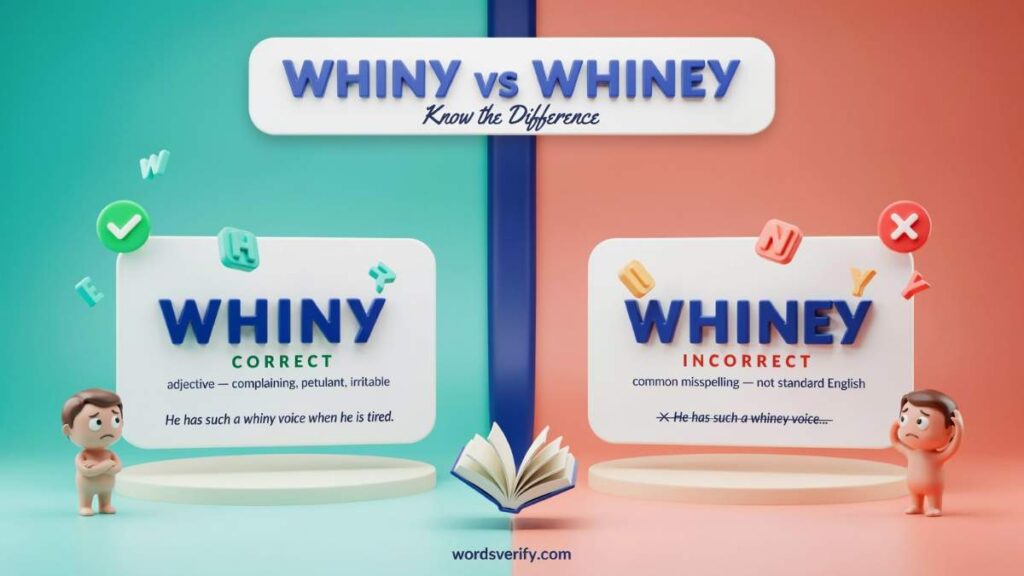
Have you ever stopped mid-sentence, wondering whether it’s whiny vs whiney? You’re not alone! English spelling has a knack for turning tiny details into big headaches. One extra letter can leave even confident writers second-guessing themselves. Think of a child complaining about bedtime: you know exactly what to call that behavior, but which spelling should you use? The difference between whiny vs whiney is simpler than it looks. With a clear explanation, practical examples, and an easy memory trick, you’ll learn which spelling is correct and how to use it confidently. Let’s clear up this common spelling confusion once and for all!
Whiny vs Whiney What’s the Difference?
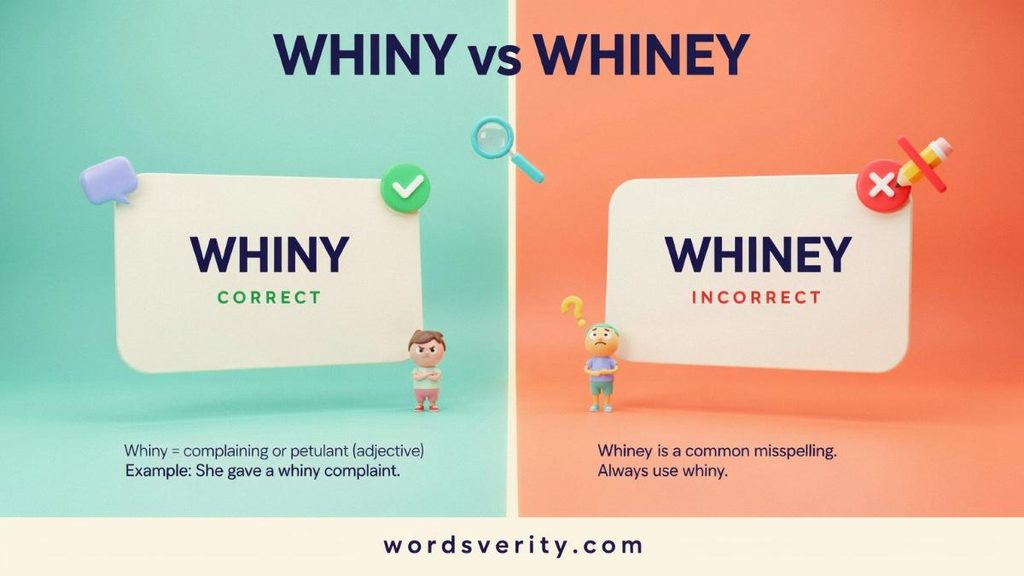
The main difference between whiny vs whiney is their spelling, not their meaning. Whiny is the standard form of the adjective derived from the verb whine. Whiney sometimes appears as an alternative spelling, but it isn’t the preferred choice in standard English.
| Word | Meaning | Usage |
|---|---|---|
| Whiny | Describes someone who complains or speaks in an irritating, drawn-out voice | Standard and recommended |
| Whiney | Usually intended to mean the same thing as whiny | Less common; best avoided in formal writing |
Examples:
- The child became whiny when he realized he couldn’t have another cookie.
- My dog makes a whiny sound whenever I leave the house.
- The coach told the players to stop complaining and focus on the game.
In each example, whiny describes a sound, attitude, or behavior associated with complaining.
You may encounter whiney in informal messages, online posts, or casual writing. Readers will usually understand what the writer means, but that doesn’t make it the best spelling to choose. When in doubt, use whiny.
Learn the difference between confusing more English words
Pricy vs Pricey which one is correct?
What Does Whiny Mean?
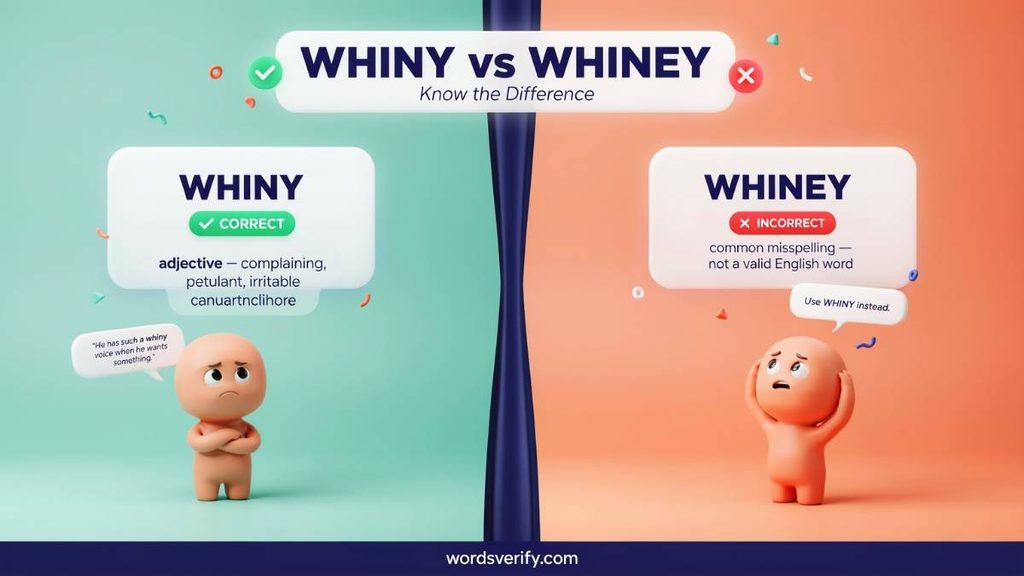
Whiny is an adjective that describes someone who complains frequently, often in a high-pitched, nasal, or drawn-out voice. It can also describe a sound that expresses dissatisfaction, discomfort, or unhappiness.
The word comes from whine, a verb meaning to complain in an annoying way or make a long, high-pitched sound.
For example, imagine a child who keeps saying, “But I don’t want to go!” after being told it’s time to leave the playground. If the child continues complaining in a drawn-out voice, you might describe the behavior as whiny.
However, the word isn’t limited to children. Adults can be whiny, too. A coworker who complains about every assignment or a friend who grumbles about every restaurant choice might also be described this way.
Examples of Whiny in Sentences
Here are some everyday examples that show how the word works.
- The whiny child refused to put on his shoes.
- Her whiny tone made it difficult to take the complaint seriously.
- Stop being whiny and tell me what’s actually bothering you.
- The puppy let out a whiny cry when its owner walked away.
- His whiny attitude frustrated the rest of the team.
- After a long day at school, the tired toddler became whiny.
- The character sounded whiny rather than genuinely upset.
- I don’t mind hearing complaints, but I can’t stand a whiny voice all afternoon.
Notice that whiny can describe a person, a tone of voice, or behavior. The word often carries a negative judgment, suggesting that someone is complaining too much or expressing dissatisfaction in an irritating way.
Still, context matters. A tired or frightened child may sound whiny because they’re overwhelmed, not because they’re deliberately trying to annoy anyone.
Learn the difference between confusing more English words
Fliers vs Flyers which one is correct?
What Does Whiney Mean?
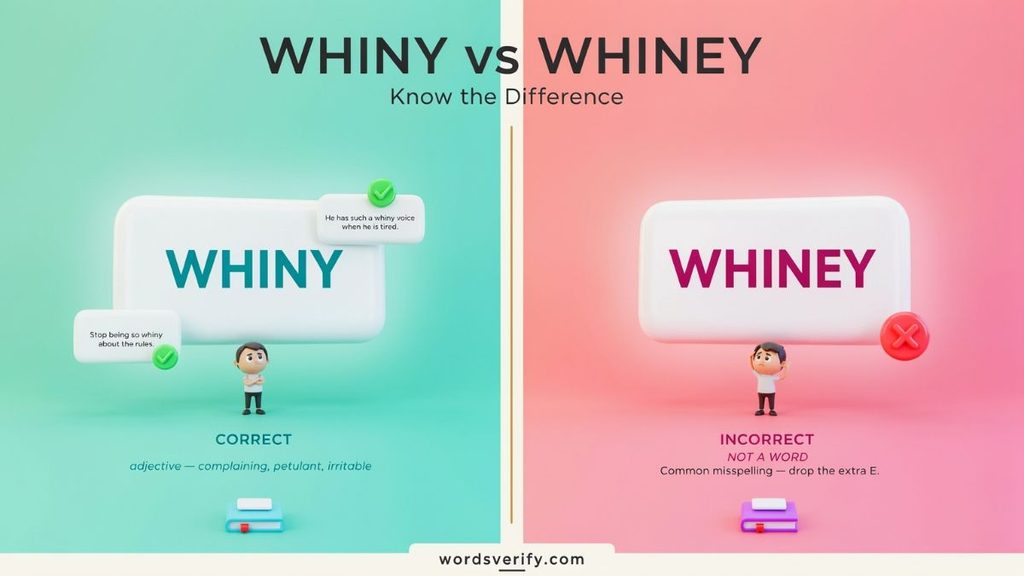
Whiney is an alternative spelling that people sometimes use when they intend to write whiny. The intended meaning is generally the same: complaining, sounding unhappy, or expressing dissatisfaction in a drawn-out voice.
The problem is that whiney isn’t the standard spelling most readers expect. Although people may use it informally, editors, teachers, and careful writers generally prefer whiny.
For example:
- Less preferred: The whiney child wanted to go home.
- Preferred: The whiny child wanted to go home.
Both sentences communicate the same idea, but the second follows standard spelling conventions.
Why Do People Write Whiney?
The confusion makes sense. English spelling doesn’t always follow a single, predictable pattern, and writers sometimes assume that adding -y to a word means keeping all its original letters.
Because whine ends in e, some people write whiney by adding y without removing the final e. However, the standard spelling of the adjective drops that silent e, giving us whiny.
You might see whiney in casual conversations, comments, or social media posts. That doesn’t necessarily mean the writer intended a different meaning. In most cases, it’s simply a spelling variation.
If you’re writing an essay, report, work email, or article, stick with whiny.
Learn the difference between confusing more English words
Mentioned vs Mentionned Which one Is Correct?
Why Is Whiny the Correct Spelling?
The easiest way to understand the spelling is to start with the base word: whine.
When we form the adjective, we drop the silent e and add y.
Whine − e + y = whiny
This pattern appears in several familiar English words. The final e often disappears when a suffix begins with a vowel or when a new form follows a related spelling rule.
Consider these examples:
| Base word | New word |
|---|---|
| Shine | Shiny |
| Smoke | Smoky |
| Ice | Icy |
| Spice | Spicy |
| Whine | Whiny |
The same basic idea helps explain why we write shiny rather than shiney and icy rather than icey in standard English.
These examples won’t cover every spelling rule in English, but they provide a useful pattern to remember.
An Easy Way to Remember Whiny
Think of the word shiny. You wouldn’t normally write shiney when describing a clean window or a polished pair of shoes. The same pattern applies to whiny.
Remember this simple connection:
- Shine becomes shiny.
- Whine becomes whiny.
Both words lose the silent e before adding y.
If you can remember shiny, you’ll have an easier time remembering whiny.
Learn the difference between confusing more English words
Journeys vs Journies Which one Is Correct?
How to Use Whiny in a Sentence
Whiny usually appears before a noun or after a linking verb such as is, seems, or sounds. Because it’s an adjective, it describes a person, sound, attitude, or behavior.
Whiny Before a Noun
When whiny comes before a noun, it describes that noun directly.
Examples:
- The whiny toddler wanted another bedtime story.
- I heard a whiny noise coming from the old machine.
- His whiny complaints made the meeting feel even longer.
- The teacher calmly addressed the whiny behavior.
- A whiny voice came from the back seat.
In these sentences, whiny adds information about the child, noise, complaints, behavior, or voice.
Whiny After a Linking Verb
You can also use whiny after verbs such as is, became, sounds, or seems.
Examples:
- The child is whiny because he didn’t sleep well.
- Her voice sounds whiny when she’s tired.
- The puppy became whiny after its owner left.
- His response seemed whiny rather than constructive.
- The complaint sounded whiny, even though the problem was real.
Here, whiny describes the subject rather than appearing directly before a noun.
When Whiny Describes a Sound
The word doesn’t always describe a person’s attitude. It can also refer to the quality of a sound.
Examples:
- The old fan made a whiny noise.
- A whiny squeal came from the brakes.
- The machine produced a whiny hum throughout the night.
In these cases, whiny suggests a thin, high-pitched, or irritating sound.
Learn the difference between confusing more English words
Developed vs Developped which one is correct?
Whiny vs Whining vs. Whined
These words come from the same verb, whine, but they serve different grammatical purposes. Understanding their forms makes it easier to choose the right one.
| Word | Part of speech or form | Example |
|---|---|---|
| Whiny | Adjective | The whiny child wanted attention. |
| Whining | Present participle or gerund | The child is whining about bedtime. |
| Whined | Simple past tense | He whined when the game ended. |
| Whine | Base verb | Please don’t whine about every decision. |
Whiny
Use whiny when you want to describe a person, sound, or behavior.
Example: His whiny voice made it hard to concentrate.
Whining
Use whining when describing the act of complaining. It often appears with forms of the verb be or as a noun-like expression.
Examples:
- The children are whining about the weather.
- I grew tired of all the whining during the trip.
- She kept whining because she didn’t get her way.
Whined
Use whined when talking about a complaint or sound that happened in the past.
Examples:
- The boy whined when his mother turned off the television.
- She whined about the long wait.
- The dog whined at the door until someone let it outside.
Whine
Whine is the base form of the verb. You can use it to describe an ongoing habit, a general action, or a request.
Examples:
- Please stop whining and explain what happened.
- Some people whine whenever they face a challenge.
- The puppy may whine during its first night in a new home.
The key is to match the form to the sentence. Whiny describes something, whining names or expresses the action, and whined refers to an action in the past.
Learn the difference between confusing more English words
Realist vs Realest which one is correct?
Whiny vs Whinny Are They the Same?
The Whiny and whinny look and sound similar, but they have different meanings.
Whiny describes complaining behavior or a high-pitched, irritating sound. Whinny is a verb or noun associated with the sound a horse makes.
| Word | Meaning | Example |
|---|---|---|
| Whiny | Complaining or sounding unhappy | The child had a whiny voice. |
| Whinny | A horse’s characteristic vocal sound | We heard the horse whinny in the stable. |
Examples of whiny:
- The whiny passenger complained about the traffic.
- His voice became whiny when he didn’t get his way.
Examples of whinny:
- The horse gave a loud whinny when it saw its owner.
- We heard the horses whinnying in the field.
- One horse let out a short whinny from the stable.
A useful memory trick is to connect whinny with horses. A horse may whinny, while a person who complains too much may sound whiny.
Although the words are easy to confuse, they aren’t interchangeable.
Synonyms for Whiny
Sometimes whiny is exactly the word you need. Other times, a more specific word can express your meaning more clearly.
The best synonym depends on whether you’re describing someone’s attitude, their voice, or the way they behave.
| Synonym | Meaning | Example |
|---|---|---|
| Complaining | Expressing dissatisfaction | He spent the morning complaining about the schedule. |
| Petulant | Irritably upset, often over a small matter | She gave a petulant response when asked to wait. |
| Cranky | Easily annoyed or bad-tempered | The baby became cranky after missing a nap. |
| Irritable | Easily bothered or annoyed | He felt irritable after a sleepless night. |
| Peevish | Easily irritated, often over minor things | Her peevish remarks upset the group. |
| Querulous | Frequently complaining in an unhappy tone | The querulous customer objected to every suggestion. |
| Fretful | Worried, restless, or uneasy | The fretful child struggled to settle down. |
| Grumbling | Complaining quietly or under one’s breath | He walked away grumbling about the rules. |
| Testy | Easily angered or impatient | She became testy after several interruptions. |
| Nagging | Repeatedly reminding or complaining | His nagging complaints wore everyone out. |
Each word has a slightly different meaning, so choosing carefully helps you avoid making your description sound harsher than intended.
For example, cranky may describe someone who’s tired or hungry. Petulant suggests childish irritation, while querulous emphasizes a habit of complaining. Whiny often combines a complaining attitude with an irritating tone of voice.
If you want a neutral description, you could say that someone is unhappy, dissatisfied, or frustrated instead. These words describe the person’s feelings without automatically criticizing how they express them.
Learn the difference between confusing more English words
Unphased vs Unfazed which one is correct?
Common Mistakes When Using Whiny vs Whiney
The difference is simple, but a few mistakes can still trip up writers.
Using Whiney in Formal Writing
Because whiney looks like a natural spelling, writers sometimes use it in essays, reports, or professional emails.
Example:
Incorrect or less preferred: The customer sounded whiney during the call.
Preferred: The customer sounded whiny during the call.
Use whiny when you want the standard spelling.
Assuming Whiny vs Whiney Have Different Meanings
Some writers assume that whiny vs whiney describes different types of complaining. In ordinary usage, however, whiney is generally intended to mean the same thing as whiny.
There’s no widely established distinction between whiny and whiney that requires you to use one spelling for a particular kind of complaint. Since whiny is the standard spelling, it’s the safest choice for clear, correct writing.
Confusing Whiny With Whining
Whiny and whining are related, but they don’t perform the same role in a sentence.
Example:
- Correct: The whiny child refused to leave.
- Correct: The child kept whining about leaving.
The first sentence describes the child. The second describes the child’s action.
Confusing Whiny With Whinny
Remember that whinny refers to a horse’s sound. If you’re describing a person who complains, whiny is the appropriate word.
Example:
- The whiny child complained about the ride.
- The horse gave a whinny when its rider approached.
The meanings are different even though the words look alike.
Relying Entirely on Spell-Check
Spell-check tools are helpful, but they don’t always explain why one spelling is preferable. A program may overlook an uncommon form or fail to distinguish a spelling variation from the standard choice.
When you’re uncertain, look at the word’s accepted spelling and how it functions in the sentence. For ordinary writing, whiny is the reliable option.
Using Whiny When You Mean Upset
Whiny often carries a negative tone. Calling someone whiny may suggest that their complaints are irritating or excessive.
However, a person can express a genuine concern without being whiny. If you want to describe the emotion rather than judge the behavior, consider words such as upset, worried, frustrated, or disappointed.
For example:
- Judgmental: He was whiny about the difficult assignment.
- More neutral: He was frustrated by the difficult assignment.
The second sentence explains the feeling without dismissing the person’s reaction.
Learn the difference between confusing more English words
Signer vs Signor which one is correct?
Is Whiny Used Differently in American and British English?
Whiny is the standard spelling in both American and British English. The spelling difference between the two regions doesn’t generally affect this word.
You may see whiney in informal writing on either side of the Atlantic, but it remains less common than whiny. There’s no need to choose whiney simply because you’re writing for a British audience.
For example:
- American English: The child became whiny after lunch.
- British English: The child became whiny after lunch.
Both sentences use the same spelling and meaning.
English does contain many regional spelling differences, such as color and colour or organize and organise. Whiny versus whiney isn’t a comparable standard American-versus-British distinction. In either variety, whiny is the safer spelling.
Learn the difference between confusing more English words
Macaroon vs Macaron which one is correct?
Practice Session Whiny vs Whiney
Complete the following sentences by filling in each blank with the appropriate word or form Whiny vs Whiney . These examples will help you practice the spelling, meaning, and usage of whiny, whiney, whine, whining, whined, and whinny.
Fill in the Blanks
1. The ______ child kept asking for another piece of candy.
2. The correct standard spelling is ______, not whiney.
3. Please stop ______ about the homework and start working on it.
4. The puppy let out a ______ cry when its owner left.
5. My little brother ______ when he was told to turn off the television.
6. The horse gave a loud ______ when it saw the other horses.
7. Her ______ tone made the simple request sound like a complaint.
8. Instead of complaining, try to explain why you’re upset without sounding ______.
9. The children were ______ about having to clean their rooms.
10. He tends to ______ whenever things don’t go his way.
11. The tired toddler became ______ after skipping his afternoon nap.
12. The horse began to ______ as the rider approached the stable.
13. His constant ______ annoyed everyone during the long trip.
14. The customer ______ about the delay for nearly twenty minutes.
15. A high-pitched, irritating sound can be described as ______.
16. The word ______ is used to describe the sound a horse makes.
17. Whine becomes ______ when the silent e is dropped and y is added.
18. The teacher asked the student to stop ______ and explain the problem calmly.
19. She sounded frustrated rather than ______ when discussing the unfair decision.
20. The child had a ______ voice because he was tired and disappointed.
21. The past-tense form of whine is ______.
22. If you want a more professional alternative to whiny, you could say “frequently expresses ______.”
23. The word ______ is an adjective that describes someone who complains frequently.
24. The baby kept ______ until her mother picked her up.
25. Remember that whiny describes complaining behavior, while ______ refers to a horse’s call.
Answers
- whiny
- whiny
- whining
- whiny
- whined
- whinny
- whiny
- whiny
- whining
- whine
- whiny
- whinny
- whining
- whined
- whiny
- whinny
- whiny
- whining
- whiny
- whiny
- whined
- dissatisfaction
- whiny
- whining
- whinny
Here’s a trusted source for clear word meanings:
FAQs
How do you spell a whiny baby?
The correct spelling is “whiny baby.” Whiny describes a baby who fusses, cries, or makes repeated sounds of discomfort or dissatisfaction.
What does whiney mean?
Whiney is a less common spelling of whiny. Both are generally used to describe someone who complains frequently or speaks in a drawn-out, unhappy tone. Whiny is the standard spelling and the better choice for everyday and formal writing.
Is whiney a valid Scrabble word?
Scrabble validity depends on the official word list used in your game. Check the relevant dictionary before playing whiney, as less common spelling variants may not be accepted. For standard English writing, use whiny.
When is a person considered whiny?
Someone may be described as whiny when they complain repeatedly, grumble about minor inconveniences, or use an irritating, unhappy tone. However, expressing genuine frustration or asking for help doesn’t automatically make a person whiny.
How do you spell the word for a baby who keeps complaining?
The correct spelling is “whiny.” For example, “The whiny baby finally settled down after a nap.” Remember the spelling pattern: whine becomes whiny by dropping the silent e and adding y.
What does “whiny kid” mean?
A “whiny kid” is a child who frequently complains, fusses, or speaks in a drawn-out, unhappy voice. The phrase can sound critical, so “upset child” or “frustrated child” may be more appropriate when you want to describe the child’s feelings gently.
What is another word for whiney?
whiny vs whiney, Useful alternatives include cranky, petulant, irritable, peevish, fretful, and complaining. The best choice depends on the situation. For example, cranky often suggests irritability, while petulant describes childish annoyance or impatience.
What’s a nicer word for whining?
Try “expressing frustration,” “voicing a concern,” or “showing disappointment.” These phrases communicate what someone is experiencing without making the person sound childish or unreasonable.
Why do adults whine so much?
Adults may complain repeatedly when they feel stressed, frustrated, ignored, tired, or powerless to change a situation. Frequent complaining can become frustrating for others, but it may also point to an unresolved problem or a need for support.
What’s a professional way to say “whiny”?
In professional communication, use phrases such as “frequently expresses dissatisfaction,” “appears frustrated,” or “raises repeated concerns.” These descriptions focus on observable behavior rather than labeling someone negatively.
Is whiny an adjective or a verb?
Whiny is an adjective that describes a person, sound, or behavior. Whine is the verb, whining describes the ongoing action, and whined is the simple past tense.
What is the difference between whiny and whinny?
Whiny describes someone who complains or sounds unhappy. Whinny refers to the characteristic sound a horse makes.
Examples:
- The whiny child complained about the long ride.
- The horse gave a loud whinny when its owner arrived.
Although the words look similar, their meanings are different.
Can you use whiny in formal writing?
Yes, but consider the context. Whiny can sound judgmental, particularly in professional reports or academic writing. If you want a more objective tone, use words such as “dissatisfied,” “frustrated,” or “expressing concerns” instead.
Learn the difference between confusing more English words
Withdraw vs Withdrawal which one is correct?
conclusion
So, is it whiny vs whiney? The answer is simple: whiny is the standard spelling, and it’s the best choice for clear, correct writing. Remember the easy trick: shine becomes shiny, and whine becomes whiny. Just drop the silent e and add y. No grammar headache required! Also, don’t confuse whiny with whinny, which describes the sound a horse makes. Although these words look similar, their meanings are quite different. With this simple spelling rule and a few examples in mind, you’ll avoid this common mistake with confidence. After all, English can be tricky enough without letting one little letter turn your sentence into a spelling rodeo!

Lisa AJS is an experienced blogger and language enthusiast at Words Verify, dedicated to making grammar simple, practical, and enjoyable. She writes engaging content on commonly confused words, grammar mistakes, word meanings, and everyday language challenges.