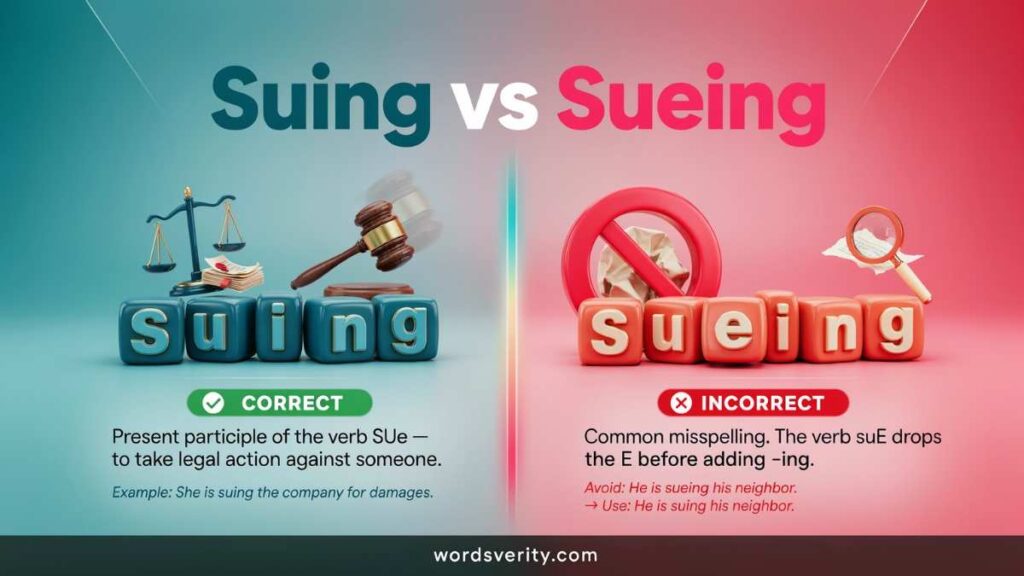
The difference between suing vs sueing may seem small, but one extra letter can turn a perfectly good sentence into a spelling blunder. So, which version is correct? If you’ve ever hesitated while writing about a legal dispute, you’re not alone. English spelling can be tricky, even when the rule seems simple. Here’s the verdict: “suing” is correct, while “sueing” is a common misspelling. The reason comes down to a basic rule about verbs ending in a silent e. Once you understand how this rule works, you’ll know which spelling to choose and keep your grammar out of trouble.
Suing vs Sueing quick answer
Suing is the correct spelling in standard English. Sueing is a misspelling, not an accepted alternative.
For example:
- Correct: She is suing the company for damages.
- Incorrect: She is sueing the company for damages.
The difference comes from a common spelling rule. When a verb ends in a silent e, you usually remove that letter before adding -ing. The verb sue follows this pattern, just like hope becomes hoping and write becomes writing.
You can use suing in everyday conversation, professional writing, news reports, and legal discussions. Its spelling stays the same in American and British English.
Suing vs Sueing Key Differences
The two spellings may look similar, but only one is correct.
| Feature | Suing | Sueing |
|---|---|---|
| Correct spelling | Yes | No |
| Meaning | Taking legal action against someone | No separate standard meaning |
| Grammar | Present participle or gerund of sue | Incorrectly formed word |
| Standard English usage | Accepted | Misspelled |
| Example | He is suing his former employer. | He is sueing his former employer. |
The key point is simple: suing follows the standard spelling rule, while sueing incorrectly keeps the final e.
If you’re writing an email, preparing a report, or discussing a legal dispute, always use suing.
Learn the difference between confusing more English words
Whiny vs Whiney difference and correct usage
What Does Suing Mean?
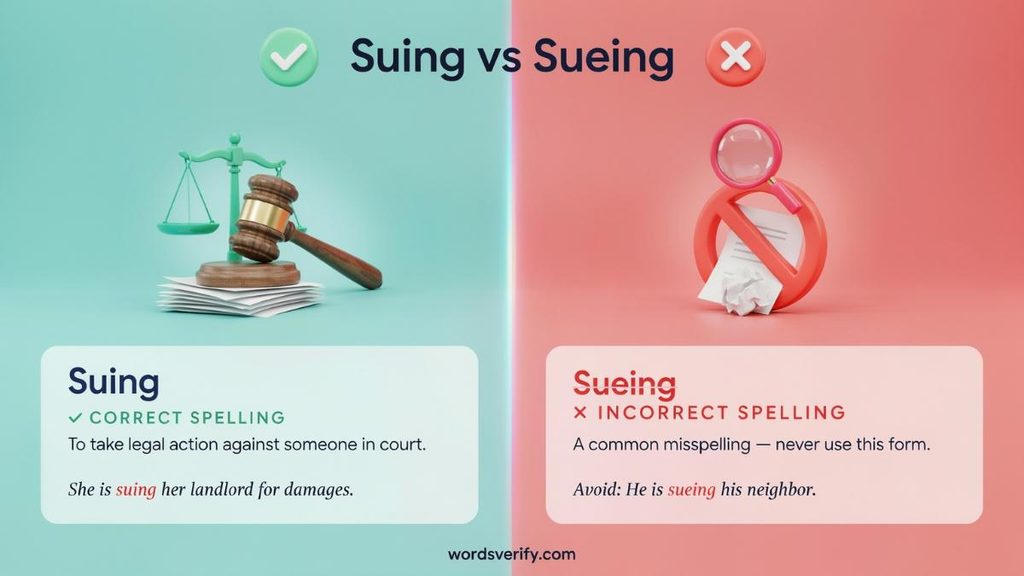
Suing means bringing a legal claim against another person or organization. It usually involves seeking a remedy through the court system.
For example, imagine that a contractor agrees to renovate a kitchen but leaves the work unfinished after receiving payment. If the homeowner takes legal action to seek compensation or another remedy, the homeowner may be suing the contractor.
People may sue over many types of disputes, including:
- Personal injuries caused by alleged negligence.
- Breaches of contracts or unpaid debts.
- Property damage.
- Employment disputes, including certain discrimination claims.
- Business disagreements involving financial losses.
The exact legal process depends on the circumstances and the laws that apply.
It’s also important to remember that suing someone doesn’t mean the person bringing the claim will win. A court may reject the claim, award damages, or grant another remedy. The parties may also settle the dispute before the case reaches trial.
What Does Suing Mean in Law?
In legal contexts, suing generally means bringing a civil claim against another party to seek a legal remedy. The person or organization bringing the claim is usually called the plaintiff, while the party responding to it is the defendant.
For example, a customer who believes a defective product caused an injury may file a lawsuit against the manufacturer. The customer would generally be the plaintiff, and the manufacturer would be the defendant.
A few legal terms help explain the process:
- Plaintiff: The person or organization bringing a civil claim.
- Defendant: The person or organization against whom the claim is brought.
- Claim: The legal basis for seeking a remedy.
- Damages: Money a court may award for a legally recognized loss.
- Lawsuit: The legal case brought before a court.
These terms are related, but they don’t mean the same thing. Suing describes the act of pursuing legal action, while a lawsuit is the case itself.
Does Suing Always Mean Going to Trial?
No. Many lawsuits settle before a trial begins.
A person may file a claim, exchange information with the other party, negotiate a settlement, or take other steps without ever appearing before a judge at trial. However, threatening to sue is different from actually filing a lawsuit.
Compare these sentences:
- She threatened to sue the landlord. This describes a possible future action.
- She is suing the landlord. This indicates that legal action is underway.
- She sued the landlord last year. This describes a past action.
Choosing the right verb form helps you explain what has happened without creating confusion.
Learn the difference between confusing more English words
Pricy vs Pricey which one is correct?
Why Is Suing Spelled Without an E?
The reason is a standard English spelling rule: You usually drop a verb’s final silent e before adding -ing.
The word formation is straightforward:
Sue + -ing = suing
The final e disappears, leaving the correct form, suing. Keeping it produces the misspelling sueing.
This rule applies to many familiar verbs. Learning a few examples can help you recognize the pattern whenever you write.
The Silent E Rule
Look at how these verbs change when you add -ing.
| Base verb | Correct form | Incorrect form |
|---|---|---|
| Sue | Suing | Sueing |
| Hope | Hoping | Hopeing |
| Make | Making | Makeing |
| Write | Writing | Writeing |
| Dance | Dancing | Danceing |
| Bake | Baking | Bakeing |
| Smile | Smiling | Smileing |
| Close | Closing | Closeing |
In each example, the verb ends in a silent e. You remove that letter before adding the suffix.
The same pattern appears in words such as saving, moving, taking, riding, and believing.
English spelling does have exceptions, so the rule doesn’t apply to every verb in exactly the same way. For example, dye becomes dyeing to distinguish it from dying, the form of die. That extra e helps preserve the distinction between two different words.
However, sue doesn’t require that exception. Its correct -ing form is always suing in standard English.
Why Do People Write Sueing?
The mistake in the spelling debate of suing vs sueing is understandable. When you look at the word “sue,” keeping every letter and adding “-ing” may seem logical. English doesn’t always make spelling changes obvious, so writers sometimes apply the wrong pattern and end up with the misspelling “sueing” instead of the correct form, “suing.”
The same mistake can happen with other words that end in a silent “e.” For example, people may write “hopeing” instead of “hoping” or “makeing” instead of “making.” In each case, the final silent “e” disappears before the suffix “-ing” is added.
To avoid this error, remember the base form and apply the spelling rule before adding the suffix. With “sue,” simply remove the final “e” to form “suing.” Once you recognize this pattern, choosing the correct spelling becomes much easier.
Learn the difference between confusing more English words
Fliers vs Flyers which one is correct?
Suing Grammar How to Use the Word Correctly
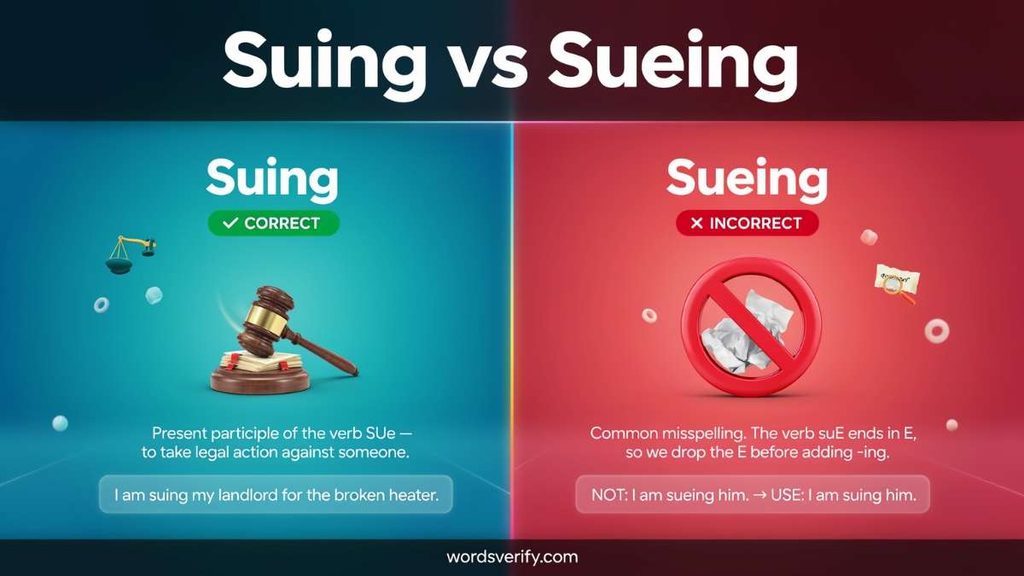
Understanding the difference between suing vs sueing starts with knowing how the correct spelling works in a sentence. “Suing” can serve two grammatical functions. It can act as a present participle in a verb phrase or as a gerund that functions as a noun. Understanding these roles helps you use “suing” naturally and avoid the common misspelling “sueing.”
Suing as a Present Participle
A present participle often appears with a form of be to describe an action in progress.
Examples include:
- She is suing the insurance company.
- The workers are suing their former employer.
- The family was suing the hospital when settlement talks began.
- The company will be suing its supplier if the dispute continues.
In these sentences, suing forms part of the verb phrase. The accompanying verb determines the tense.
For example, is suing describes an ongoing action in the present, while was suing places the action in the past. The spelling of suing doesn’t change.
Suing as a Gerund
A gerund is a verb form ending in -ing that functions as a noun.
Consider these examples:
- Suing can be expensive.
- She considered suing after negotiations failed.
- They discussed suing during the meeting.
- The company avoided suing because both parties reached an agreement.
In the first sentence, suing acts as the subject. In the others, it follows verbs such as considered, discussed, and avoided.
Although the word retains its connection to the verb sue, its grammatical role depends on how you use it in a sentence.
Sue, Sues, Sued and Suing
The verb sue has several forms. Each one fits a different grammatical structure.
| Verb form | Example |
|---|---|
| Sue | They plan to sue the contractor. |
| Sues | The company sues when negotiations fail. |
| Sued | She sued the manufacturer last year. |
| Sued | They have sued the landlord. |
| Suing | He is suing the insurance company. |
Use sue after modal verbs such as may, might, can, and will. Use sues with a singular third-person subject in the simple present. Sued is both the simple past form and the past participle. Suing appears in continuous verb phrases and gerund constructions.
For example, “She is suing the company” is correct, while “She is sue the company” is not. The verb form must match the sentence structure.
Learn the difference between confusing more English words
Journeys vs Journies Which one Is Correct?
Suing in a Sentence Examples and Usage
Examples can make the difference between suing vs sueing easier to understand. They show how to use the correct spelling in different situations, from everyday conversations to legal discussions. For instance, you might write, “The company is suing its former supplier over a contract dispute.” Seeing “suing” in a complete sentence helps you remember the correct form without having to repeat the spelling rule every time. With a few examples, you can recognize the pattern more easily and avoid the common mistake of writing “sueing.
Everyday Conversation
- My neighbor is suing the contractor over the unfinished driveway.
- She threatened to sue after the company refused to refund her money.
- They are considering suing because the damage was never repaired.
- He doesn’t want to sue, but he believes the company owes him compensation.
- Suing someone can take time, money, and patience.
These sentences use the word in ordinary conversations about disagreements and possible legal action.
Suing a Company
People may sue a company over alleged misconduct, defective products, unpaid wages, or contract disputes.
Examples include:
- She is suing the company for damages caused by the defective equipment.
- The former employee is suing the business over alleged workplace discrimination.
- Several customers are suing the manufacturer after reporting problems with its product.
- The supplier considered suing the retailer for breach of contract.
When describing a real legal dispute, be careful not to present allegations as proven facts. Words such as alleged and claimed help distinguish an accusation from an established finding.
Suing Someone for Damages or Compensation
People often sue to seek compensation for a loss or injury. Whether a court awards damages depends on the facts and applicable law.
Here are a few examples:
- The cyclist is suing the driver for damages after the collision.
- They are suing the contractor for the cost of repairing the house.
- The family filed a lawsuit seeking compensation for its losses.
- The business is suing its former partner over an alleged breach of contract.
Damages generally refers to money a court may award for a legally recognized loss. Compensation is a broader term for payment intended to address a loss or injury. The words overlap, but they aren’t interchangeable in every legal context.
Suing in Professional Writing
In formal writing, precision matters. The wording should reflect whether someone is considering legal action, has filed a claim, or is already involved in a lawsuit.
For example:
- The plaintiff is suing the defendant for breach of contract.
- The company is suing its former distributor over unpaid invoices.
- The civil case concerns allegations of negligence.
- The parties are negotiating a settlement while the lawsuit remains pending.
If no lawsuit has been filed, a phrase such as considering legal action may be more accurate than saying someone is suing. A small wording choice can change the meaning of a report.
Learn the difference between confusing more English words
Developed vs Developped which one is correct?
Suing vs Sewing What’s the Difference?
The Suing and sewing look similar, but their meanings have nothing to do with each other.
Suing means taking legal action. Sewing means joining pieces of fabric or other material with stitches, usually using a needle and thread or a sewing machine.
| Word | Meaning | Example |
|---|---|---|
| Suing | Bringing a legal claim | She is suing the company. |
| Sewing | Joining material with stitches | She is sewing a button onto her coat. |
Context makes the difference clear. A sentence about a lawsuit, a court, or damages calls for suing. A sentence about clothes, fabric, or stitches calls for sewing.
The two words also have different vowel sounds in standard American English. Suing begins with the long oo sound, while sewing begins with the vowel sound in go.
A simple way to remember the difference is to connect suing with a courtroom and sewing with a needle and thread.
Learn the difference between confusing more English words
Realist vs Realest which one is correct?
Suing Pronunciation Guide
In the spelling debate of suing vs sueing, pronunciation can help you recognize the correct word, even though it doesn’t determine the spelling. In standard American English, “suing” is commonly pronounced /ˈsuː.ɪŋ/. It has two syllables, with the stress on the first.
You can break it down like this:
- The first syllable sounds like the word “sue.”
- The second syllable ends with the same sound heard in “sing.”
Say both syllables slowly, then blend them into one smooth word. Avoid adding an extra syllable or changing the opening vowel sound.
The spelling remains “suing” in both American and British English. Regional accents may affect pronunciation slightly, but “sueing” is not the standard written form in either variety.
Learn the difference between confusing more English words
Mentioned vs Mentionned Which one Is Correct?
Common Mistakes When Writing Suing
Even familiar words can cause trouble when a spelling pattern looks unusual. These are the mistakes worth watching for.
Keeping the Final E
Incorrect: The family is sueing the hospital.
Correct: The family is suing the hospital.
The solution is to remove the silent e before adding -ing.
Assuming Every Verb Follows the Same Pattern
English spelling has exceptions. Although many verbs drop the final e before adding -ing, some retain it to preserve a distinction.
For example:
- Hope becomes hoping.
- Sue becomes suing.
- Die becomes dying.
- Dye becomes dyeing.
The last two examples show why it’s worth checking unfamiliar forms. Dying refers to the form of die, while dyeing refers to coloring something.
The general rule is useful, but established spelling conventions still matter.
Using the Wrong Verb Form
A word can be spelled correctly and still be used incorrectly in a sentence.
Incorrect: She is sue the company.
Correct: She is suing the company.
Incorrect: They have suing the contractor.
Correct: They have sued the contractor.
The first pair requires the present participle. The second requires the past participle. When proofreading, check both spelling and grammar.
Learn the difference between confusing more English words
Signer vs Signor which one is correct?
Suing in Real Life Situations
A few realistic examples can show how the word works in context.
A Contract Dispute
Imagine that a small business pays a supplier for equipment that never arrives. After several unsuccessful attempts to obtain a refund, the business considers taking legal action.
You might write:
“The business is considering suing the supplier for breach of contract.”
If the business later files a claim, the sentence could become:
“The business sued the supplier after settlement negotiations failed.”
The first sentence describes a possible future action. The second describes an action that took place in the past.
A Defective Product
Suppose a customer believes a household appliance caused property damage. The customer decides to seek compensation from the manufacturer.
A careful description would be:
“The customer is suing the manufacturer for damages allegedly caused by the defective appliance.”
The word allegedly matters because the claim may still be disputed. The sentence describes the legal action without assuming that the manufacturer is responsible.
When Suing Is Only a Possibility
Not every disagreement leads to a lawsuit. People may discuss the problem, seek legal advice, send a demand letter, or attempt mediation before deciding what to do.
For example:
“The tenant is considering suing the landlord if the dispute cannot be resolved.”
This sentence describes a possible future action, not a lawsuit that has already been filed. Using the right form keeps the timeline clear.
These examples illustrate ordinary language use, not legal advice. Legal rights, procedures, deadlines, and remedies depend on the circumstances and jurisdiction.
Tips to Remember the Correct Spelling
If you sometimes confuse suing vs sueing, a few simple habits can help.
- Start with the base verb: sue.
- Remember the rule: drop the final silent e before adding -ing.
- Compare the word with familiar examples such as hoping, making, and writing.
- Connect suing with legal action to distinguish it from sewing.
- Read the full sentence to check that the verb form fits the grammar.
- Consult a reliable dictionary when an unfamiliar spelling seems plausible.
Here’s an easy reminder: When you sue, drop the e before adding -ing.
Learn the difference between confusing more English words
Macaroon vs Macaron which one is correct?
Practice Session Suing vs Sueing
Fill in each blank with the correct word or form Suing vs Sueing. This practice session uses simple sentences to help you remember the correct spelling and understand how to use it naturally.
Fill in the blanks
1. The customer is thinking about ______ the company over the unpaid refund.
2. ______ is the correct spelling, not “sueing.”
3. She threatened to ______ her landlord over the property damage.
4. The family is ______ the hospital for negligence.
5. He ______ the business after several attempts to resolve the dispute.
6. They are considering ______ the manufacturer for selling a faulty product.
7. The lawyer explained the risks of ______ someone without enough evidence.
8. Maria decided to ______ her former employer over unpaid wages.
9. The company is being ______ by a former employee.
10. The customer considered ______ the seller after receiving a damaged item.
11. The past tense of “sue” is ______.
12. The final silent “e” is dropped when “sue” becomes ______.
13. The phrase “I am ______ you” describes an ongoing legal action.
14. The neighbors discussed ______ the contractor over the unfinished work.
15. Instead of writing “sueing,” you should write ______.
16. The athlete plans to ______ the company that used his image without permission.
17. The business was ______ for allegedly breaking its contract.
18. Before ______ someone, it is wise to understand the legal process.
19. The correct spelling is “suing,” with no extra ______ before “-ing.”
20. He said he would ______ if the company refused to honor the agreement.
21. The customer is ______ the airline over a disputed charge.
22. “Sue,” “sued,” and “______” are different forms of the same verb.
23. The attorney discussed the possible costs of ______ the company.
24. The employee threatened to sue, but later decided against ______.
25. Remember the silent-e rule when changing “sue” into ______.
Answers
- suing
- Suing
- sue
- suing
- sued
- suing
- suing
- sue
- sued
- suing
- sued
- suing
- suing
- suing
- suing
- sue
- sued
- suing
- e
- sue
- suing
- suing
- suing
- it
- suing
Here’s a trusted source for clear word meanings:
FAQs
Is “sueing” ever the correct spelling?
No. “Sueing” is a misspelling. The correct spelling is “suing,” formed by dropping the final silent “e” from “sue” before adding “-ing.”
Why does “sue” become “suing” instead of “sueing”?
English spelling rules generally require you to drop a silent final “e” before adding “-ing.” That’s why “sue” becomes “suing,” just as “write” becomes “writing.”
What is the difference between sue, sued, and suing?
“Sue” is the base form, “sued” is the past tense, and “suing” describes an ongoing legal action.
Examples:
- I may sue the company.
- She sued her former employer.
- They are suing the manufacturer.
Is “suing” a noun or a verb?
“Suing” is the present participle of the verb “sue.” It can also function as a gerund when it acts as a noun in a sentence.
Example: “Suing can be expensive.”
Does “suing” have a plural form?
No. “Suing” describes an action, so it doesn’t have a standard plural form. The related noun “lawsuit,” however, becomes “lawsuits” in the plural.
Is suing the same as filing a lawsuit?
The terms are closely related but emphasize different things. “Suing” means taking legal action against someone, while “filing a lawsuit” refers to formally submitting a legal claim to a court.
What is the difference between suing and being sued?
“Suing” means bringing a legal claim against someone. “Being sued” means facing a legal claim brought by another person or organization.
Example: “The customer is suing the company, and the company is being sued.”
Can you use “suing” in everyday conversation?
Yes. People commonly use “suing” when discussing legal disputes, potential claims, or threats of legal action.
Example: “The customer threatened to sue after the company refused to issue a refund.”
What is another word for suing?
Depending on the context, you can use phrases such as “taking legal action,” “bringing a lawsuit,” or “pursuing a legal claim.” Each expression has a slightly different emphasis, so choose the one that best fits your sentence.
How can you remember the correct spelling of “suing”?
Use this simple rule: drop the final silent “e” before adding “-ing.” Since “sue” becomes “suing,” writing “sueing” adds a letter that doesn’t belong. Remember the rule, and this spelling mistake won’t stand a chance in court!
Learn the difference between confusing more English words
Unphased vs Unfazed which one is correct?
conclusion
When it comes to suing vs sueing, the verdict is simple: “suing” is correct, while “sueing” is a common spelling mistake. Fortunately, remembering the difference doesn’t require a courtroom battle. Just follow the silent-e rule: drop the final “e” before adding “-ing.” The same rule applies to words like “writing” and “making.” Once you understand this pattern, you’ll find it easier to avoid similar mistakes and write with confidence. English spelling may have a few tricks up its sleeve, but this one is easy to master. Keep the rule in mind, and your grammar will stay out of trouble!

Lisa AJS is an experienced blogger and language enthusiast at Words Verify, dedicated to making grammar simple, practical, and enjoyable. She writes engaging content on commonly confused words, grammar mistakes, word meanings, and everyday language challenges.