One extra letter might seem harmless, but it can turn a perfectly good word into a spelling mistake! The confusion between chef vs cheff often leaves writers wondering whether a professional cook needs one “f” or two. Although both spellings may look convincing at first glance, only one is correct in standard English. Whether you’re writing about a restaurant professional, a talented home cook, or a famous culinary expert, getting the spelling right matters. Let’s clear up this common grammar confusion, explore the meaning and usage of each word, and learn a simple way to remember the correct spelling without burning your brain!
Cheff vs Chef Quick Answer
Chef is the correct spelling in standard English. Cheff is an incorrect spelling when referring to a professional cook or someone who manages a kitchen.
The word comes from French and retains its original spelling with one F. Adding another F doesn’t change its meaning or create an accepted alternative.
Consider these examples:
- Correct: My brother works as a chef at a popular restaurant.
- Incorrect: My brother works as a cheff at a popular restaurant.
The first sentence uses the accepted spelling. The second contains an unnecessary extra letter.
If you ever wonder how to spell a professional cook’s job title, remember this simple rule: chef has four letters and only one F.
Chef vs Cheff Quick Comparison
Although these two spellings chef vs cheff look almost identical, they don’t have the same status in English.
| Feature | Chef | Cheff |
|---|---|---|
| Spelling | Correct | Incorrect |
| Meaning | A professional cook or kitchen leader | No standard culinary meaning |
| Part of speech | Noun | Not a standard English noun |
| Dictionary recognition | Established English word | Not an accepted spelling of chef |
| Pronunciation | /ʃɛf/ | Usually intended to sound the same |
| Origin | French | Misspelling of chef |
| Professional usage | Accepted | Incorrect |
| Plural | Chefs | Cheffs is incorrect for this meaning |
The difference isn’t about cooking skills, experience, or professional responsibilities. It’s simply a matter of spelling.
For example, a restaurant might advertise a vacancy for an executive chef. Writing executive cheff in the same advertisement would be a spelling mistake.
Learn how to use confusing more words correctly
Shakey vs Shaky which one is correct?
What Does Chef Mean?
A chef is a skilled cook, particularly someone who prepares food professionally. Chefs commonly work in restaurants, hotels, resorts, catering companies, and private households.
However, their responsibilities often extend beyond preparing meals.
A professional chef may develop recipes, plan menus, select ingredients, supervise kitchen staff, maintain hygiene standards, and ensure consistent food quality. In larger establishments, chefs may manage entire kitchen departments or oversee daily operations.
The word also appears in several professional titles. An executive chef usually manages the overall kitchen, while a pastry chef specializes in desserts and baked goods.
Chef as a Professional Title
Not every person who cooks professionally has the same responsibilities. Commercial kitchens often use different titles to describe experience, authority, and areas of specialization.
Here are some common examples:
1. Executive chef: Usually the senior culinary professional responsible for menu development, kitchen management, staffing, food quality, and budgets.
2. Head chef: Oversees daily kitchen operations and supervises the kitchen team. In some restaurants, this position has responsibilities similar to those of an executive chef.
3. Sous chef: Works directly under the head or executive chef. This professional helps supervise staff, organize food preparation, and maintain kitchen standards.
4. Pastry chef: Specializes in desserts, pastries, cakes, breads, and other baked products.
5. Private chef: Prepares meals for an individual, family, or private client. The job may include planning menus, shopping for ingredients, and preparing meals according to personal preferences.
6. Chef de cuisine: A French culinary title generally used for the person in charge of a restaurant kitchen.
These titles show that a chef’s work involves much more than knowing how to cook. Many chefs also need leadership, organization, creativity, and problem-solving skills.
Example Sentences Using Chef
Here are some natural examples showing how to use chef in everyday and professional writing:
- The chef prepared a delicious three-course dinner for the guests.
- Maria hopes to become a professional chef after graduating from culinary school.
- Our restaurant hired an experienced head chef last month.
- The executive chef introduced several new dishes to the menu.
- A pastry chef prepared the wedding cake and other desserts.
- The chef carefully selected fresh vegetables from the local market.
- My uncle has worked as a private chef for several years.
- The sous chef organized the kitchen staff before dinner service.
- Every chef in the restaurant follows strict food safety procedures.
- The celebrity chef shared a new recipe during the television show.
In each sentence, chef functions as a noun. It identifies a person rather than an activity, tool, or cooking method.
Learn how to use confusing more words correctly
Natzi vs Nazi which one is correct?
What Does Cheff Mean?
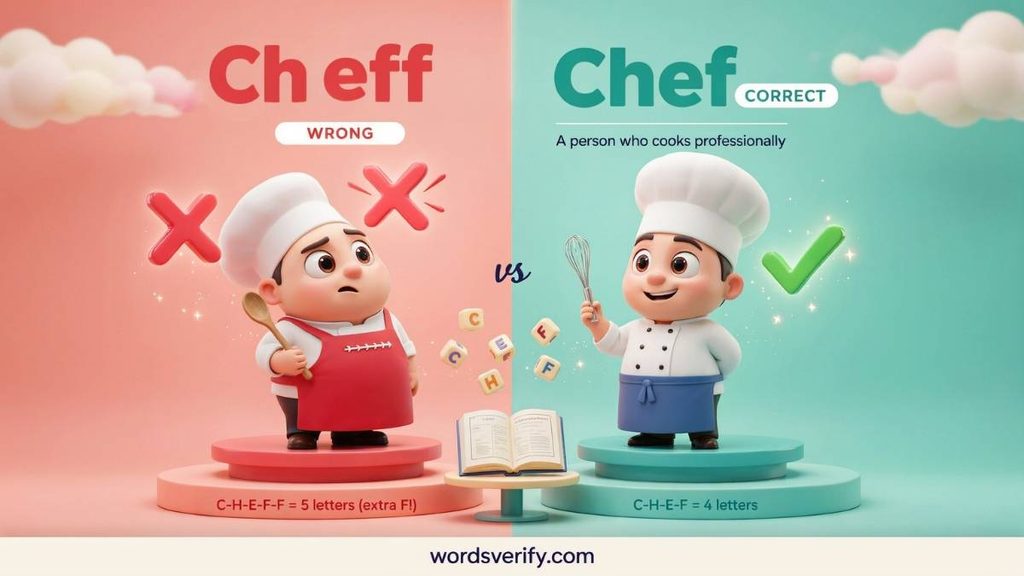
You may encounter cheff in online searches, social media posts, usernames, or informal messages. However, it isn’t the standard English spelling of the culinary profession.
In ordinary writing, cheff is simply a misspelling of chef. Adding another F doesn’t give the word a new definition or identify a different type of cook.
For example, someone might write:
- The cheff prepared our dinner.
- We need to hire a new cheff.
- My friend is training to become a cheff.
All three sentences contain the same spelling mistake. The correct word is chef.
There are a few situations in which the spelling Cheff might appear intentionally. It could be someone’s surname, a username, a fictional character’s name, or a business name. However, a chosen name or brand spelling doesn’t make it an accepted alternative to chef in standard English.
Is Cheff a Real Word?
The answer depends on what you mean by a real word.
As a standard English spelling for a professional cook, cheff isn’t accepted. Major English dictionaries recognize chef as the conventional spelling of this occupation.
However, the letter sequence may appear as a proper name or creative spelling. That doesn’t make it an appropriate substitute for chef in ordinary sentences.
If you’re asking whether cheff is an English word with the same meaning as chef, the answer is no.
Incorrect Examples Using Cheff
Comparing incorrect sentences with their corrected versions makes the spelling rule easier to understand.
| Incorrect sentence | Correct sentence |
|---|---|
| The cheff made fresh pasta. | The chef made fresh pasta. |
| She wants to become a cheff. | She wants to become a chef. |
| Our cheff prepared the wedding meal. | Our chef prepared the wedding meal. |
| The restaurant hired two cheffs. | The restaurant hired two chefs. |
| He works as a pastry cheff. | He works as a pastry chef. |
| The cheff created a new menu. | The chef created a new menu. |
The correction is the same every time: remove the extra F.
Learn how to use confusing more words correctly
Enrol vs Enroll which one is correct?
Why Is Chef the Correct Spelling?
The correct spelling of chef comes from its French origin. English borrowed the word from French and retained its original spelling rather than changing it to match a guessed pronunciation.
The French word chef historically referred to a head, leader, or person in charge. Over time, it became closely associated with someone responsible for directing a professional kitchen.
This history explains why the word contains one F. Its spelling isn’t based on an English rule that requires doubling the final consonant. English simply adopted the established French form.
Why Is Chef Spelled With One F?
Several factors explain why chef keeps a single F.
1. French spelling: The original French word is chef. English adopted that spelling.
2. Established usage: English dictionaries, restaurant terminology, culinary schools, and professional organizations consistently use chef.
3. No alternative spelling rule: Adding another F doesn’t create a recognized English variation. The correct form remains unchanged.
4. Consistent grammatical forms: The word becomes chefs in the plural, not cheffs. Its possessive forms also retain the original spelling.
For example:
- One chef prepared the meal.
- Three chefs prepared the meal.
- The chef’s recipe became popular.
- The chefs’ recommendations improved the menu.
The spelling stays consistent even when the grammatical form changes.
Why Do People Spell Chef as Cheff?
A spelling mistake doesn’t always happen because someone doesn’t know the correct form. Sometimes the sound of a word encourages an incorrect guess.
Here are some common reasons people write cheff:
1. Sound-based spelling: People sometimes add an extra consonant when guessing how an unfamiliar word should look.
2. Typing mistakes: Someone may accidentally press F twice while typing quickly.
3. Unfamiliar French spelling: English speakers may not realize that chef comes from French and retains its original spelling.
4. Repeated online errors: When people see a misspelling several times, it can begin to look familiar and correct.
5. Spell-check limitations: Some tools don’t catch every mistake, particularly when a misspelled form resembles a name or another recognized term.
The best solution is to remember the established spelling rather than rely entirely on how a word sounds.
Learn how to use confusing more words correctly
Suing vs Sueing which one is correct?
Chef Pronunciation Guide
Spelling and pronunciation don’t always follow the same patterns. Chef is a good example because its opening letters produce a sound that may surprise people who haven’t encountered the word before.
The standard English pronunciation is “shef.”
It has one syllable and ends with the F sound. The opening letters produce the same sound you hear at the beginning of ship or shoes.
How to Pronounce Chef in American English
In American English, chef is pronounced /ʃɛf/.
The IPA transcription helps explain each sound:
- /ʃ/: The opening sound in ship, shoe, and she.
- /ɛ/: The short vowel sound in bed and red.
- /f/: The final sound in fish and coffee.
Put these sounds together and you get one syllable.
American English pronunciation: /ʃɛf/
The pronunciation becomes straightforward once you recognize the opening SH sound. You don’t pronounce the C separately or give the word a long E sound.
Chef Pronunciation in British English
British English also generally uses /ʃɛf/ for chef.
The word doesn’t have a different standard spelling in Britain. American and British speakers may have minor differences in vowel quality because of their accents, but the basic pronunciation remains the same.
For example:
- American English: chef
- British English: chef
- Canadian English: chef
- Australian English: chef
Regional accents don’t change the spelling or introduce a second F.
Chef Pronunciation in French
The French pronunciation has a slightly different vowel quality from the typical English pronunciation.
In French, chef is generally pronounced /ʃɛf/. The opening sound resembles the English SH sound, while the vowel is a French open-mid front vowel.
The word is also used in French for a chief, leader, or person in charge. Its culinary meaning developed from that broader sense of leadership.
English speakers generally pronounce the word according to the sounds of their own language, even though the spelling comes from French.
Is Chef Pronounced Shef or Cheef?
This is one of the most common pronunciation questions.
The correct answer is shef, not cheef.
The confusion often comes from the similar appearance of chef vs cheff. Both begin with C and end with an F sound, but their vowels and meanings differ.
| Word | Pronunciation | Meaning |
|---|---|---|
| Chef | /ʃɛf/ | A professional cook or kitchen leader |
| Chief | /tʃiːf/ | A leader or person in charge |
Notice the two important differences:
- Chef begins with an SH sound.
- Chief begins with a CH sound and has a long E vowel.
For example:
- The chef prepared a special dinner.
- The chief approved the new plan.
Although these words look similar, they aren’t interchangeable.
Learn how to use confusing more words correctly
Whiny vs Whiney difference and correct usage
Chef Word Origin and Etymology
The word chef has French roots and entered English through the French language.
Its original meaning is connected to leadership and authority rather than cooking alone. The French word chef can refer to a head, chief, or person in charge.
This history helps explain why the term became associated with the person leading a professional kitchen.
French Origins of Chef
The French word chef developed from the Old French word chief, which traces back to the Latin word caput, meaning “head.”
The same Latin root appears in several English words connected to the head or leadership, including capital and chapter.
In French, chef came to describe someone who leads or directs a group. Its culinary meaning developed from the idea of a person who heads a kitchen.
This is why the term carries a sense of professional responsibility. A chef may prepare food, but the position can also involve managing people, organizing work, and maintaining standards.
How Chef Developed Its Modern Meaning
Professional kitchens became more organized as restaurants and large food-service establishments developed.
Kitchen workers increasingly took on specialized responsibilities. Some prepared sauces, others handled desserts, and senior staff supervised different sections.
The word chef became an established title for skilled culinary professionals, particularly those who directed kitchen work.
Today, the word appears in several professional titles:
- Executive chef
- Head chef
- Sous chef
- Pastry chef
- Private chef
- Chef de cuisine
Although these roles have different responsibilities, they all share the same spelling.
Learn how to use confusing more words correctly
Pricy vs Pricey which one is correct?
Grammar Rules for Using Chef
Knowing the correct spelling is only half the job. You also need to understand how to use chef in a sentence.
The word is a countable noun. You can refer to one chef, two chefs, or several chefs.
It can appear as the subject, object, or possessive noun in a sentence.
Part of Speech
Chef functions as a noun because it names a person or occupation.
Examples:
- The chef works at a five-star hotel.
- We interviewed a talented chef.
- The chef prepared the dessert.
- Several chefs attended the culinary competition.
In each sentence, chef identifies a person.
It isn’t normally used as a verb or adjective in standard English. Instead, related expressions such as cooking and culinary describe activities or characteristics associated with the profession.
Singular and Plural Forms
The singular form is chef. The plural form is chefs.
You simply add S to the singular noun. You don’t add another F or use ES.
| Form | Correct spelling | Example |
|---|---|---|
| Singular | Chef | The chef is preparing lunch. |
| Plural | Chefs | The chefs are preparing lunch. |
| Incorrect plural | Cheffs | The cheffs are preparing lunch. |
| Incorrect plural | Chefes | The chefes are preparing lunch. |
Remember that the final F doesn’t double when you make the word plural.
Other familiar words follow different plural patterns. For example, knife becomes knives, while chef becomes chefs. English plural rules vary from word to word, so it’s best to learn the established form of each noun.
Possessive Form
A possessive noun shows ownership or association.
For chef, the singular possessive takes an apostrophe followed by S. The plural possessive places the apostrophe after the final S.
Singular possessive: Chef’s
- The chef’s knife is on the counter.
- I enjoyed the chef’s special recipe.
- The chef’s experience helped the restaurant succeed.
Plural possessive: Chefs’
- The chefs’ meeting starts at noon.
- The chefs’ uniforms arrived yesterday.
- The chefs’ recommendations improved the menu.
The difference is small but important. Chef’s refers to one chef, while chefs’ refers to more than one.
Common Phrases and Word Combinations
The word chef appears in many culinary expressions. Learning these combinations can help you use it naturally.
| Expression | Meaning |
|---|---|
| Head chef | The person leading a kitchen or kitchen team |
| Executive chef | A senior culinary professional responsible for kitchen management |
| Sous chef | A chef who assists the head or executive chef |
| Pastry chef | A specialist in desserts and baked goods |
| Private chef | A chef who prepares food for a private client |
| Celebrity chef | A chef who has gained public recognition |
| Chef’s special | A dish selected or recommended by the chef |
| Chef’s knife | A versatile kitchen knife used for chopping and slicing |
| Chef de cuisine | A French culinary title for a kitchen leader |
These expressions always use chef with one F.
Learn how to use confusing more words correctly
Fliers vs Flyers which one is correct?
Chef vs Cook vs. Cooker What’s the Difference?
The words chef, cook, and cooker are closely connected to food preparation, but they don’t mean the same thing. Understanding the difference is also useful when discussing chef vs cheff, since the correct spelling refers to a professional cook.
People sometimes use chef and cook interchangeably in everyday conversation. However, the terms can describe different levels of responsibility, professional experience, and kitchen work. A chef often has specialized culinary skills and may manage kitchen operations, while a cook generally prepares food. Cooker is different because it usually refers to an appliance rather than a person.
Understanding these distinctions will help you choose the right word and avoid confusing a kitchen professional with a cooking appliance.
What Does Chef Mean?
A chef is generally a skilled or professionally trained cook who works in the food industry. Depending on the position, a chef may prepare food, create recipes, supervise kitchen staff, plan menus, and manage food preparation.
For example:
The executive chef designed a new seasonal menu for the restaurant.
What Does Cook Mean?
A cook is someone who prepares food. The term covers both professional and nonprofessional cooking.
You can describe someone who prepares dinner at home as a cook. You can also use it for someone employed in a restaurant kitchen.
For example:
My father is an excellent cook who enjoys preparing traditional meals.
A cook may have extensive culinary experience without holding a formal chef position.
What Does Cooker Mean?
A cooker is a device or appliance used to prepare food.
Common examples include:
- Rice cooker
- Pressure cooker
- Slow cooker
- Electric cooker
- Induction cooker
For example:
She used a rice cooker to prepare dinner.
A cooker isn’t a person who prepares meals. Confusing it with chef or cook can completely change the meaning of a sentence.
Chef vs Cook vs. Cooker Comparison Table
| Word | Meaning | Example |
|---|---|---|
| Chef | A professional culinary worker, often with specialized skills or management duties | The chef prepared dinner. |
| Cook | A person who prepares food professionally or at home | My mother is a wonderful cook. |
| Cooker | An appliance used to prepare food | The cooker stopped working. |
The simplest distinction is this: a chef is a professional culinary worker, a cook is someone who prepares food, and a cooker is a machine.
Learn how to use confusing more words correctly
Mentioned vs Mentionned Which one Is Correct?
Chef in Everyday and Professional Writing
The word chef appears in conversations, restaurant advertisements, job applications, culinary publications, and professional documents.
Its spelling doesn’t change according to the setting. Whether you’re writing a casual message or a formal employment document, chef remains the correct form.
Everyday Conversations
In everyday conversation, chef usually refers to someone who prepares food professionally.
Examples:
- The chef at that restaurant makes excellent pasta.
- My cousin wants to become a chef.
- We met the chef after dinner.
- The hotel chef prepared a special breakfast.
You don’t need complicated language to use the word correctly. Just remember its standard spelling.
Professional Communication
Restaurants and hotels use chef in job advertisements, staff descriptions, employment documents, and business communication.
For example:
We are looking for an experienced sous chef to join our restaurant team.
Writing sous cheff in a professional advertisement would look careless and could affect the credibility of the business.
When using chef as part of a person’s formal title, capitalization depends on its position in the sentence and the organization’s style.
Examples:
- Chef Daniel prepared the main course.
- Daniel works as a chef at a luxury hotel.
The first example uses Chef as a title before a person’s name. The second uses it as a common occupational noun.
Academic and Formal Writing
Students studying culinary arts, hospitality management, and food science may encounter the word chef in essays, reports, and research assignments.
Correct spelling matters in these settings because formal writing follows standard language conventions.
For example:
Professional chefs must understand food safety, ingredient selection, and kitchen management.
Using cheff instead would introduce an avoidable spelling error.
Online Content and Social Media
Food bloggers, restaurant owners, recipe creators, and cooking professionals frequently use chef in online content.
You might see it in:
- Restaurant biographies
- Cooking tutorials
- Food reviews
- Recipe descriptions
- Professional profiles
- Social media captions
- Culinary business advertisements
Search engines may still display results containing misspellings because people often type incorrect versions of familiar words. However, seeing a spelling online doesn’t automatically make it correct.
If you’re publishing content about cooking, use chef consistently.
Learn how to use confusing more words correctly
Developed vs Developped which one is correct?
Common Spelling Mistakes Related to Chef
Even familiar words can cause trouble when their spelling doesn’t match what people expect. The word chef is particularly interesting because its French origin gives it an unusual opening sound for English readers. This can make the spelling seem less familiar, especially when comparing chef vs cheff. However, the correct form is simple to remember: chef has just one F. Understanding its pronunciation, meaning, and French roots can help you recognize the correct spelling and avoid adding an unnecessary letter.
Here are some mistakes worth avoiding.
Adding an Extra F
The most obvious mistake is writing cheff instead of chef.
This usually happens when someone guesses the spelling rather than remembering the established form.
Incorrect: The cheff prepared a delicious meal.
Correct: The chef prepared a delicious meal.
There’s no need to double the final consonant.
Confusing Pronunciation With Spelling
English contains plenty of words whose pronunciation doesn’t clearly reveal their spelling.
Chef is one of them. Its opening SH sound may encourage people to guess incorrectly when writing it.
However, the standard spelling remains chef.
A useful approach is to connect the word with familiar phrases such as head chef or pastry chef. Repeated exposure to the correct form makes it easier to remember.
Confusing Chef With Chief
Chef and chief look similar, but they have different meanings and pronunciations.
| Word | Meaning | Example |
|---|---|---|
| Chef | A professional cook or kitchen leader | The chef prepared the meal. |
| Chief | A leader or person holding a senior position | The chief addressed the team. |
The word chief has a long E sound and begins with a CH sound. Chef begins with SH and has a short E sound.
Incorrect Pluralization
Another common mistake involves adding an unnecessary letter when referring to multiple chefs.
Correct: The chefs attended a cooking competition.
Incorrect: The cheffs attended a cooking competition.
The same rule applies to possessive forms. Use chef’s for one chef vs cheff’ for multiple chefs.
Ignoring Spell-Check Warnings
Spell-checking tools can help identify common mistakes, but they shouldn’t replace proofreading.
Some tools may overlook an error when a misspelled form resembles a proper name or appears in a specialized context.
For important documents, check unfamiliar words against a reliable dictionary. This simple habit can prevent embarrassing mistakes in resumes, advertisements, and professional writing.
How to Remember the Correct Spelling of Chef
Remembering the correct spelling doesn’t require a complicated trick. A few simple associations can help you understand chef vs cheff and avoid this common spelling mistake.
1. Remember the French spelling: The word comes from French, where it is written as chef with one F.
2. Think of a head chef: This familiar professional title reinforces the correct spelling.
3. Memorize the plural: The plural form is chefs, not cheffs. Learning both forms helps prevent mistakes.
4. Connect spelling with pronunciation: Chef sounds like “shef,” even though it begins with the letters C and H.
5. Practice with a sentence: Write “The chef prepared dinner” a few times. Repeated practice helps reinforce the correct spelling.
A particularly useful memory trick is to picture a restaurant sign that reads “Head Chef Wanted.” Whenever you recall that phrase, you reinforce the single-F spelling. The next time you wonder about chef vs cheff, remember that a great chef needs just one F!
Is Chef Spelled Differently in American and British English?
Some English words have different spellings in different countries. For example, American English uses color, while British English generally uses colour.
However, chef doesn’t follow that pattern.
The correct spelling is the same in American, British, Canadian, and Australian English.
| English variety | Correct spelling | General pronunciation |
|---|---|---|
| American English | Chef | /ʃɛf/ |
| British English | Chef | /ʃɛf/ |
| Canadian English | Chef | /ʃɛf/ |
| Australian English | Chef | /ʃɛf/ |
Minor pronunciation differences may occur because of regional accents. Nevertheless, none of these varieties accepts cheff as the standard spelling of the culinary occupation.
American English
American English uses chef in restaurant menus, job descriptions, culinary education, and everyday conversation.
For example:
The restaurant is searching for an experienced executive chef.
British English
British English follows the same spelling convention.
A British restaurant would advertise a position for a head chef, not a head cheff.
Canadian and Australian English
Canadian and Australian English also use chef with one F.
The word doesn’t change its spelling when you cross national borders. Its French origin and established English usage remain consistent.
Cheff vs Chef Correct Usage in Different Contexts
The correct spelling chef vs cheff becomes easier to remember when you see how it works in real situations.
Consider the following examples:
| Situation | Correct usage | Incorrect usage |
|---|---|---|
| Job advertisement | Experienced chef wanted | Experienced cheff wanted |
| Restaurant menu | Chef’s special | Cheff’s special |
| Professional introduction | I am a trained chef. | I am a trained cheff. |
| Culinary school | She wants to become a chef. | She wants to become a cheff. |
| Food blog | The chef shared a new recipe. | The cheff shared a new recipe. |
| Restaurant review | The chef prepared an excellent meal. | The cheff prepared an excellent meal. |
| Social media caption | A delicious meal prepared by our chef! | A delicious meal prepared by our cheff! |
The setting doesn’t change the spelling rule. Use chef whenever you’re referring to the culinary professional.
Practice Session Chef vs Cheff
Complete each sentence by filling in the blank with the correct word. Use the words chef vs cheff, chief, or chefs where appropriate.
1. My brother wants to become a professional __________.
2. The restaurant hired a talented __________ to prepare its special menu.
3. The correct spelling is __________, not cheff.
4. Several experienced __________ work in this hotel.
5. The head __________ prepared a delicious meal for the guests.
6. A person who prepares food professionally is called a __________.
7. The restaurant’s executive __________ introduced a new menu.
8. The word __________ refers to a leader or person in charge.
9. The plural form of chef is __________.
10. The female kitchen professional is also called a __________.
11. The spelling __________ is incorrect when referring to a professional cook.
12. The French word chef originally referred to a head or __________.
13. The restaurant hired three new __________ last month.
14. The kitchen staff replied, “Yes, __________!” to their supervisor.
15. The team __________ welcomed everyone to the meeting.
16. The restaurant’s head __________ has years of cooking experience.
17. The singular possessive form of chef is __________.
18. The plural possessive form of chefs is __________.
19. A kitchen appliance used for cooking food is called a __________.
20. The __________ of the department organized the meeting.
21. My favorite __________ specializes in Italian cuisine.
22. The restaurant needs more skilled __________ for its busy kitchen.
23. Remember that the word chef contains only one __________.
24. The word chef can describe both men and __________.
25. Always use __________ instead of cheff when writing about a professional cook.
Answers
- Chef
- Chef
- Chef
- Chefs
- Chef
- Chef
- Chef
- Chief
- Chefs
- Chef
- Cheff
- Leader
- Chefs
- Chef
- Chief
- Chef
- Chef’s
- Chefs’
- Cooker
- Chief
- Chef
- Chefs
- F
- Women
- Chef
Here’s a trusted source for clear word meanings:
FAQs
What does cheffe mean?
“Cheffe” is a feminine form of the French word “chef” used in some French-speaking contexts. In English, however, “chef” is the standard term for people of all genders.
Who is called a chef?
A chef is a person who prepares food professionally, usually in a restaurant, hotel, catering business, or another food service setting. Chefs may also create menus, develop recipes, and manage kitchen teams.
How do you spell chef vs cheff?
Both “chef” and “chief” are correct words, but they have different meanings. A chef prepares food professionally, while a chief is a leader or person in charge.
Is chef spelled with one f or two?
Chef is spelled with one “f.” The spelling “cheff” is incorrect when referring to a professional cook.
What does “cheft” mean?
“Cheft” isn’t a standard English word. It’s usually a typing error or misspelling of “chef.”
What is a fancy name for a chef?
Some professional titles for chefs include executive chef, head chef, master chef, and culinary director. Each title reflects a particular level of responsibility, experience, or position in a kitchen.
What is a nickname for a chef?
Informal nicknames for a chef include kitchen wizard, culinary artist, kitchen maestro, and food magician. These playful expressions describe cooking skills rather than official job titles.
Why do chefs call everyone chef?
In professional kitchens, calling someone “chef” can show respect and encourage teamwork. Staff members may use it to acknowledge one another’s skills or recognize their role in the kitchen.
What are two chefs called?
Two or more chefs are simply called “chefs.” The word follows the regular English plural rule: add “s” to form the plural.
Can I call a girl chief?
Yes. You can call a woman “chief” as an informal way to address someone in charge or show respect. However, “chief” and “chef” have different meanings, so use the word that fits your intended message.
What is the real spelling of chef?
The correct English spelling is “chef.” It comes from French and refers to a professional cook, particularly someone with culinary training or responsibility for leading a kitchen.
Is a female chef called a chef?
Yes. “Chef” is a gender-neutral word in English. A woman who prepares food professionally is called a chef, just like a man in the same role.
How do you write chef in plural?
The plural form of “chef” is “chefs.” For example: “The restaurant hired three experienced chefs to lead its kitchen.”
Do chefs say yes chef?
Yes. “Yes, chef” is a common expression in professional kitchens. Kitchen staff use it to acknowledge instructions, confirm understanding, and show respect for the person leading the team.
conclusion
Spelling mistakes can sneak into your writing just as easily as an extra pinch of salt can sneak into a recipe. However, when it comes to chef vs cheff, the choice is simple: chef is the correct spelling, while cheff is a common misspelling. Remember, one “f” is all you need to write this culinary title correctly. Whether you’re discussing a restaurant chef, a skilled home cook, or your favorite celebrity chef, stick with the standard spelling. After all, you want your writing to serve up the right word, not a spelling mistake on a silver platter!

Lisa AJS is an experienced blogger and language enthusiast at Words Verify, dedicated to making grammar simple, practical, and enjoyable. She writes engaging content on commonly confused words, grammar mistakes, word meanings, and everyday language challenges.