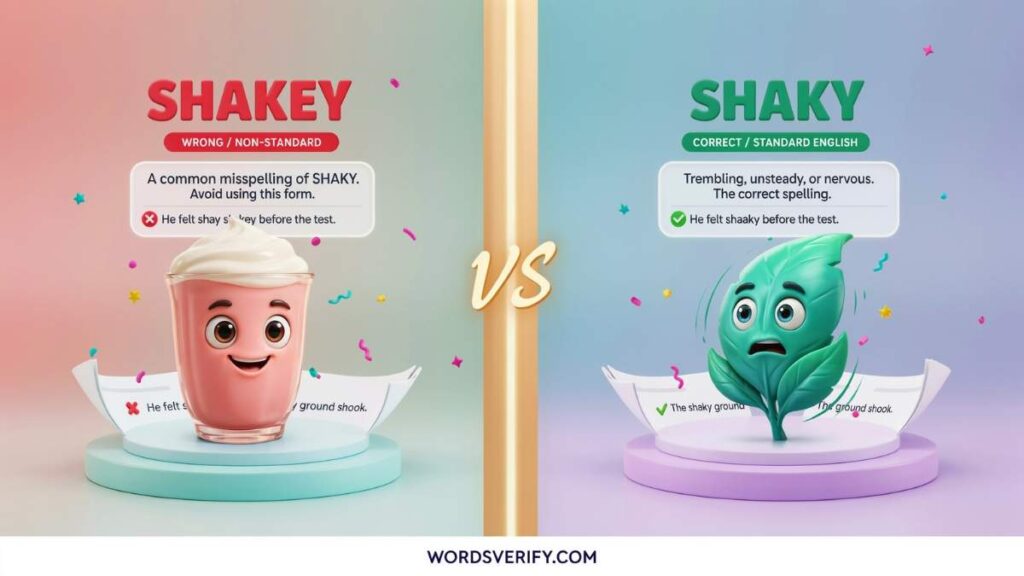
A single letter can turn a simple word into a spelling puzzle! If you’ve ever paused over shakey vs shaky, you’re not alone. The two spellings look almost identical, but only one is correct for standard English writing. So, does that extra “e” belong there, or is it just creating unnecessary confusion? The answer is simple: shaky is the correct spelling of the adjective, while shakey usually appears in proper names or stylized forms. Let’s explore their meanings, spelling rules, and practical examples to help you avoid this common mistake and write with confidence.
Shakey vs Shaky Quick Answer
The correct spelling is shaky, not shakey, when describing something that shakes, feels unsteady, or lacks reliability.
Although both forms may sound the same in conversation, only shaky is the standard adjective in modern English.
Here’s a quick comparison:
| Feature | Shaky | Shakey |
|---|---|---|
| Standard spelling | Yes | No |
| Accepted adjective | Yes | No |
| Part of speech | Adjective | Usually a proper name or nonstandard spelling |
| Meaning | Unsteady, trembling, weak, or uncertain | No established standard adjective meaning |
| Formal writing | Correct | Incorrect as an adjective |
| Use in proper names | Possible | Possible |
| Example | My hands feel shaky. | Shakey (as a name) |
Consider these examples:
- Correct: The old wooden staircase feels shaky.
- Incorrect: The old wooden staircase feels shakey.
- Correct: She gave a shaky explanation during the meeting.
- Incorrect: She gave a shakey explanation during the meeting.
Remember one simple rule: Use shaky whenever you mean unsteady, trembling, or unreliable.
Learn the difference between confusing word pairs
Natzi vs Nazi which one is correct?
Shaky Meaning and Definition
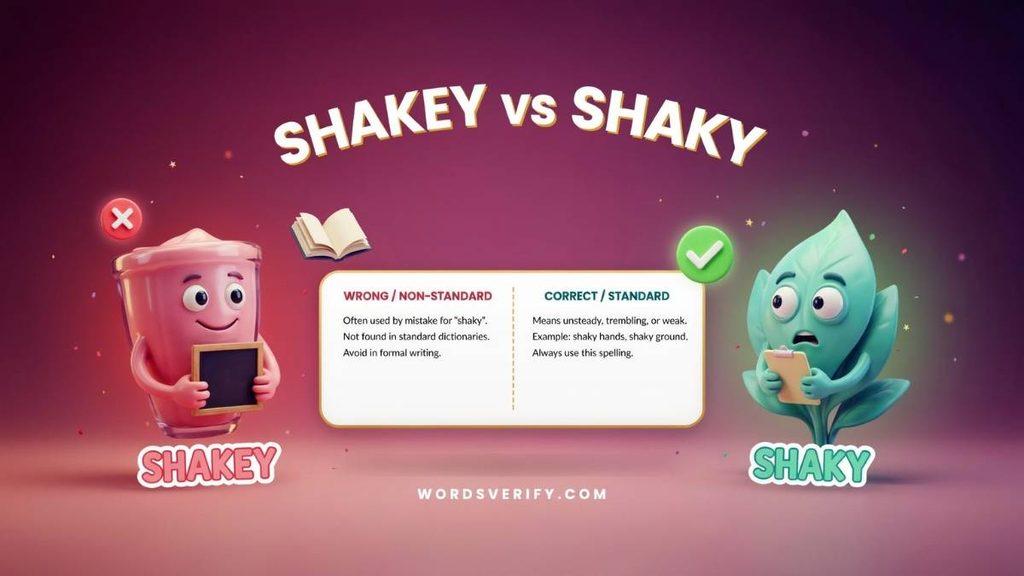
The Shaky is an adjective that describes something physically unstable or figuratively uncertain. Its meaning depends on the situation, but the central idea remains the same: something doesn’t feel firm, steady, or dependable.
The word can describe physical movement, emotional reactions, weak arguments, and situations that lack security.
Imagine someone holding a glass of water with trembling hands. The glass moves slightly because the person’s hands aren’t steady. You could describe those hands as shaky.
Now consider a business with declining sales, uncertain funding, and an unclear future. You could also call its financial position shaky. The meaning has shifted from physical movement to a lack of stability, but the underlying idea remains similar.
Shaky as Physical Instability
One of the most common meanings of shaky relates to physical movement. Something shaky trembles, wobbles, or struggles to remain steady.
You might use the word to describe:
- Shaky hands: Hands that tremble or shake.
- Shaky legs: Legs that feel weak or unsteady.
- A shaky table: A table that moves when someone touches it.
- A shaky ladder: A ladder that doesn’t stand firmly.
- A shaky bridge: A structure that appears unstable.
- A shaky voice: A voice that trembles while someone speaks.
For example:
“After running up five flights of stairs, his legs felt shaky.”
Here, shaky describes physical weakness and unsteadiness. The person’s legs may tremble because of fatigue.
However, exhaustion isn’t the only reason someone might feel shaky. Nervousness, fear, cold temperatures, and other circumstances can also cause trembling.
Shaky as Nervousness or Emotional Uncertainty
Sometimes, your body reveals feelings that your words try to hide. That’s where shaky becomes useful for describing nervousness and emotional reactions.
Imagine someone preparing to speak in front of a large audience. They understand their subject perfectly well, but anxiety makes their hands tremble and their voice waver.
Consider these examples:
- Her voice became shaky when she started discussing the accident.
- I felt shaky before my first job interview.
- He gave a shaky smile when the manager asked about the missing documents.
- The nervous student held the microphone with shaky hands.
In these sentences, shaky describes the physical signs of an emotional state.
It doesn’t necessarily mean someone lacks courage or ability. Even confident people can experience temporary nervousness.
Shaky as Weak or Unreliable
Shaky isn’t limited to physical movement. It can also describe something that lacks convincing support, dependable information, or a strong foundation.
This meaning often appears in academic, professional, financial, and legal discussions.
For example:
- The lawyer challenged the prosecution’s shaky evidence.
- Their business plan rests on shaky assumptions.
- The report contains several shaky conclusions.
- The company’s financial position remains shaky.
A shaky argument doesn’t necessarily mean every statement is false. It means the reasoning or supporting information isn’t strong enough to inspire confidence.
Similarly, shaky evidence may contain useful information, but it lacks the reliability or support needed to establish a convincing conclusion.
This figurative meaning makes shaky useful in both everyday and formal writing.
Shaky as Lacking Confidence or Security
The adjective can also describe a person, relationship, or situation that feels uncertain or insecure.
For instance, someone who doubts their abilities might have shaky confidence. A relationship experiencing repeated disagreements and trust problems might be described as shaky.
Examples include:
- Their relationship became shaky after the disagreement.
- She felt shaky about her decision to change careers.
- His position at the company looks shaky.
- The agreement rests on a shaky understanding between both parties.
The word doesn’t automatically mean something will fail. It simply suggests that the situation lacks stability and could become worse without improvement.
Learn the difference between confusing word pairs
Enrol vs Enroll which one is correct?
What Does Shakey Mean?
The spelling shakey often appears when people try to write a word according to how it sounds. However, it isn’t the standard spelling of the adjective.
Standard English dictionaries recognize shaky as the accepted adjective. Adding an extra E doesn’t create a separate standard adjective with a different meaning.
The distinction matters because English spelling doesn’t always follow pronunciation perfectly. Two spellings can sound identical without both being correct.
Is Shakey a Real Word?
The answer depends on how you’re using it.
If you mean an object that wobbles or a person whose hands tremble, shakey isn’t the correct standard spelling. Use shaky instead.
However, Shakey may appear as a proper name, nickname, username, or intentionally stylized term. Proper names don’t always follow ordinary dictionary spelling conventions.
A familiar example is Shakey’s Pizza. The restaurant brand uses Shakey’s as its official name. That doesn’t make shakey an accepted alternative spelling of the adjective.
Compare these examples:
- Correct adjective: The chair looks shaky.
- Proper name: We ordered dinner from Shakey’s Pizza.
- Incorrect adjective: The chair looks shakey.
The difference is simple: a name can have its own spelling, but ordinary descriptive writing should follow standard English conventions.
Why Do People Spell Shaky as Shakey?
Several things can explain this common spelling confusion.
1. Pronunciation: Both spellings can suggest the same spoken sound. When people rely on pronunciation rather than remembered spelling, they may add an unnecessary E.
2. English spelling patterns: English doesn’t always follow predictable rules. Readers sometimes apply familiar letter combinations to words where they don’t belong.
3. Informal online writing: Social media posts, text messages, and casual conversations often contain nonstandard spellings. Repeated exposure can make an incorrect form look familiar.
4. Confusion with proper names: People who recognize names such as Shakey’s Pizza may assume that shakey is also a valid alternative spelling of the adjective. However, brand names and ordinary vocabulary follow different conventions.
The safest approach is to remember the standard spelling: shaky.
Learn the difference between confusing word pairs
Suing vs Sueing which one is correct?
Shakey vs Shaky Key Differences
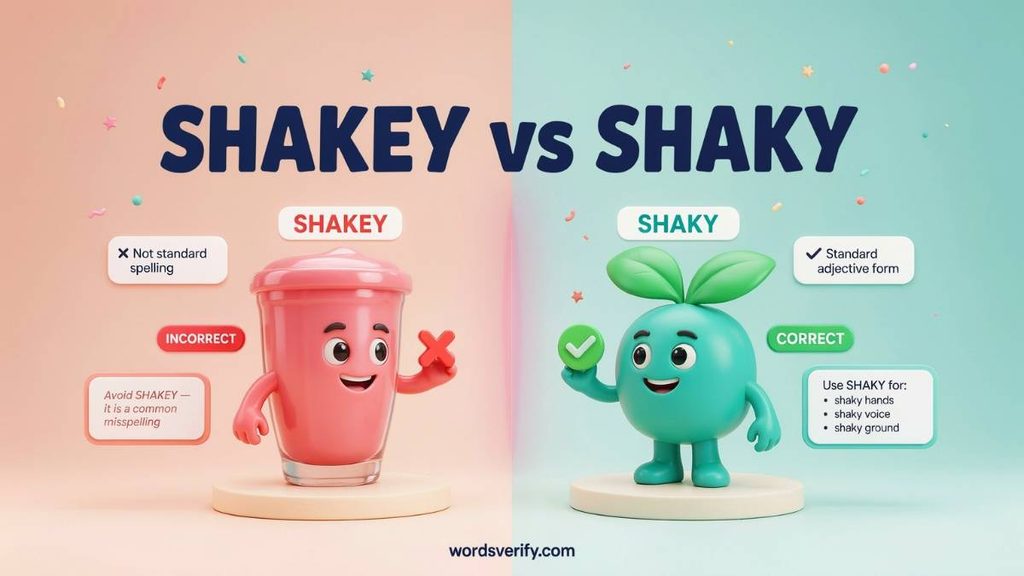
The main difference between shakey vs shaky comes down to spelling rather than pronunciation or meaning. One is the accepted adjective, while the other is generally a spelling mistake in ordinary writing.
Understanding this distinction helps you avoid confusion in emails, school assignments, reports, and everyday communication.
Shakey vs Shaky Spelling Difference
The difference is only one letter, but that small detail matters.
- Shaky: S-H-A-K-Y
- Shakey: S-H-A-K-E-Y
The standard adjective contains no E between K and Y. Its spelling follows the word shake combined with the adjective-forming suffix -y.
For example:
- The shaky ladder needs repairs.
- His hands became shaky after the exercise.
- The company has a shaky financial foundation.
Writing shakey in these sentences introduces a spelling mistake.
Shakey vs Shaky Meaning
People sometimes assume that the two forms have different definitions.
They don’t have two established, separate adjective meanings in standard English.
Shaky describes something physically unsteady or figuratively unreliable. Shakey doesn’t have a separate accepted adjective definition that changes or expands that meaning.
For instance, both “shaky evidence” and “shakey evidence” might communicate the same intended idea to a reader. However, only the first follows standard spelling conventions.
Shakey vs Shaky in Professional Writing
Spelling becomes particularly important when you’re writing for an audience that expects accuracy.
In professional communication, use shaky when describing unstable equipment, weak arguments, uncertain plans, or unreliable information.
Consider these examples:
| Situation | Correct usage |
|---|---|
| Business report | The company’s financial position remains shaky. |
| Academic paper | The researcher identified shaky assumptions. |
| Workplace email | The current arrangement seems shaky. |
| News article | The company faces a shaky financial outlook. |
| Personal communication | My hands were shaky this morning. |
Using shakey instead may distract readers and make otherwise polished writing look careless.
Learn the difference between confusing word pairs
Whiny vs Whiney difference and correct usage
Shakey vs Shaky Which One Should You Use?
If you’re wondering whether to write shakey vs shaky, the answer is simple: choose shaky when you need the ordinary English adjective.
The correct spelling remains the same whether you’re describing a physical object, a nervous person, or an uncertain situation.
Here are some practical examples.
When describing physical movement:
- The old wooden floor feels shaky.
- His knees became shaky after the long walk.
- She noticed that her hands were shaky.
or When describing uncertainty:
- Their business partnership is on shaky ground.
- The witness gave a shaky explanation.
- We have a shaky understanding of the problem.
When referring to an established name:
1. Shakey’s Pizza is a proper brand name.
So, is shakey a correct spelling? Not as the standard adjective. However, it may be appropriate when a particular person, business, or organization deliberately uses it as a name.
How to Use Shaky in Everyday Sentences
Understanding a dictionary definition is helpful, but seeing a word in context makes its meaning much easier to remember.
The following examples show how shaky works in everyday English and how its meaning changes depending on the noun it describes.
Shaky Hands and Physical Movements
The phrase shaky hands usually refers to hands that tremble or move involuntarily.
This movement may happen for several reasons, including nervousness, physical exhaustion, cold temperatures, or temporary weakness.
The meaning depends on the situation. A person might have trembling hands because they’re frightened, while another might experience the same movement after strenuous exercise.
Examples:
- My hands were shaky after carrying those heavy boxes.
- The child held the fragile glass with shaky hands.
- She noticed her hands becoming shaky during the presentation.
- His shaky fingers made it difficult to button his shirt.
- The cold weather left everyone with slightly shaky hands.
It’s worth remembering that shaky hands describes an observable physical condition. The adjective doesn’t identify its cause.
Shaky Voice and Nervous Feelings
A shaky voice is a voice that trembles, wavers, or sounds unsteady while someone speaks.
This expression often appears when describing fear, sadness, anxiety, or emotional stress.
For example:
- Her voice sounded shaky as she announced the results.
- He tried to speak confidently, but his shaky voice revealed his nervousness.
- The witness answered the questions in a shaky voice.
- I could hear a shaky voice on the other end of the phone.
A shaky voice doesn’t always indicate nervousness. Strong emotions such as grief, excitement, and fear can also affect someone’s voice.
A person may know exactly what they want to say but struggle to control their voice while expressing it.
Shaky Evidence and Weak Arguments
In academic and professional settings, shaky often describes evidence or reasoning that doesn’t provide strong support for a conclusion.
For example:
- The investigation relied on shaky evidence.
- His argument sounded convincing at first, but its foundation was shaky.
- The researchers questioned the study’s shaky assumptions.
- The report presented a shaky explanation for the unexpected results.
Consider a simple example.
Case study: A weak business proposal
Imagine a company wants to invest in a new product. Its proposal predicts strong sales but provides no reliable market research, customer surveys, or financial estimates.
A manager might describe the proposal as shaky because its central claims lack convincing support.
Notice that shaky doesn’t necessarily mean the proposal is completely useless. It means the available information isn’t strong enough to justify confidence.
Shaky Relationships and Uncertain Situations
A shaky relationship is one that lacks stability, trust, or security.
It can refer to romantic relationships, friendships, family connections, or professional partnerships.
For example:
- Their relationship became shaky after several disagreements.
- The business partners have a shaky relationship because they no longer trust each other.
- Years of poor communication left their friendship on shaky ground.
A shaky relationship doesn’t necessarily mean the people involved will separate. It suggests that unresolved disagreements, broken trust, or changing expectations have made the connection less secure.
The word also describes situations beyond personal relationships:
- The company is facing a shaky financial situation.
- Their future plans remain shaky.
- The agreement stands on a shaky foundation.
Learn the difference between confusing word pairs
Pricy vs Pricey which one is correct?
Shaky Synonyms and Related Words
English offers several alternatives to shaky, but they don’t all mean exactly the same thing.
Some describe physical movement, while others focus on uncertainty, weakness, or a lack of reliability. Choosing the right synonym depends on what you’re trying to communicate.
| Synonym | Meaning | Example |
|---|---|---|
| Unsteady | Not firmly balanced | The unsteady chair moved whenever he sat down. |
| Wobbly | Moving from side to side | The baby took a few wobbly steps. |
| Trembling | Shaking repeatedly or slightly | Her trembling hands held the letter. |
| Unstable | Lacking stability | The unstable structure needed repairs. |
| Uncertain | Not definite or predictable | Their future remains uncertain. |
| Unreliable | Not dependable or trustworthy | The witness provided unreliable information. |
| Weak | Lacking strength or support | His argument was weak. |
| Flimsy | Lacking strength or solid construction | The box had a flimsy cardboard base. |
| Insecure | Lacking confidence or security | She felt insecure about her decision. |
| Precarious | Dangerously unstable or uncertain | The workers stood in a precarious position. |
Physical Synonyms of Shaky
When shaky describes physical movement, these alternatives may fit:
- Unsteady: Something that doesn’t remain firmly balanced.
- Wobbly: Something that moves from side to side.
- Trembling: A repeated shaking movement.
- Unbalanced: Something that lacks proper balance.
- Unstable: Something that may shift, move, or collapse.
For example, you could describe an old chair as wobbly rather than shaky if its legs move from side to side whenever someone sits on it.
Similarly, trembling may describe someone’s hands more precisely when they shake repeatedly.
Figurative Synonyms of Shaky
When the word describes uncertainty or weakness, different alternatives work better.
- Doubtful: Something that seems questionable.
- Uncertain: Something that lacks a definite outcome.
- Unreliable: Something that cannot be trusted.
- Insecure: Something that lacks confidence or security.
- Weak: Something that lacks convincing support.
- Precarious: Something exposed to danger or sudden change.
For example, shaky evidence and unreliable evidence have similar meanings, although unreliable places greater emphasis on whether the evidence can be trusted.
Antonyms of Shaky
Antonyms are words with opposite meanings. Depending on the context, useful opposites of shaky include:
| Antonym | Opposite meaning |
|---|---|
| Steady | Firm and controlled |
| Stable | Secure and unlikely to change unexpectedly |
| Firm | Strong and solid |
| Balanced | Properly positioned or controlled |
| Reliable | Dependable and trustworthy |
| Certain | Definite or confidently established |
| Secure | Protected or firmly established |
| Strong | Having considerable strength or support |
For example:
- Shaky hands → Steady hands
- A shaky foundation → A stable foundation
- Shaky evidence → Reliable evidence
- A shaky relationship → A secure relationship
Learn the difference between confusing word pairs
Fliers vs Flyers which one is correct?
Shaky Grammar Rules and Word Forms
Understanding the grammar behind shaky makes it easier to use the word correctly in different sentence structures.
The word functions primarily as an adjective. However, English also has related forms that serve different grammatical purposes.
Shaky as an Adjective
An adjective describes a noun or pronoun. Since shaky describes a quality or condition, it belongs to this word class.
You can use it before a noun:
- A shaky bridge
- Shaky hands
- A shaky voice
- Shaky evidence
- A shaky business arrangement
You can also place it after linking verbs such as is, seems, looks, feels, and becomes.
Examples:
- The table looks shaky.
- His explanation seems shaky.
- My legs feel shaky.
- Their agreement became shaky.
Both positions are grammatically correct.
Comparative and Superlative Forms of Shaky
Like many English adjectives, shaky has comparative and superlative forms.
The comparative form is shakier, while the superlative form is shakiest.
This follows a common English spelling rule: when an adjective ends in a consonant followed by Y, change the Y to I before adding -er or -est.
| Form | Word | Example |
|---|---|---|
| Positive | Shaky | The table is shaky. |
| Comparative | Shakier | This table is shakier than that one. |
| Superlative | Shakiest | That is the shakiest table in the room. |
More examples:
- My hands feel shakier today than yesterday.
- The second ladder looks shakier than the first.
- This is the shakiest argument in the entire report.
Avoid writing shakyer or shakeyest. Neither follows the standard spelling rule.
Adverb and Related Word Forms
English also uses related forms of shaky to express different ideas.
Shakily: This is the adverb form. It describes how someone performs an action.
Examples:
- She walked shakily across the narrow bridge.
- He spoke shakily during the interview.
- The old machine moved shakily across the floor.
Shakiness: This is the noun form. It describes the condition or quality of being shaky.
Examples:
- The shakiness in his hands became noticeable.
- She tried to hide the shakiness in her voice.
- The shakiness of the structure raised safety concerns.
These forms are related, but they aren’t interchangeable.
Compare:
- Her voice was shaky. (Adjective)
- She spoke shakily. (Adverb)
- The shakiness in her voice was obvious. (Noun)
Learn the difference between confusing word pairs
Mentioned vs Mentionned Which one Is Correct?
Shakey vs Shaky Pronunciation Guide
Pronunciation can explain why people confuse shakey vs shaky. Both spellings may represent the same spoken sound, even though only one is the standard adjective.
The correct pronunciation of shaky is /ˈʃeɪ.ki/.
The word has two syllables, with the stress falling on the first.
IPA Pronunciation and Syllable Breakdown
You can divide shaky into two syllables:
- Shay: The first syllable carries the main stress.
- Kee: The second syllable has a lighter, unstressed sound.
The pronunciation begins with the same sound found in ship, followed by the long A sound in day.
The second syllable sounds like the word key.
Shaky vs Shakey Pronunciation
The two spellings don’t usually create a pronunciation difference in ordinary English.
Someone who writes shakey may intend exactly the same pronunciation as shaky. However, pronunciation doesn’t determine whether a spelling follows standard English conventions.
It’s also worth noting that Shakey as a personal name or nickname may have an individual or family-specific pronunciation.
Learn the difference between confusing word pairs
Journeys vs Journies Which one Is Correct?
Origin and Etymology of Shaky
The word shaky comes from the English verb shake. Understanding this connection helps explain both its spelling and meaning.
The verb shake describes moving something rapidly or repeatedly, often from side to side or up and down.
For example:
- Shake the bottle before opening it.
- The windows shook during the storm.
- His hands started to shake when he heard the news.
English uses the suffix -y to form adjectives from nouns and other word bases. This suffix often means having a particular quality or characteristic.
When attached to shake, it produces shaky, an adjective associated with shaking or instability.
Why Is Shakey Spelled Shaky?
The spelling shaky follows an established word-formation pattern:
Shake + -y = Shaky
The final E in shake disappears when the adjective-forming suffix -y is added.
This pattern also appears in other English words:
| Base word | Adjective | Meaning |
|---|---|---|
| Ice | Icy | Covered with or resembling ice |
| Spice | Spicy | Containing or tasting of spice |
| Noise | Noisy | Making a lot of noise |
| Grease | Greasy | Covered with grease |
| Haze | Hazy | Misty or unclear |
| Shake | Shaky | Trembling or unstable |
These examples demonstrate a familiar English spelling pattern. The final E often drops when a suffix beginning with a vowel is added.
Therefore, shakey doesn’t follow the accepted spelling pattern for this adjective.
How Did Shaky Develop Its Figurative Meaning?
The connection between shaky and physical shaking is easy to understand. Something that shakes isn’t completely steady.
Over time, English speakers began using the adjective to describe situations that lacked stability in a broader sense.
For example, a shaky table physically wobbles. A shaky business plan, however, lacks dependable support.
The word gradually became useful for describing:
- Physical movement and trembling.
- Emotional nervousness and insecurity.
- Weak arguments and doubtful evidence.
- Unstable financial and professional situations.
- Relationships that lack trust or security.
This development reflects a common feature of English: words describing physical experiences often acquire figurative meanings.
Learn the difference between confusing word pairs
Developed vs Developped which one is correct?
Shakey vs Shaky in American and British English
One common question is whether American and British English use different spellings.
The answer is no. Both varieties use shaky as the standard adjective.
There is no accepted regional spelling difference that makes shakey correct in one country and incorrect in another.
in American English
In American English, shaky is the correct spelling.
You can use it in everyday conversation, school assignments, business documents, journalism, and academic writing.
Examples:
- The old building has a shaky foundation.
- His financial position looks shaky.
- She had shaky hands during the presentation.
American dictionaries recognize shaky as the standard adjective.
Shakey vs Shaky UK Spelling
British English also uses shaky.
Although British and American English have several spelling differences, this isn’t one of them.
For example, British English uses colour while American English uses color. However, both varieties spell shaky the same way.
Examples:
- The ladder looks shaky.
- His voice sounded shaky.
- The company’s future remains shaky.
Canadian and Australian English
Canadian and Australian English also use shaky as the standard spelling.
There isn’t a separate Canadian or Australian adjective spelling that changes the accepted form.
| English variety | Correct spelling |
|---|---|
| American English | Shaky |
| British English | Shaky |
| Canadian English | Shaky |
| Australian English | Shaky |
Therefore, you don’t need to change the spelling based on your audience’s location.
Learn the difference between confusing word pairs
Realist vs Realest which one is correct?
Common Mistakes When Using Shaky
Even though shaky is a relatively simple adjective, several mistakes can occur when people use it.
Understanding these errors will help you improve your grammar and spelling.
Writing Shakey Instead of Shaky
This is the most common mistake associated with the word.
People sometimes add an unnecessary E because they assume the spelling should match a familiar pronunciation pattern.
Incorrect: The old bridge looks shakey.
Correct: The old bridge looks shaky.
Remember that the standard adjective doesn’t contain an E before its final Y.
Confusing Shaky with Shakily
These words share the same root, but they perform different grammatical functions.
Shaky is an adjective, while shakily is an adverb.
Incorrect: She walked shaky across the room.
Correct: She walked shakily across the room.
You can use shaky to describe her movements, but shakily describes how she walked.
Using the Wrong Comparative Form
Some writers mistakenly form the comparative by adding -er without changing the final Y.
Incorrect: This chair is shakyer than the other one.
Correct: This chair is shakier than the other one.
The same spelling rule applies to the superlative.
Incorrect: That is the shakeyest structure in the neighborhood.
Correct: That is the shakiest structure in the neighborhood.
Assuming Shaky Only Describes Physical Movement
Another common misunderstanding is treating shaky as a word that only describes trembling objects or body parts.
However, its figurative meanings are equally important.
For example:
- Shaky evidence describes information that lacks strong support.
- A shaky relationship describes an unstable personal connection.
- Shaky confidence describes uncertainty about someone’s abilities.
- Shaky finances describe an insecure financial position.
Recognizing these meanings helps you use the word naturally in different situations.
Treating Shakey as a Regional Spelling
Some people assume that shakey might be acceptable in British English or another English variety.
That’s incorrect.
American, British, Canadian, and Australian English all use shaky as the standard adjective.
Shaky vs Similar Words Understanding the Differences
Although several words have meanings close to shaky, each one carries a slightly different emphasis.
Choosing the right word can make your writing more precise.
Shaky vs Wobbly
Both words describe physical instability, but wobbly often suggests noticeable movement from side to side.
A wobbly chair moves when someone sits on it. A shaky chair may feel unstable or poorly balanced.
Examples:
- The old chair has a wobbly leg.
- The wooden table feels shaky.
- The toddler took a few wobbly steps.
Use wobbly when you want to emphasize movement. Use shaky when you want to emphasize a general lack of steadiness.
Shaky vs Unsteady
These adjectives have very similar meanings.
Unsteady describes something that cannot maintain a firm or balanced position. Shaky can describe the same condition but also has broader figurative meanings.
Examples:
- He walked with unsteady legs.
- He walked with shaky legs.
- The company’s future looks shaky.
Both shaky and unsteady work in the first two examples. However, shaky often sounds more natural when describing weak plans, arguments, or relationships.
Shaky vs Trembling
Trembling describes the physical act of shaking, often through small, repeated movements.
Shaky is broader. It can describe both the movement itself and the general condition of instability.
Examples:
- Her trembling hands held the envelope.
- Her hands felt shaky after the long journey.
- The frightened child stood trembling near the doorway.
The first sentence emphasizes the movement. The second describes the condition of the hands.
Shaky vs Uncertain
These words overlap when describing situations that lack confidence or predictability.
However, uncertain focuses more directly on doubt, while shaky often suggests that something lacks a dependable foundation.
Examples:
- Their future remains uncertain.
- Their relationship is on shaky ground.
- The results are still uncertain.
- The argument rests on shaky evidence.
A future can be uncertain without being unstable. Similarly, an argument can be shaky because its supporting evidence is weak.
Shaky in Different Writing Contexts
The word shaky works in casual conversation as well as formal communication. Its meaning remains recognizable across different situations, although the subject it describes may change.
Everyday Conversation
In daily conversations, people commonly use shaky to describe physical movement, nervousness, or uncertainty.
Examples:
- My legs are still shaky after that hike.
- The coffee table feels shaky.
- I had a shaky start to the morning.
- Her voice sounded shaky when she answered.
- I’m feeling a little shaky about the decision.
These sentences sound natural because they use the adjective in familiar situations.
Academic and Professional Writing
In academic and professional contexts, shaky often describes weak reasoning, unreliable information, or conclusions that lack sufficient support.
For example:
- The study relies on shaky assumptions.
- The researcher’s conclusion rests on shaky evidence.
- The proposed solution has a shaky theoretical foundation.
- The report identifies weaknesses in the company’s financial position.
Although shaky is acceptable in formal writing, more specific alternatives may be better when precision matters.
For instance, insufficient evidence, unsupported assumptions, or unreliable findings may communicate a problem more clearly than shaky evidence.
Creative Writing and Literature
Writers often use shaky to make descriptions more vivid.
Instead of simply saying someone feels nervous, a writer might describe their shaky hands, trembling voice, or uncertain movements.
For example:
“She reached for the door handle with shaky fingers. Outside, the wind rattled the windows, making the entire house feel less secure.”
The adjective helps readers imagine both physical movement and emotional tension.
Journalism and Media
In journalism, shaky can describe political uncertainty, financial instability, weak claims, and questionable evidence.
Examples:
- The company faces a shaky economic outlook.
- The candidate’s explanation rests on shaky claims.
- Investors remain concerned about the unstable financial situation.
- The agreement appears to stand on shaky ground.
The word is especially useful when a writer wants to communicate uncertainty without claiming that a situation has already failed.
Practice Session Shakey vs Shaky
Complete the following sentences by filling in each blank with the correct word or form Shakey vs Shaky. This practice session will help you remember the spelling, meaning, and proper use of shaky.
Fill in the blanks
- The old wooden bridge felt _______ as we walked across it.
- Her hands became _______ when she heard the unexpected news.
- The witness gave a _______ explanation that raised several questions.
- After running up the stairs, my legs felt _______.
- His voice sounded _______ during the nervous speech.
- The ladder looked _______ and unsafe to climb.
- She felt _______ before her first public presentation.
- The company was facing a _______ financial situation.
- The earthquake made the entire building feel _______.
- His argument was too _______ to convince the audience.
- The child held the glass with _______ hands.
- The politician’s explanation seemed _______ to reporters.
- I felt _______ on my feet after standing up too quickly.
- The table became _______ after one of its legs broke.
- Her confidence was still _______ after the disappointing result.
- The boat moved _______ across the rough water.
- The patient walked _______ while recovering from the injury.
- The team had a _______ start to the competition.
- His excuse sounded _______ because the details kept changing.
- The little puppy stood on its _______ legs.
- The correct spelling of the adjective is _______.
- The comparative form of shaky is _______.
- The superlative form of shaky is _______.
- The noun form of shaky is _______.
- When you add “y” to “shake,” you should drop the final _______.
Answers
- Shaky
- Shaky
- Shaky
- Shaky
- Shaky
- Shaky
- Shaky
- Shaky
- Shaky
- Shaky
- Shaky
- Shaky
- Shaky
- Shaky
- Shaky
- Shakily
- Shakily
- Shaky
- Shaky
- Shaky
- Shaky
- Shakier
- Shakiest
- Shakiness
- E
Here’s a trusted source for clear word meanings:
FAQs
Is shakey a real word?
Shakey isn’t the standard spelling of the adjective. However, it may appear in proper names, nicknames, or stylized brand names. When describing something unsteady, trembling, or uncertain, use shaky.
What does shaky mean?
Shaky means physically unsteady, trembling, weak, or uncertain. You might use it to describe trembling hands, a wobbly chair, unreliable evidence, or a decision you aren’t confident about.
How do you spell shaky hands?
The correct spelling is “shaky hands.” The word shaky describes hands that tremble or move uncontrollably. Writing “shakey hands” is a spelling mistake in standard English.
Is shaky a valid Scrabble word?
Yes, SHAKY is a valid Scrabble word. It is an adjective that describes something unsteady, trembling, or uncertain. Always check the current word list used in your game if you need an official ruling.
What is the difference between shaky and shakey?
Shaky is the correct standard English spelling of the adjective. Shakey is generally found in proper names, nicknames, or creative spellings. For everyday writing, shaky is the form you should use.
What is another word for shaky?
Several words can replace shaky, depending on the meaning. Common alternatives include unsteady, wobbly, trembling, unstable, uncertain, unreliable, and insecure. For example, you could describe a shaky argument as weak or unconvincing.
What is the opposite of shaky?
The most common opposites of shaky are steady and stable. Other suitable choices include firm, balanced, secure, reliable, and confident. The best option depends on whether you’re describing physical movement or a lack of certainty.
What does shaky mean in slang?
In informal English, shaky can describe something doubtful, suspicious, or unreliable. For instance, saying “That explanation sounds shaky” suggests that the explanation doesn’t seem convincing or trustworthy.
What is another word for feeling shaky?
If you feel physically or emotionally shaky, you might use words such as jittery, nervous, anxious, trembling, or unsteady. Jittery and nervous describe emotional uneasiness, while trembling and unsteady focus more on physical sensations.
Is it spelled scary or scarey?
Scary is the correct standard English spelling. Scarey is a common misspelling. The same spelling principle applies to shaky: drop the final “e” before adding “y.”
What is a more sophisticated word for shake?
The best alternative depends on the type of movement you’re describing. Tremble suggests a slight, often nervous movement, while quiver describes a small, rapid shaking motion. Other alternatives include shudder, vibrate, and oscillate, each with a slightly different meaning.
Conclusion
The difference between shaky vs shakey may come down to just one letter, but getting it right makes your writing much stronger. Remember, shaky is the correct standard English spelling when describing something unsteady, trembling, uncertain, or unreliable. Shakey, on the other hand, is generally reserved for proper names and stylized uses. The easiest way to remember the correct form is to drop the final “e” from shake before adding “y.” With this simple rule in mind, you can leave the spelling confusion behind. After all, your writing can be shaky in meaning, but your spelling shouldn’t be!

Lisa AJS is an experienced blogger and language enthusiast at Words Verify, dedicated to making grammar simple, practical, and enjoyable. She writes engaging content on commonly confused words, grammar mistakes, word meanings, and everyday language challenges.