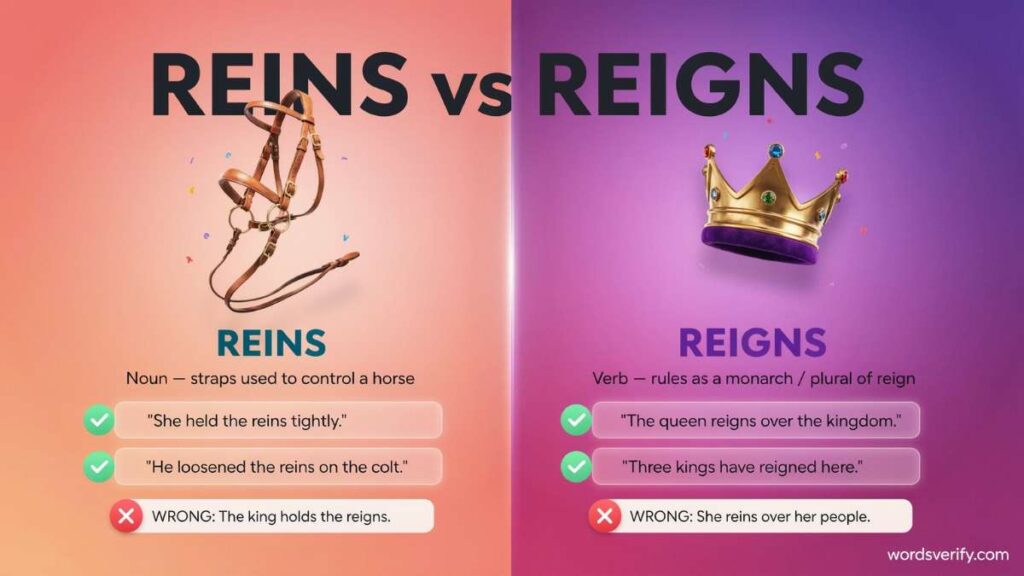
Ever found yourself wondering whether it’s “reins” vs “reigns”? English has a knack for making simple words surprisingly confusing! These homophones sound identical, yet mixing them up can turn a perfectly good sentence into a grammar blunder. Fortunately, mastering reins vs reigns is easier than you might think. One word relates to control and responsibility, while the other describes ruling or holding power. No horse-riding experience or royal knowledge required! In this guide, you’ll discover the difference between these tricky words, explore clear examples, and learn practical tips to avoid common spelling mistakes and write with confidence.
Reins vs Reigns quick answer?
The main difference between “reins” and “reigns” lies in their meanings and uses.
Reins are straps used to guide and control a horse. The word also refers to control or responsibility in a broader sense. For example, a new manager might take the reins of a company.
Reigns is the present-tense form of the verb “reign,” used with a singular subject. It means to rule or hold power. The word can also be the plural form of the noun “reign,” which refers to a period of rule.
| Word | Meaning | Example |
|---|---|---|
| Reins | Horse-riding straps; control or responsibility | She took the reins of the company. |
| Reigns | Rules or holds power; periods of rule | The king reigns over the kingdom. |
An easy way to remember the difference is to connect “reins” with control and “reigns” with ruling.
Avoid everyday grammar mistakes with simple tips
Stellar vs Steller which one is correct?
What Does Reins Mean?

The word “reins” has both a literal and a figurative meaning. You’ll find it in conversations about horse riding, leadership, responsibility, and self-control.
Reins as a Noun
In horse riding, reins are straps attached to a horse’s bridle. The rider holds them to guide the horse, change direction, or control its movement.
Here are a few examples:
- The rider pulled the reins gently to slow the horse.
- She held the reins firmly as the horse approached the gate.
- The instructor showed the beginner how to handle the reins safely.
The word also describes control over a situation, organization, or group. In this sense, you don’t need an actual horse for the word to make sense.
For example:
- After the director retired, Maria took the reins of the department.
- The new coach took the reins of the struggling team.
- He finally took the reins of his own life and began making better decisions.
In each sentence, “reins” represents responsibility or control rather than horse-riding equipment.
Rein as a Verb
“Rein” can also function as a verb. It means to control, restrain, or limit something. The expression “rein in” is especially common when talking about spending, emotions, behavior, or excessive activity.
Consider these examples:
- The company needs to rein in its expenses.
- She tried to rein in her excitement during the meeting.
- The teacher asked the students to rein in their enthusiasm.
- He had to rein in his temper before responding.
The verb changes depending on the tense. You might write “rein in” in the present tense, “reined in” in the past tense, or “reining in” to describe an ongoing action.
Common Expressions With Reins
Several familiar expressions use “reins.” Learning them will help you recognize the correct spelling in everyday writing.
- Take the reins: To take control or accept responsibility.Example: After years of working under her mentor, she was ready to take the reins.
- Hand over the reins: To transfer control or responsibility to someone else.Example: The founder handed over the reins to his daughter.
- Hold the reins: To remain in control of a situation.Example: Despite several setbacks, the manager continued to hold the reins.
- Free rein: The freedom to act, make decisions, or do something without unnecessary restrictions.Example: The designer was given free rein to create the new collection.
- Keep a tight rein on: To maintain strict control over someone or something.Example: The treasurer keeps a tight rein on the organization’s budget.
These expressions all relate to control, responsibility, or freedom. That connection makes “reins” the correct choice.
Avoid everyday grammar mistakes with simple tips
Cheer vs Chear Which one Is Correct?
What Does Reigns Mean?
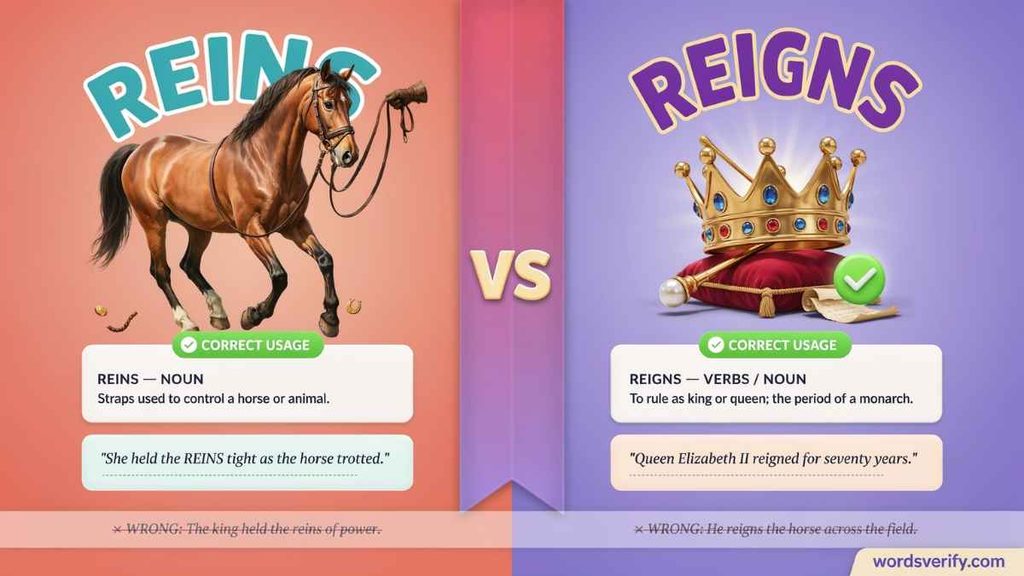
“Reigns” comes from the verb “reign,” which means to rule as a monarch or hold authority over a place or group. It can also describe a situation in which a particular condition prevails.
Unlike “reins,” “reigns” has no connection to horse-riding equipment.
Reigns as a Verb
When used as a verb, “reigns” describes someone who rules or something that dominates a situation. It commonly appears with a singular subject in the present tense.
For example:
- The king reigns over the kingdom.
- The queen reigns with the support of her people.
- The champion reigns supreme in the competition.
- Peace reigns throughout the region after the conflict ends.
The word can also be used figuratively. If someone says that an artist “reigns supreme,” they mean the artist stands above others in a particular field.
Here are some additional examples:
- The team reigns supreme after winning three consecutive championships.
- Creativity reigns in the studio, where artists can experiment freely.
- Confusion reigns when nobody understands the instructions.
In these sentences, “reigns” describes ruling, dominance, or a condition that prevails.
Reigns as a Noun
The noun “reign” refers to the period during which a monarch or another ruler holds power. Its plural form is “reigns.”
For example:
- The museum displays portraits from the reigns of several British monarchs.
- Historians compare the reigns of different kings to understand political change.
- The two rulers had long reigns marked by major reforms.
The distinction is straightforward: “reign” refers to one period of rule, while “reigns” refers to multiple periods.
Common Expressions With Reign
The word “reign” appears in several expressions associated with authority, dominance, or ruling.
- Reign supreme: To be the most successful, powerful, or dominant.Example: The team continues to reign supreme in its division.
- Reign over: To rule or exercise authority over a place or group.Example: The emperor reigned over a vast territory.
- Reign of terror: A period marked by extreme violence, fear, or oppression.Example: The citizens struggled to survive during the dictator’s reign of terror.
- During someone’s reign: Throughout the period when a particular person rules.Example: Several important reforms took place during the monarch’s reign.
These expressions relate to ruling, authority, or dominance. That is your clue to use “reign” or “reigns,” depending on the sentence.
Avoid everyday grammar mistakes with simple tips
Suit vs Suite which one is correct?
Key Differences Between Reins vs Reigns
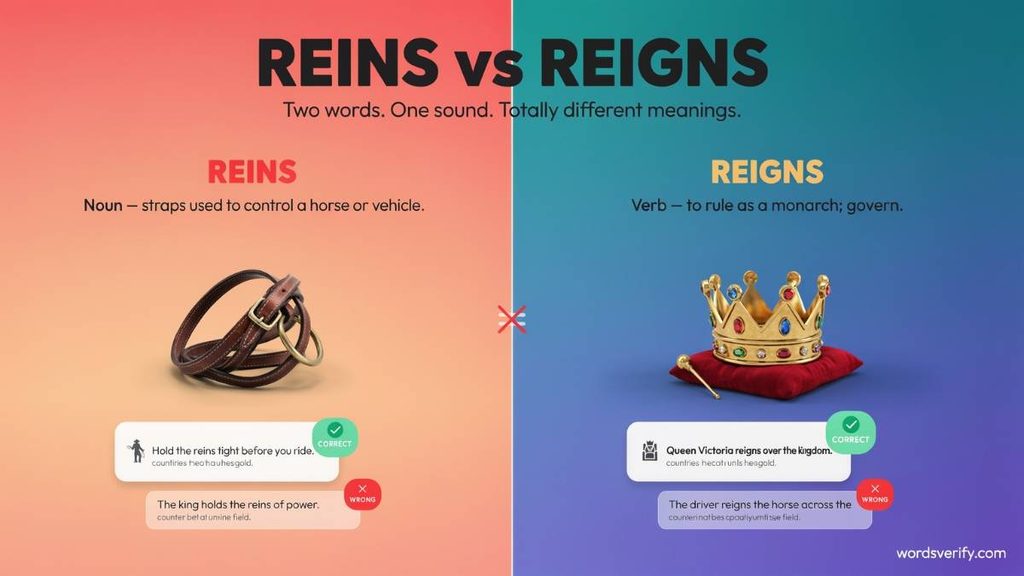
Although these words sound the same, their meanings, grammatical roles, and typical contexts differ.
Meaning and Usage
“Reins” usually refers to control, whether literal or figurative. “Reigns” refers to ruling, exercising authority, or describing multiple periods of rule.
For example:
- The rider held the reins tightly. This describes physical control.
- The new manager took the reins of the project. This describes leadership.
- The monarch reigns over the kingdom. This describes royal authority.
- The country experienced several peaceful reigns. This refers to periods of rule.
When choosing between the words, consider what the sentence describes. If it involves control or responsibility, “reins” is often appropriate. If it involves ruling or a ruler’s period in power, “reigns” is usually the better choice.
Grammar and Word Forms
The two words also differ in their grammatical forms.
| Word | Grammatical role | Example |
|---|---|---|
| Rein | Singular noun or verb | He held the rein in his left hand. |
| Reins | Plural noun | She took the reins. |
| Reign | Noun or verb | The king began his reign. |
| Reigns | Third-person singular verb or plural noun | The queen reigns over the kingdom. |
Although “reins” and “reigns” both end in “s,” they come from different base words. “Reins” comes from “rein,” while “reigns” comes from “reign.”
Context Makes the Difference
The surrounding sentence usually reveals which word belongs there.
For example:
“She took the reins after the manager resigned.”
This sentence describes taking responsibility.
“The queen reigns over the country.”
This sentence describes royal authority.
A useful trick is to replace the word with a simple synonym. If “control” fits, consider “reins.” If “rules” fits, consider “reigns.”
Avoid everyday grammar mistakes with simple tips
Busing vs Bussing Which one Is Correct?
Reins vs Reigns in Sentences
Examples make the difference easier to understand. The following sentences show how each word works in everyday writing.
Examples Using Reins
- The rider loosened the reins as the horse slowed down.
- After the team leader left, Jacob took the reins.
- Parents sometimes need to rein in their children’s screen time.
- The director gave the actors free rein to interpret their roles.
- She kept a tight rein on the project’s spending.
- The coach handed over the reins to his assistant.
- He struggled to rein in his anger during the argument.
- The new principal took the reins at the beginning of the school year.
- The company needs to rein in unnecessary costs.
- The rider gathered the reins before turning the horse.
Each example relates to control, guidance, restraint, or responsibility.
Examples Using Reigns
- The king reigns over the kingdom.
- The queen’s reign lasted for decades.
- The champion reigns supreme in the sport.
- Several major changes occurred during the ruler’s reign.
- Peace reigns in the village after years of conflict.
- The emperor reigned over a large territory.
- The team reigns supreme after another successful season.
- Historians study the reigns of powerful rulers.
- Confusion reigns when instructions are unclear.
- The monarch reigns with the support of the parliament.
These examples describe ruling, dominance, or periods of authority.
Side-by-Side Examples
Comparing similar sentences can make the distinction even clearer.
| Using reins | Using reigns |
|---|---|
| She took the reins of the business. | The king reigns over the kingdom. |
| The rider adjusted the reins. | The queen reigns with authority. |
| He needs to rein in his spending. | The champion reigns supreme. |
| The coach handed over the reins. | Historians studied the monarchs’ reigns. |
| The manager keeps a tight rein on costs. | Peace reigns throughout the region. |
The first column focuses on control or responsibility. The second focuses on ruling, dominance, or periods of rule.
Avoid everyday grammar mistakes with simple tips
Sentence vs Sentance which one is correct?
Rain, Rein and Reign What’s the Difference?
English has three words that sound alike but have different meanings: “rain,” “rein,” and “reign.” These are called homophones.
Because their pronunciation is the same, you can’t rely on sound alone to choose the correct spelling. You need to understand what the sentence means.
Rain
“Rain” refers to water that falls from clouds.
Examples:
- Heavy rain flooded the streets.
- We canceled the picnic because of the rain.
- The farmers welcomed the rain after weeks of dry weather.
Rein
“Rein” refers to a strap used to guide a horse. It can also mean to control or restrain something.
Examples:
- The rider held the rein carefully.
- She tried to rein in her excitement.
- The manager must rein in unnecessary spending.
Reign
“Reign” means to rule or describes a period of rule.
Examples:
- The monarch began a long reign.
- The king continued to reign for many years.
- The team seemed to reign supreme throughout the tournament.
A simple memory aid can help you keep them straight:
- Rain falls from the sky.
- Reins help control a horse or a situation.
- Reign relates to rulers and ruling.
Once you connect each word with its meaning, choosing the correct spelling becomes much easier.
Avoid everyday grammar mistakes with simple tips
Training vs Trainning which one is correct?
Free Rein or Free Reign?
“Free rein” is the standard expression. It means giving someone the freedom to act, make decisions, or use their judgment without unnecessary restrictions.
For example:
- The editor gave the writer free rein to develop the story.
- The children had free rein to explore the garden.
- The manager gave her team free rein to suggest new ideas.
The expression comes from horse riding. When a rider loosens the reins, the horse has greater freedom to move.
“Free reign” is a common mistake when someone intends to use this expression. Although “reign” relates to ruling, the traditional phrase uses “rein” because it refers to allowing freedom of movement or action.
To remember the correct form, picture a rider loosening the reins and allowing a horse to move more freely. The image connects the word directly to its meaning.
Take the Reins or Take the Reigns?
The correct expression is “take the reins.” It means taking control, accepting responsibility, or becoming the person in charge.
For example:
- After the founder retired, his daughter took the reins of the company.
- The assistant coach took the reins when the head coach became ill.
- She decided to take the reins of her career instead of waiting for someone else to make decisions.
“Take the reigns” is a common misspelling of this expression. Although “reign” relates to ruling, the established idiom uses “reins” because it draws on the idea of guiding a horse.
Use “take the reins” when someone assumes control of a project, organization, team, or personal situation.
Rein In or Reign In?
The correct expression is “rein in.” It means to control, limit, or restrain something.
For example:
- The government introduced measures to rein in inflation.
- He needs to rein in his spending.
- The teacher asked the class to rein in its excitement.
- The company is trying to rein in operating costs.
“Reign in” is generally incorrect when you mean to restrain or control something. The expression comes from the idea of pulling on a horse’s reins to guide or slow it down.
Remember that “reign” relates to ruling, while “rein in” means bringing something under control.
Avoid everyday grammar mistakes with simple tips
Phenix vs Phoenix Which one Is Correct?
Why Do People Confuse Reins vs Reigns?
Even experienced writers sometimes mix up these words. A few factors explain why the mistake is so common.
They Sound Exactly Alike
“Reins” and “reigns” are pronounced the same way in standard English. When you hear them in conversation, you can’t identify the intended spelling from pronunciation alone.
This makes the mistake especially common in quick messages, notes, and informal writing.
Their Meanings Can Seem Related
Both words can appear in discussions about authority or control. Someone who takes the reins of a company becomes responsible for its direction. A monarch who reigns holds power over a kingdom.
Because these ideas overlap slightly, it may seem reasonable to use the spellings interchangeably. However, they aren’t interchangeable.
The Expressions Are Easy to Misremember
Phrases such as “free rein,” “take the reins,” and “reign supreme” are familiar, but they don’t all use the same word.
The easiest way to remember them is to connect each expression with its meaning:
- Free rein means freedom.
- Take the reins means take control.
- Rein in means restrain.
- Reign supreme means dominate or hold the highest position.
With a little practice, these expressions will become easier to recognize.
Avoid everyday grammar mistakes with simple tips
Chef vs Cheff which one is correct?
How to Choose Between Reins vs Reigns
When you’re unsure which word to use, follow these simple steps.
- Identify the meaning. Ask yourself whether the sentence refers to control or ruling. Control usually points to “reins,” while ruling points to “reigns.”
- Check the expression. If you’re writing a familiar phrase, use its established spelling. For example, write “take the reins,” “free rein,” and “reign supreme.”
- Replace the word with a synonym. If “control” or “guidance” makes sense, consider “reins.” If “rules” or “holds power” fits, consider “reigns.”
- Read the sentence again. Make sure the chosen word matches the meaning and grammar of the entire sentence.
Consider this example:
“The new director took the reigns of the company.”
The intended meaning is that the director accepted responsibility. Replacing “reigns” with “reins” gives you the correct sentence:
“The new director took the reins of the company.”
Now consider this sentence:
“The king reins over the kingdom.”
Here, the sentence describes royal rule, so “reigns” is correct:
“The king reigns over the kingdom.”
A quick check of the intended meaning can prevent many spelling mistakes.
Avoid everyday grammar mistakes with simple tips
Shakey vs Shaky which one is correct?
practice session Reins vs Reigns
Complete the following sentences by filling in each blank with the correct word Reins vs Reigns. Use the answer session below to check your work.
fill in the blanks
1. The rider held the horse’s __________ tightly while crossing the field.
2. The king __________ over the kingdom for many years.
3. Heavy __________ ruined our plans for a picnic.
4. After the manager retired, Sarah took the __________ of the company.
5. The queen’s __________ lasted for several decades.
6. You should __________ in your spending if you want to save money.
7. The __________ champion prepared for the upcoming tournament.
8. Peace __________ throughout the village after the conflict ended.
9. The coach handed over the __________ to his assistant.
10. The emperor __________ over a vast territory.
11. The teacher asked the students to __________ in their excitement.
12. The rider gently pulled the __________ to slow the horse.
13. The team continues to __________ supreme in its division.
14. Historians studied the __________ of several medieval kings.
15. The company introduced new measures to __________ in unnecessary costs.
16. The monarch __________ over the country during a period of great change.
17. The designer was given free __________ to create the new collection.
18. Confusion __________ when nobody understands the instructions.
19. The rider __________ in the horse before approaching the gate.
20. The __________ champion defended the title successfully.
21. The museum displays information about the __________ of several rulers.
22. The horse’s __________ were adjusted before the race began.
23. The athlete hopes to __________ supreme in the sport.
24. The government tried to __________ in rising expenses.
25. The king’s long __________ came to an end when he abdicated.
Answers
- reins
- reigns
- rain
- reins
- reign
- rein
- reigning
- reigns
- reins
- reigned
- rein
- reins
- reign
- reigns
- rein
- reigned
- rein
- reigns
- reined
- reigning
- reigns
- reins
- reign
- rein
- reign
Here’s a trusted source for clear word meanings:
FAQs
What is the difference between reins and leadership?
“Reins” can represent control, authority, or responsibility, especially in expressions such as “take the reins.” Leadership refers more broadly to guiding people, making decisions, and directing a team. For example, a new manager may take the reins of a company.
What does it mean to hold the reins of power?
To hold the reins of power means to be in control of a government, organization, or situation. The expression suggests that someone has the authority to make important decisions and influence what happens next.
Can “reign” be used outside royalty?
Yes. Although “reign” commonly refers to a monarch’s rule, it can also describe dominance or a condition that prevails. For example, a champion may reign supreme in a sport, or confusion may reign in a disorganized office.
What does “reign supreme” mean?
“Reign supreme” means to be the most successful, powerful, or dominant in a particular field. For example, a team that repeatedly wins championships may reign supreme in its league.
What is a reigning champion?
A reigning champion is someone who currently holds a championship title. The title remains theirs until another competitor wins it or the rules otherwise determine a new champion. For example, a boxer who holds a championship belt is the reigning champion.
What is the difference between a reign and a rule?
A “reign” usually refers to the period during which a monarch or ruler holds power. “Rule” can describe the act of governing or exercising authority. For example, a king’s reign might last 30 years, while his rule describes how he governs the kingdom.
Can “reins” be used in professional writing?
Yes. “Reins” often appears in professional writing as a metaphor for control or responsibility. For example, “The new director took the reins of the company” means the director assumed leadership.
What does “give someone free rein” mean?
To give someone free rein means to allow them to act, make decisions, or express their ideas with few restrictions. For example, a teacher might give students free rein to choose their research topics.
What is the difference between “reined in” and “reigning”?
“Reined in” means controlled or restrained, while “reigning” means ruling or holding a position of power.
- Reined in: She reined in her spending to save money.
- Reigning: The reigning champion prepared for the next competition.
Although the words sound similar, their meanings are quite different.
What are the past-tense forms of “rein” and “reign”?
The past-tense forms are “reined” and “reigned,” respectively. Both words sound alike, but their spellings and meanings differ.
- Reined: The rider reined in the horse.
- Reigned: The monarch reigned for many years.
What does “reign over yourself” mean?
“Reign over yourself” generally suggests exercising control over your emotions, decisions, or behavior. However, the phrase is less common than expressions such as “control yourself,” “exercise self-control,” or “keep your emotions in check.”
What is the difference between reins, reigns, and rains?
“Reins,” “reigns,” and “rains” are homophones. They sound alike but have different meanings.
- Reins: The rider held the reins tightly.
- Reigns: The queen reigns over the kingdom.
- Rains: It rains heavily during the monsoon season.
The context of the sentence helps you identify the correct spelling.
Why is “free rein” correct instead of “free reign”?
“Free rein” is the established expression for allowing someone the freedom to act or make decisions. It comes from horse riding, where loosening the reins gives a horse more freedom of movement. “Free reign” is a common spelling mistake when someone intends to use this idiom.
How can I remember the difference between reins vs reigns?
Use a simple mental picture. Imagine a rider holding reins to guide a horse, then picture a king or queen reigning over a kingdom. Remembering these two images connects each spelling with its meaning and makes the words easier to distinguish.
Avoid everyday grammar mistakes with simple tips
Natzi vs Nazi which one is correct?
Conclusion
English loves keeping us on our toes, and “reins” vs “reigns” are perfect examples! Although these words sound identical, their meanings are worlds apart. Remember, “reins” refers to control or responsibility, while “reigns” relates to ruling or holding power. Once you understand the difference, expressions such as “take the reins,” “free rein,” and “reign supreme” become much easier to remember. The trick is to focus on meaning rather than sound. So, the next time these tricky homophones test your grammar skills, don’t let confusion take the reins! With a little practice, you’ll choose the right word confidently and keep your writing clear, polished, and mistake-free.

Lisa AJS is an experienced blogger and language enthusiast at Words Verify, dedicated to making grammar simple, practical, and enjoyable. She writes engaging content on commonly confused words, grammar mistakes, word meanings, and everyday language challenges.