
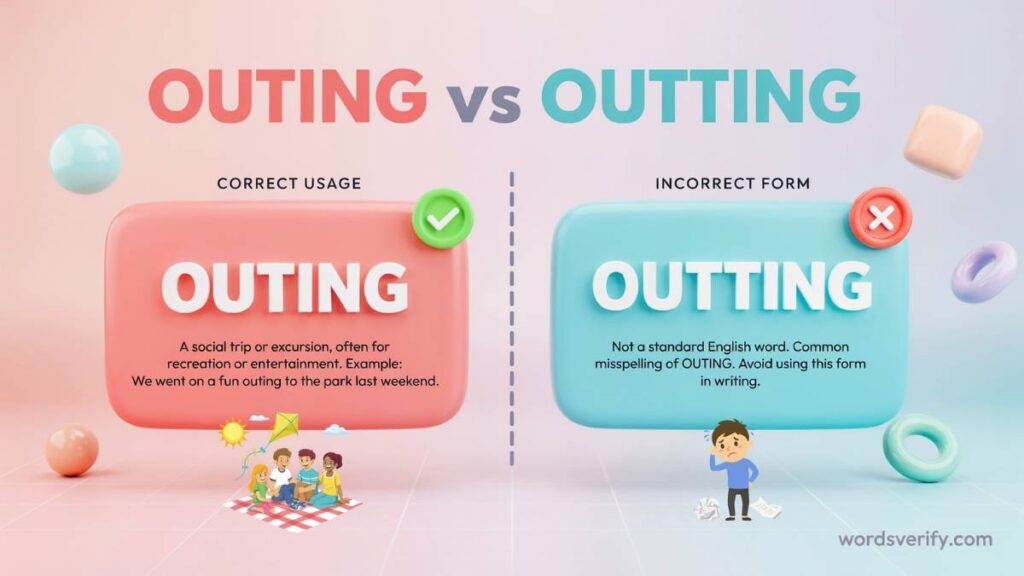
A single extra letter can create quite a spelling puzzle! The confusion over Outting vs Outing is a common example. Both forms may look reasonable at first glance, but only one is correct. The right choice is outing, with just one T. So, why does this word break the pattern that makes some writers double a final consonant before adding -ing? The answer lies in a simple spelling rule. In this article, you’ll discover what outing means, why outting is incorrect, and how to use the word confidently in everyday writing.
Outting vs Outing quick answer
Outing is the correct spelling in standard English. Outting is a common spelling mistake, not an accepted alternative.
The difference comes down to one letter. The correct form contains a single t, while the incorrect form doubles it.
| Spelling | Correct or Incorrect? | Explanation |
|---|---|---|
| Outing | Correct | Standard English spelling |
| Outting | Incorrect | Common misspelling |
| Outings | Correct | Standard plural form |
| Outtings | Incorrect | Incorrect plural spelling |
If you’re unsure which form to use, remember that outing is correct in everyday conversation, school assignments, emails, and professional writing.
For example:
- We planned a family outing to the beach.
- The school organized an outing to the local museum.
- Their weekend outing turned into an unexpected adventure.
- The newspaper discussed the ethical concerns surrounding the outing of a public figure.
The spelling stays the same regardless of the meaning. Whether you’re describing a trip, a social event, or the disclosure of private information, always write outing with one t.
What Is the Correct Spelling of Outing?
The correct spelling is O-U-T-I-N-G.
The word has two parts:
- Out: The base word.
- -ing: The suffix added to form the new word.
Put them together and you get outing.
Out + ing = Outing
This follows a common English spelling pattern. When a base word ends in a vowel combination followed by a consonant, you generally don’t double that final consonant before adding -ing.
Is Outting a Real English Word?
Outting isn’t a recognized standard spelling in contemporary English. You might see it in social media posts, casual messages, or documents containing typing errors. However, its appearance doesn’t make it correct. When comparing Outting vs Outing, remember that standard English uses outing, not outting. Therefore, if you’re wondering how to spell the word, the answer is simple. Outting vs Outing comes down to one unnecessary letter: the extra T has no place in the correct spelling.
Learn the difference between tricky more English words
Excel vs Excell which one is correct?
What Does Outing Mean?
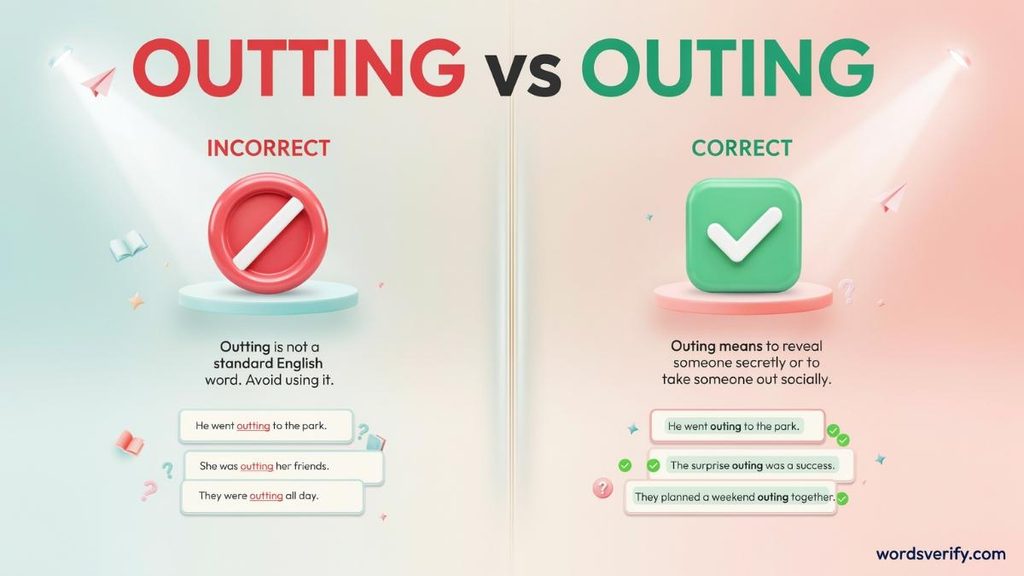
The meaning of outing depends on the context. Most commonly, it describes a short pleasure trip or recreational activity. However, the word also has meanings related to public disclosure and appearances in sports or entertainment.
Outing primarily functions as a noun, although it can also serve as the -ing form of the verb out.
Here are its main meanings:
- A short trip or excursion for pleasure.
- The public disclosure of someone’s previously private identity or information.
- An appearance or performance in a particular event, especially in sports.
Let’s look at each meaning in more detail.
Outing as a Short Trip or Excursion
The most familiar meaning of outing is a short recreational trip away from home. When discussing Outting vs Outing, the correct word describes visiting a place, enjoying an activity, or spending time with other people.
An outing doesn’t have to last several days. Many outings take only a few hours or a single day. You might visit a park, explore a nearby town, spend an afternoon at the beach, or enjoy a meal with friends. These everyday activities are all examples of outing.
Imagine a family that spends Saturday morning at the zoo, has lunch at a nearby restaurant, and returns home before dinner. That activity is a family outing. Understanding Outting vs Outing helps you describe such enjoyable trips without adding an unnecessary T to the word.
Common examples include:
- Family outing: A recreational activity involving parents, children, or relatives.
- School outing: An educational or recreational trip organized by a school.
- Group outing: An activity involving friends, colleagues, or other participants.
- Weekend outing: A short trip or leisure activity during the weekend.
- Business outing: A social or recreational event organized for employees, clients, or business associates.
- Picnic outing: An outdoor meal or gathering in a park, garden, or countryside.
- Outdoor outing: An activity such as hiking, sightseeing, or visiting a nature reserve.
An outing generally focuses on enjoyment, recreation, or spending time together rather than simply traveling from one place to another.
For example:
- The children enjoyed a school outing to the science museum.
- We arranged a weekend outing to explore the countryside.
- Their family outing included a picnic beside the lake.
- The employees went on a business outing after the annual conference.
In each sentence, outing describes an organized or informal recreational experience.
Outing as the Public Disclosure of Private Information
The word has another important meaning in discussions about privacy and personal identity. In the context of Outting vs Outing, the correct spelling refers to publicly revealing someone’s private information without their consent.
Outing someone means publicly revealing information about that person’s identity or private life when they haven’t chosen to share it publicly. This meaning often appears in discussions about sexual orientation and gender identity. For example, someone might reveal that another person is gay, lesbian, bisexual, or transgender without that person’s permission.
Such disclosure can raise serious concerns about privacy, personal safety, discrimination, and individual choice. Understanding Outting vs Outing also means recognizing that the word can carry sensitive social implications.
Consider this situation:
A public figure hasn’t shared their sexual orientation publicly. Another person reveals that information to the media without permission. This act may be described as outing the individual. In this context, Outting vs Outing isn’t just a spelling distinction; the correct form also helps you discuss a sensitive subject accurately.
The term can also apply to revealing other private identities, affiliations, or personal information.
Examples include:
- The journalist faced criticism for outing someone without consent.
- The organization discussed the consequences of publicly outing its members.
- The article examined the ethical questions surrounding the outing of public figures.
- Unauthorized outing can expose people to unwanted attention and discrimination.
Although this meaning differs from a recreational trip, the spelling remains exactly the same.
Outing as a Sports Appearance or Performance
In sports reporting, outing can describe an athlete’s appearance or performance in a particular competition.
The term appears frequently in baseball coverage, where journalists often discuss a pitcher’s latest outing. It can also describe a player’s appearance in a tournament or championship.
For example:
- The pitcher delivered an impressive outing against the opposing team.
- Her first outing of the season showed significant improvement.
- The team struggled during its opening outing of the tournament.
- His previous outing was much stronger than his performance yesterday.
This meaning focuses on a specific appearance or performance rather than a recreational trip.
Learn the difference between tricky more English words
Studder vs Stutter which one is correct?
Why Is Outting Incorrect? Understanding the Spelling Mistake
The main reason people write outting is that English has several words that double their final consonant before adding -ing.
Once you learn that pattern, it’s easy to assume that every word ending in t needs another t. However, English spelling doesn’t work that way. Consonant doubling follows specific conditions.
Consider these examples:
- Sit becomes sitting.
- Run becomes running.
- Get becomes getting.
- Hit becomes hitting.
- Out becomes outing.
The first four words double their final consonant. However, out follows a different pattern because of its vowel structure.
The word out contains the vowel combination ou, which represents a diphthong. This combination produces a different vowel sound from the short vowel sounds in sit, run, and get.
As a result, the final t remains unchanged when you add -ing.
Why Does Outing Have One T Instead of Two?
The answer becomes clearer when you examine the base word.
The consonant-doubling rule generally applies when a word:
- Ends in one consonant preceded by one vowel letter.
- Contains a single short vowel sound.
- Has the stress on its final syllable when it contains more than one syllable.
- Takes a suffix beginning with a vowel, such as -ing or -ed.
For example, sit has one vowel letter, i, followed by the consonant t. The vowel makes a short sound, so the final consonant doubles when you add -ing.
However, out contains two vowel letters, o and u. Together, they represent a diphthong, so the word doesn’t meet the usual consonant-doubling condition.
Compare these examples:
| Base Word | Vowel Pattern | Correct -ing Form |
|---|---|---|
| Sit | One short vowel | Sitting |
| Run | One short vowel | Running |
| Get | One short vowel | Getting |
| Stop | One short vowel | Stopping |
| Wait | Vowel combination | Waiting |
| Rain | Vowel combination | Raining |
| Out | Vowel combination | Outing |
This comparison explains why outing has one t. It doesn’t follow the same pattern as sitting or getting.
Understanding the Diphthong in Out
A diphthong is a vowel sound that moves from one vowel position toward another within the same syllable.
In out, the letters ou produce the /aʊ/ sound, as in house, shout, and about.
This differs from the short /ɪ/ sound in sit or the short /ʌ/ sound in cut.
The distinction matters because consonant doubling depends partly on the vowel structure of the base word.
For example:
- Sit becomes sitting because it ends in a consonant preceded by one short vowel.
- Wait becomes waiting because its vowel combination doesn’t fit that pattern.
- Out becomes outing for the same general spelling reason.
You don’t need to memorize every English suffix rule to spell this word correctly. Just remember that out + ing = outing.
Why Don’t You Double the T When Adding -Ing?
The suffix -ing doesn’t automatically double the final consonant of every base word.
The spelling depends on the word’s final letters and vowel sound. Words with vowel combinations, such as out, generally keep their original final consonant when taking -ing.
Here are a few more comparisons:
| Base Word | Correct Form | Incorrect Form |
|---|---|---|
| Out | Outing | Outting |
| Wait | Waiting | Waitting |
| Rain | Raining | Rainning |
| Read | Reading | Readding |
| Help | Helping | Helpping |
| Walk | Walking | Walkking |
These examples show why adding -ing requires attention to the base word rather than a habit of doubling the last letter.
Outing vs Outting Key Differences
The difference between outing vs outting is spelling, not meaning. Only outing is the standard modern English form.
The incorrect spelling doesn’t represent a separate word with its own accepted definition. Therefore, you shouldn’t use outting to describe a trip, a sports appearance, or public disclosure.
Here’s a closer comparison:
| Feature | Outing | Outting |
|---|---|---|
| Spelling | Correct | Incorrect |
| Number of Ts | One | Two |
| Dictionary status | Standard English word | Nonstandard misspelling |
| Grammatical role | Noun or verb form | No standard grammatical role |
| Meaning | Trip, appearance, or public disclosure | No separate standard meaning |
| Plural | Outings | Outtings is incorrect |
| Example | We planned an outing. | We planned an outting. |
The correct spelling doesn’t change with the context.
For instance, you might write about a school outing in one paragraph and an athlete’s latest outing in another. Both uses require exactly one t.
A useful rule is simple: If you’re writing about a trip, an appearance, or revealing private information, use outing.
Learn the difference between tricky more English words
Choosing vs Chosing which one is correct?
The Origin and History of the Word Outing
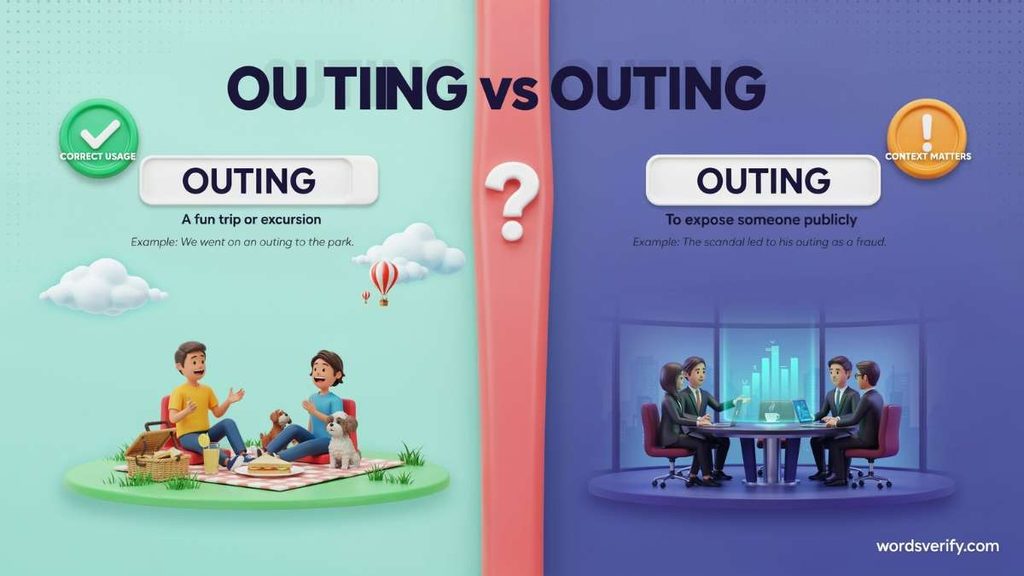
The history of outing helps explain why the word has several meanings today.
The word developed from the verb out combined with the suffix -ing. Its earliest recorded English uses date back to the late Middle English period.
Historical records trace outing to the late 14th century, when it referred to going out or issuing forth. By the middle of the 15th century, it could also describe the act of putting or driving someone out.
Over time, the word developed additional meanings.
How Outing Came to Mean a Pleasure Trip
The modern recreational meaning developed much later.
The word began to describe an excursion or pleasure trip around 1821. This sense refers to temporarily leaving home for enjoyment, sightseeing, or another activity.
As organized leisure activities became more common, outing became a convenient word for describing group excursions, school trips, and recreational visits.
Today, you might hear someone say:
- We’re planning a family outing this weekend.
- The students enjoyed their annual school outing.
- Our summer outing included a picnic and a boat ride.
The modern meaning retains the basic idea of going out, but it emphasizes recreation rather than simply leaving a place.
How Outing Developed Its Meaning of Public Disclosure
The word outing also became associated with revealing someone’s previously private identity.
In contemporary discussions, this meaning frequently concerns sexual orientation or gender identity. It describes making personal information public when the individual hasn’t chosen to disclose it themselves.
The verb out already had meanings connected to exposing, revealing, or making something known. The modern noun outing developed from this broader sense of disclosure.
The word therefore carries different meanings depending on its context. A family outing is a recreational activity, while the outing of a private identity concerns disclosure.
Learn the difference between tricky more English words
Accross vs Across Which one Is Correct?
Is Outing the Same in American and British English?
Yes. The standard spelling is outing in both American and British English.
You don’t need to change the spelling depending on your audience. American, British, Canadian, and Australian English all use the same standard form.
| English Variety | Correct Spelling | Incorrect Spelling |
|---|---|---|
| American English | Outing | Outting |
| British English | Outing | Outting |
| Canadian English | Outing | Outting |
| Australian English | Outing | Outting |
Some English words have genuine regional spelling differences. For example, American English uses color, while British English generally uses colour. Similarly, organize and organise reflect different spelling conventions.
However, outing doesn’t have this type of variation.
Whether you’re writing a school assignment in the United States, a travel article in the United Kingdom, or a business email in Australia, use outing.
There is no standard regional spelling that doubles the final t.
Learn the difference between tricky more English words
Sponsor vs Sponser Which one Is Correct?
How to Use Outing in a Sentence
Knowing the spelling Outing vs Outting is only half the job. You should also understand how to use outing naturally.
The word usually functions as a countable noun when it refers to a trip or an individual appearance. You can use articles such as a and the before it, and you can make it plural by adding -s.
For example:
- We had an outing yesterday.
- The children enjoyed the outing.
- Our family plans several outings every summer.
It can also function as the -ing form of the verb out. In this construction, it describes the action of revealing or exposing someone or something.
Let’s examine its common uses.
Examples of Outing as a Trip or Social Activity
When you use outing to describe a recreational trip, it usually refers to an enjoyable activity outside the home.
Here are some natural examples:
- Our family planned an outing to the beach during the summer.
- The school organized a special outing to the local history museum.
- We enjoyed a weekend outing with friends in the countryside.
- The children were excited about their picnic outing in the park.
- Their business outing included dinner and a friendly bowling competition.
- The hiking outing gave everyone a chance to enjoy the fresh air.
- My parents arranged a family outing to celebrate their anniversary.
- The students returned from their educational outing with plenty of photographs.
- We canceled our outdoor outing because the weather turned unpleasant.
- Their group outing to the amusement park lasted almost the entire day.
Notice how the surrounding words make the meaning clear. Terms such as family, school, picnic, and weekend help readers understand the type of activity.
Examples of Outing as Public Disclosure
The second meaning appears in discussions about privacy, identity, and personal information.
Examples include:
- The journalist questioned the ethics of outing someone without permission.
- The organization condemned the public outing of its members.
- The article examined the effects of unwanted disclosure of sexual orientation.
- The discussion focused on privacy concerns surrounding gender identity disclosure.
- Publicly outing someone can expose that person to unwanted attention.
- The documentary explored the history of outing in media and popular culture.
In these examples, outing doesn’t describe a recreational trip. It refers to making private information public.
Examples of Outing in Sports and Entertainment
Sports journalists frequently use outing to describe an athlete’s appearance in a competition.
The word can also describe a public performance or appearance by an entertainer.
Examples:
- The pitcher delivered an excellent outing in the championship game.
- Her latest outing on the tennis court showed remarkable improvement.
- The athlete struggled during his first outing of the season.
- The team’s opening outing attracted thousands of spectators.
- The actor’s latest film outing received mixed reviews.
- The singer’s television outing introduced her music to a wider audience.
These examples demonstrate why context matters. An athlete’s outing can refer to a competitive appearance, while an actor’s outing may describe a particular performance or public appearance.
Learn the difference between tricky more English words
Chalet vs Château which one is corrcet?
Outing Grammar Noun, Gerund and Present Participle
Understanding the grammar of outing makes it easier to use the word in different sentence structures.
Although outing most commonly appears as a noun, it can also function as the present participle or gerund of the verb out.
Its grammatical role depends on how it works in a sentence.
Outing as a Noun
As a noun, outing refers to a trip, excursion, appearance, or act of public disclosure.
Examples:
- Our annual family outing takes place in July.
- The school arranged an outing for its senior students.
- His latest outing attracted considerable media attention.
In these sentences, outing names an event or activity.
Outing as a Present Participle
The present participle is the verb form created by adding -ing to a base verb.
The verb out can mean to reveal or expose something. Its present participle is outing.
For example:
- The journalist is outing the people involved in the scandal.
- They are outing individuals without considering the consequences.
- The documentary discusses the practice of outing public figures.
Here, outing describes an ongoing action.
Outing as a Gerund
A gerund is an -ing verb form that functions as a noun.
For example:
- Outing someone without consent raises serious ethical concerns.
- Publicly outing another person can violate their privacy.
- Outing individuals against their wishes can cause significant harm.
In these sentences, outing functions as the subject of the sentence.
The important distinction is that the spelling never changes. Whether you use outing as a noun, present participle, or gerund, you always write it with one t.
Learn the difference between tricky more English words
Reins vs Reigns which one is correct?
What Is the Plural of Outing?
The plural of outing is outings.
To make the word plural, simply add -s to the end. You don’t double the final consonant or change any other letters.
The correct forms are:
| Form | Correct Spelling |
|---|---|
| Singular | Outing |
| Plural | Outings |
| Incorrect singular | Outting |
| Incorrect plural | Outtings |
Examples:
- We organized three family outings last summer.
- The school schedules several educational outings each year.
- Their weekend outings usually involve hiking or sightseeing.
- The company arranges regular group outings for its employees.
Is It Outings vs Outtings?
Always use outings when referring to more than one outing.
The spelling outtings is incorrect in standard contemporary English because the original word doesn’t double its final t.
For example:
Incorrect: The children enjoyed several outtings during their vacation.
Correct: The children enjoyed several outings during their vacation.
The same spelling rule applies whether you’re using the singular or plural form.
Learn the difference between tricky more English words
Stellar vs Steller which one is correct?
Outing Pronunciation How Do You Say It?
The correct pronunciation of outing is /ˈaʊtɪŋ/.
The word has two syllables, with the stress on the first syllable.
Its pronunciation can be understood in three parts:
- The opening sound begins with /aʊ/, as in house.
- The middle consonant is a clear /t/ sound.
- The ending /ɪŋ/ sounds like the ending of running or walking.
The pronunciation doesn’t require a doubled t. Adding an extra letter doesn’t create a different standard pronunciation.
You can compare it with these related words:
| Word | Pronunciation |
|---|---|
| Out | /aʊt/ |
| About | /əˈbaʊt/ |
| Shouting | /ˈʃaʊtɪŋ/ |
| Counting | /ˈkaʊntɪŋ/ |
| Outing | /ˈaʊtɪŋ/ |
Connecting the spelling with its pronunciation can make the word easier to remember.
Outing Synonyms and Related Words
The best synonym for outing depends on the meaning you intend to communicate.
When outing describes a recreational trip, several words can express a similar idea. However, they don’t all mean exactly the same thing.
Synonyms for Outing as a Trip
| Synonym | Meaning | Example |
|---|---|---|
| Excursion | A short organized trip, usually for pleasure | The students went on an excursion to the museum. |
| Trip | Travel to a destination and usually back | We planned a trip to the beach. |
| Day trip | A journey completed within one day | They took a day trip to the countryside. |
| Jaunt | A short, enjoyable journey | We went on a little jaunt outside town. |
| Picnic | An outdoor meal or social gathering | The family enjoyed a picnic by the lake. |
| Tour | A journey involving visits to several places | They joined a guided tour of the city. |
| Getaway | A short break away from everyday life | The couple planned a weekend getaway. |
| Expedition | An organized journey with a particular purpose | The researchers began an expedition into the mountains. |
| Field trip | An educational visit outside a classroom | The students went on a field trip to the aquarium. |
Excursion is probably the closest general synonym when you’re describing a short pleasure trip. A field trip works better when education is the main purpose.
Related Words for Outing as Public Disclosure
When outing refers to revealing someone’s private identity, the alternatives require more care.
Some related words include:
- Disclosure
- Exposure
- Revelation
- Identification
- Uncovering
- Public announcement
These terms aren’t perfect substitutes. For example, disclosure can describe the voluntary sharing of information, while outing often suggests revealing something about another person without their consent.
Choosing the right word helps preserve the intended meaning.
Learn the difference between tricky more English words
Cheer vs Chear Which one Is Correct?
Common Spelling Mistakes Related to Outing
The misspelling outting is part of a larger pattern of confusion surrounding English words that take the suffix -ing.
Many writers know that certain words double their final consonant. However, they sometimes apply that rule too broadly.
Here are some common spelling errors and their corrections:
| Incorrect Form | Correct Form | Explanation |
|---|---|---|
| Outting | Outing | The vowel combination prevents consonant doubling. |
| Outtings | Outings | Add only -s to the correct plural form. |
| Waitting | Waiting | The vowel combination remains unchanged. |
| Rainning | Raining | The base word ends in a vowel combination. |
| Helpping | Helping | The final consonant doesn’t meet the doubling conditions. |
| Walkking | Walking | The final consonant isn’t doubled. |
| Sitting | Sitting | Correct doubling after a short vowel. |
| Running | Running | Correct doubling after a short vowel. |
These examples show that English spelling mistakes often happen when writers remember a rule but forget its conditions.
A Simple Way to Avoid the Outting Spelling Mistake
Instead of guessing whether the final consonant needs doubling, examine the base word.
Follow these steps:
- Identify the original word: out.
- Find the suffix you need: -ing.
- Combine the two parts without changing the base spelling.
- Check the result: outing.
This method works because the word doesn’t meet the conditions for doubling its final consonant.
Learn the difference between tricky more English words
Suit vs Suite which one is correct?
How to Remember the Correct Spelling of Outing
A simple memory trick can help you avoid the same spelling mistake.
Remember this formula:
OUT + ING = OUTING
One t is all you need.
You can also remember it by comparing outing with other words that contain the same vowel combination:
- Shout becomes shouting.
- Count becomes counting.
- Sprout becomes sprouting.
- Out becomes outing.
The key is to keep the original spelling intact when adding -ing.
Whenever you hesitate between outting vs outing, break the word into its two parts. The correct form becomes much easier to recognize.
Practice session Outting vs Outing
Choose the correct word to complete each sentence. Remember, outing is the correct spelling, while outting is incorrect.
- We planned a family ______ to the beach last Sunday.
- The school organized an educational ______ for its students.
- Our weekend ______ turned out to be more exciting than expected.
- She enjoys going on a picnic or a short ______ with friends.
- The children were thrilled about their class ______ to the zoo.
- They canceled the outdoor ______ because of heavy rain.
- We had a wonderful ______ in the countryside.
- The company arranged a team-building ______ for its employees.
- Their first ______ together was a visit to the museum.
- Everyone enjoyed the summer ______ organized by the community.
- The newspaper faced criticism for ______ the actor without consent.
- He regretted ______ his friend’s private information.
- The celebrity spoke publicly about being ______ against their wishes.
- She decided against ______ herself before she was ready.
- The article discussed the consequences of ______ someone without permission.
- Our family ______ included a visit to a nearby historical site.
- The children returned home happily after their school ______.
- The baseball pitcher had an impressive ______ during the game.
- The team’s final ______ of the season was a memorable performance.
- We are planning another group ______ for next month.
- A simple day ______ can be a great way to relax.
- The guide recommended a short ______ to explore the nearby village.
- He apologized for ______ his colleague’s personal information.
- The students shared photographs from their weekend ______.
- A successful ______ doesn’t have to involve an expensive trip.
Answers
- outing
- outing
- outing
- outing
- outing
- outing
- outing
- outing
- outing
- outing
- outing
- outing
- outed
- outing
- outing
- outing
- outing
- outing
- outing
- outing
- out
- outing
- outing
- outing
- outing
Here’s a trusted source for clear word meanings:
FAQs
Is “outing” a countable noun?
Yes. “Outing” is a countable noun. You can use it with articles and numbers, such as “an outing,” “two outings,” or “a family outing.”
Why does “outing” have only one t?
“Outing” comes from the verb “out” with the suffix “-ing.” Because “out” ends in two different consonant-vowel-consonant sounds? Actually, the final spelling rule does not require doubling the t here. The correct form is “outing,” not “outting.”
What is the plural of “outing”?
The plural is “outings.” Simply add an “s” to the end.
Example: “Our summer outings usually include trips to the beach and nearby parks.”
What is the difference between an outing and an excursion?
Both words describe trips away from home, but “outing” often suggests a casual social activity, while “excursion” can sound more organized or purposeful.
Example:
- We planned a family outing to the zoo.
- The students went on an educational excursion.
What does “family outing” mean?
A family outing is a trip or activity that family members enjoy together outside the home. It might include visiting a park, going to the movies, having a picnic, or exploring a nearby town.
Can “outing” describe a work-related activity?
Yes. A work outing is a social activity organized for colleagues outside their usual workplace. Examples include team lunches, company picnics, group trips, and recreational events.
What is the difference between “outing” and “outdoor activity”?
An outing refers to a trip or social visit away from home, while an outdoor activity describes something you do outside. An outing may include outdoor activities, but it can also involve indoor destinations such as museums or restaurants.
Can “outing” refer to revealing someone’s private identity?
Yes. In this context, “outing someone” means revealing information about a person’s identity or personal life without their consent. The term is often used when someone discloses another person’s LGBTQ+ identity. This can seriously affect their privacy and safety.
What is the difference between “outing” and “calling someone out”?
“Outing someone” means revealing private information about them, often without permission. “Calling someone out” means publicly challenging their behavior, words, or actions, usually because you believe they have done something wrong.
Is “outing” always a positive experience?
No. In everyday conversation, an outing often refers to an enjoyable trip or social activity. However, in other contexts, the word can describe revealing someone’s private information without consent. Its meaning depends on how it’s used.
What is the difference between “outing” and “outgoing”?
“Outing” is a noun that describes a trip or social activity. “Outgoing” is an adjective that describes someone who is friendly, sociable, and comfortable interacting with others.
Examples:
- We enjoyed a weekend outing.
- My outgoing cousin makes friends everywhere.
How do you use “outing” in a sentence?
Here are five natural examples:
- Our family planned an outing to the beach.
- The school organized an outing for its students.
- We had a wonderful outing with our friends.
- The company arranged a weekend outing for its employees.
- Their first outing together was a visit to the local museum.
What are some alternatives to “outing” in everyday English?
Depending on the context, you can use “trip,” “excursion,” “day out,” “visit,” “get-together,” or “group activity.” For example, “a family outing” could also be described as “a family day out.”
Conclusion
A small spelling mistake can make a big difference, and outting vs. outing is a perfect example. Although adding an extra T might seem harmless, outing is the only correct spelling. Whether you’re writing about a weekend adventure, a public disclosure, or a sports appearance, the word always takes one T. The key is understanding why the final consonant doesn’t double before the suffix -ing. Once you know the rule, this spelling becomes easy to remember. So, the next time you plan an outing or write about one, keep the extra T out of the picture!

Lisa AJS is an experienced blogger and language enthusiast at Words Verify, dedicated to making grammar simple, practical, and enjoyable. She writes engaging content on commonly confused words, grammar mistakes, word meanings, and everyday language challenges.