
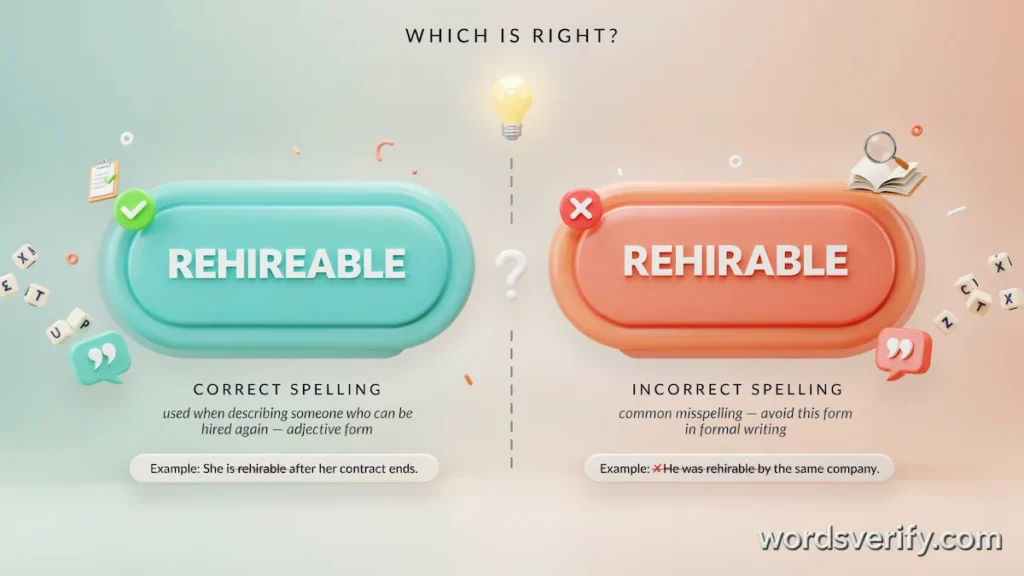
Have you ever tried to describe a former employee who could be hired again, only to pause over “rehireable” vs “rehirable”? You’re not alone. That little letter E can turn an ordinary spelling choice into a surprisingly tricky puzzle. Both forms look correct at first glance, and their similar meanings only add to the confusion. So, which one should you use? The answer lies in how English forms adjectives with the suffix “-able.” In this guide, we’ll explore rehireable vs. rehirable, explain what each form means, examine common usage, and share practical examples to help you write with confidence.
Rehireable vs Rehirable quick answer
Both “rehireable” and “rehirable” communicate the idea that someone can be hired again. They function as adjectives and generally describe a former employee who may qualify for another position with the same employer.
The difference is spelling rather than meaning.
- Rehireable: Keeps the final E in “rehire” before adding “-able.”
- Rehirable: Drops the final E before adding “-able.”
The shorter spelling follows the familiar pattern found in “hirable,” while “rehireable” preserves the complete base word. English spelling allows some variation when writers attach suffixes to words ending in a silent E.
For everyday writing, “rehirable” is a concise choice. However, if you’re preparing a formal employment document, “eligible for rehire” often communicates the intended status more clearly.
Quick Comparison
| Feature | Rehireable | Rehirable |
|---|---|---|
| Word type | Adjective | Adjective |
| Meaning | Capable of being hired again | Capable of being hired again |
| Base word | Rehire | Rehire |
| Suffix | -able | -able |
| Final E | Retained | Dropped |
| Pronunciation | Same | Same |
| Meaning difference | None established | None established |
| General writing | Understandable | Concise choice |
| Formal HR alternative | Eligible for rehire | Eligible for rehire |
The important point is that these spellings don’t describe different employment situations. A person described as rehireable generally has the same intended status as someone described as rehirable.
Is Rehireable a Word?
Yes. “Rehireable” is an understandable adjective formed by combining “rehire” with “-able.” It communicates that someone or something can be hired again.
However, a word’s logical formation doesn’t automatically establish that every dictionary recognizes it as a preferred spelling. Dictionary recognition and everyday usage are related but separate matters.
Is Rehirable a Word?
“Rehirable” is also an understandable formation. It follows the shorter spelling pattern associated with “hirable,” which removes the final E before adding “-able.”
Both forms make sense in employment-related writing. For consistency, choose one spelling and stick with it throughout your document.
Learn the difference between commonly misused words
Monkeys vs Monkies which one is correct?
The Meaning of Rehireable
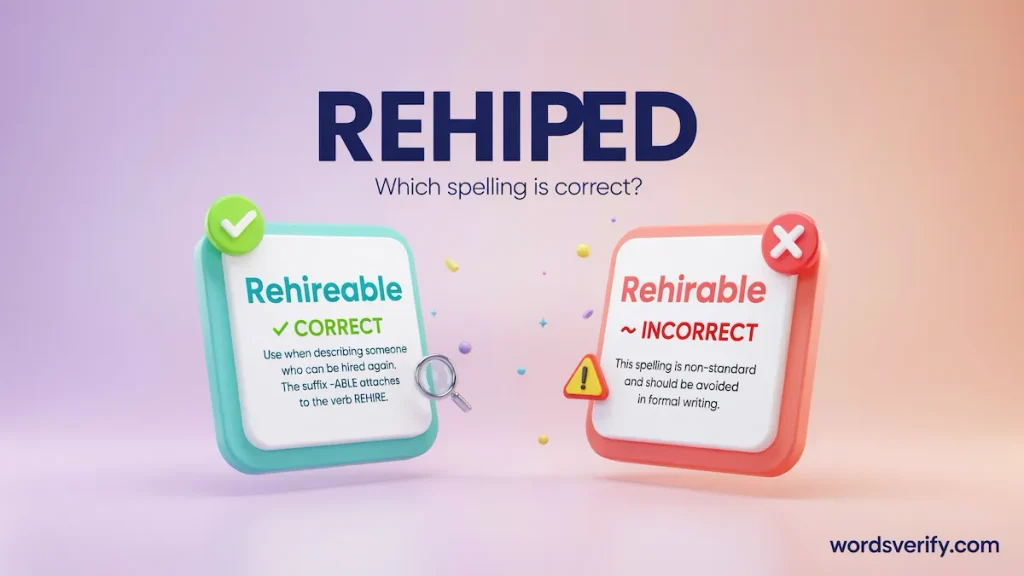
Meaning of rehireable is straightforward: capable of being hired again by a previous employer. The word describes a former employee who may return to an organization after leaving it.
Imagine someone who worked at a retail store for three years before moving to another city. A year later, that person moves back and applies for a position at the same store. If the employer considers the former worker suitable for another job, the person may be described as rehireable.
However, the word doesn’t mean the company has an open position or intends to offer the person a job. It simply describes the possibility of another hiring arrangement.
Rehireable Definition and Word Formation
The meaning becomes easier to understand when you break the word into its parts:
- Re-: A prefix meaning again or anew.
- Hire: A verb meaning to employ someone for work.
- -able: A suffix meaning capable of, suitable for, or able to be.
Together, these elements express the idea of being capable of getting hired again.
| Word part | Meaning | Function |
|---|---|---|
| Re- | Again | Prefix |
| Hire | Employ someone | Base word |
| -able | Capable of | Suffix |
| Rehireable | Capable of being hired again | Adjective |
The prefix changes the meaning of the original verb. While “hire” describes employing someone, “rehire” describes employing that person again.
Adding “-able” then turns the verb into an adjective that describes the possibility of that action.
What Is the Difference Between Rehire and Rehireable?
Although these words share the same root, they perform different grammatical jobs.
“Rehire” is a verb. It describes the action of employing a former worker again.
“Rehireable” is an adjective. It describes someone who may be considered for another job with a previous employer.
Consider these examples:
- The company plans to rehire two former employees next month.
- Both former employees are rehireable under the company’s employment policy.
The first sentence describes an action. The second describes an employment possibility.
This distinction matters when discussing employment history, HR decisions, and future job opportunities.
Learn the difference between commonly misused words
Salvadoran vs Salvadorian Which one Is Correct?
The Meaning of Rehirable

Meaning of rehirable is the same as that of rehireable: able or suitable to be hired again.
The spelling removes the final E from “rehire” before adding “-able.” This creates a shorter adjective without changing its intended meaning.
For example:
- The former manager is rehirable.
- The company considers its previous employees rehirable.
- Her resignation did not affect her rehirable status.
- The hiring manager confirmed that the applicant was rehirable.
In each sentence, the adjective describes a person’s potential eligibility for another job.
Rehirable Definition and Word Formation
The word follows the same basic formation as rehireable. The difference lies in the treatment of the final E.
Rehire becomes rehirable when the final E is dropped before adding “-able.”
This follows a common English spelling convention: writers generally remove a silent final E before adding a suffix that begins with a vowel.
For example:
| Base word | Adjective |
|---|---|
| Use | Usable |
| Move | Movable |
| Like | Likable |
| Size | Sizable |
| Hire | Hirable |
| Rehire | Rehirable |
English spelling has exceptions and alternative forms. For instance, both “likable” and “likeable” appear in standard usage.
The related words “hireable” and “hirable” also demonstrate this variation. Both forms appear in English-language dictionaries and spelling references.
Rehirable as an Adjective
Both rehirable and rehireable function as adjectives. They describe a person, employment status, or candidate’s potential suitability for another position.
You can use the adjective in several ways:
- Before a noun: The company maintains a list of rehirable former employees.
- After a linking verb: The former supervisor is rehirable.
- In an HR assessment: The employee received a positive rehire recommendation.
However, describing someone as rehirable doesn’t mean that person meets every requirement for a particular vacancy. An employer may still review qualifications, experience, availability, and previous performance before making a hiring decision.
Learn the difference between commonly misused words
Attend vs Tend which one is correct?
Why Are Rehireable vs Rehirable Confusing?
The confusion comes down to one small letter: E.
The base word “rehire” ends with a silent E. When you add “-able,” you must decide whether to keep or remove that letter.
English spelling conventions don’t always produce one obvious answer. Some words drop the final E, while others retain it. A few accept both forms.
Consider these examples:
| Base word | Form without final E | Alternative form |
|---|---|---|
| Like | Likable | Likeable |
| Love | Lovable | Loveable |
| Live | Livable | Liveable |
| Hire | Hirable | Hireable |
| Rehire | Rehirable | Rehireable |
These examples explain why writers may choose either form. However, the existence of similar spelling variations doesn’t automatically mean every possible formation receives equal dictionary recognition.
The Silent-E Rule Explained
A common English spelling convention says that writers usually remove a silent final E when adding a suffix that begins with a vowel.
Why does this happen? In many words, the E helps establish the sound of the preceding vowel. When another vowel begins the suffix, that final E may no longer be necessary.
For example:
- Use + -able = Usable.
- Move + -able = Movable.
- Like + -able = Likable.
- Hire + -able = Hirable.
The last example is especially useful because it relates directly to rehireable vs rehirable.
If “hirable” drops the final E, “rehirable” follows the same pattern. However, “hireable” also appears as a recognized alternative, which helps explain why some writers retain the E in “rehireable.”
A useful way to remember the distinction is to look at your preferred spelling of “hireable” and “hirable.” If you use “hirable,” rehirable follows naturally. If you prefer “hireable,” rehireable may feel more consistent.
Does the Extra E Change the Pronunciation?
No. In ordinary English usage, rehireable vs rehirable have the same intended pronunciation.
The extra E doesn’t create another syllable or change the word’s meaning. Both forms retain the pronunciation of the base word “rehire” followed by the “-able” ending.
Readers generally understand either spelling when they encounter it in an employment document or conversation.
Learn the difference between commonly misused words
Hoodie vs Hoody Which one Is Correct?
Rehireable vs Rehirable in American and British English
Does American English prefer rehireable while British English prefers rehirable? There isn’t enough reliable evidence to establish that regional distinction.
It’s better to understand these spellings as variations involving the silent-E rule rather than an established American-versus-British difference.
The related words “hireable” and “hirable” appear in English-language dictionaries and spelling references. However, their recognition doesn’t establish a universal regional preference for the complete words “rehireable” and “rehirable.”
American English Usage
In American English, “rehirable” is a practical, concise choice because it follows the familiar spelling of “hirable.”
You may also encounter “rehireable” in workplace documents, online discussions, and employee records. Its formation is easy to understand because it preserves the complete spelling of “rehire.”
For consistent American English writing, consider using:
- Rehirable employee.
- Rehirable former staff member.
- Eligible for rehire.
- Not eligible for rehire.
The last two expressions are especially useful in professional HR communication.
British English Usage
British English follows the same basic word-building principles, although spelling conventions don’t always produce identical results across every word.
For example, British and American English sometimes differ in words such as “ageing” and “aging.” However, those differences don’t establish a specific regional rule for rehireable vs rehirable.
If you’re writing for a British audience, follow your organization’s preferred dictionary or editorial style guide. More importantly, avoid switching between the two spellings in the same document.
American vs British Spelling Comparison
| Feature | American English | British English |
|---|---|---|
| Rehireable | Understandable formation | Understandable formation |
| Rehirable | Concise formation | Concise formation |
| Meaning | Able to be hired again | Able to be hired again |
| Formal alternative | Eligible for rehire | Eligible for rehire |
| Regional distinction | No established exclusive form | No established exclusive form |
The safest conclusion is simple: don’t treat rehireable vs rehirable as separate regional words. Their difference concerns spelling, not geography or meaning.
Learn the difference between commonly misused words
Outting vs Outing which one is correct?
Which Spelling Should You Use Rehireable vs Rehirable?
If you’re writing an article, email, or informal message, either spelling can communicate your meaning. However, choosing one and using it consistently makes your writing look more polished.
For a concise spelling, rehirable is a sensible option because it follows the pattern of hirable.
For formal employment communication, “eligible for rehire” is often the better choice. It sounds clear, professional, and familiar in HR contexts.
Your choice should depend on the document rather than an assumption that one spelling is universally wrong.
For HR Documents
Human resources departments deal with employee records, separation documents, performance evaluations, and employment verification. These documents need precise wording because other departments and future hiring managers may rely on them.
Instead of writing:
“The former employee is rehireable.”
Consider:
“The former employee is eligible for rehire.”
The second sentence communicates the employment status directly.
HR departments can also use more specific descriptions:
- Eligible for rehire.
- Not eligible for rehire.
- Rehire eligibility subject to management approval.
- Eligible for consideration for future vacancies.
- Rehire status pending review.
These expressions help distinguish a general recommendation from a formal company decision.
For Job Applications
Job applications sometimes ask applicants whether they’ve worked for the company before and whether their previous employer considers them eligible for rehire.
You may encounter a question such as:
“Are you eligible for rehire by your previous employer?”
This question asks about your employment history and rehire eligibility. It doesn’t ask whether you’ve already returned to the organization.
For example:
Question: Are you eligible for rehire by your previous employer?
Answer: Yes. I left my previous position voluntarily and maintained a positive working relationship with the company.
Another possible answer:
Answer: I’m unsure of my previous employer’s current rehire policy and would recommend confirming my status with its HR department.
Be honest when answering these questions. Employers may conduct reference checks or employment verification to confirm information about your previous position.
For Emails and Workplace Communication
In everyday workplace communication, either spelling can work when the reader understands the context.
However, a direct phrase often sounds more natural.
Less direct:
“Please confirm whether the employee is rehirable.”
Clearer:
“Please confirm whether the employee is eligible for rehire.”
Here are additional examples:
- HR confirmed that the former employee is eligible for rehire.
- The hiring manager wants to review the employee’s previous performance before making a rehire decision.
- Please update the employee’s rehire status in the personnel records.
- The company may consider former employees for future vacancies.
- The employee’s rehire eligibility remains subject to management approval.
Notice how the wording changes according to the information you want to communicate. Sometimes an adjective is enough. In other cases, a complete employment-status phrase is more useful.
For General Writing
For general writing, rehirable is a concise option. It works when you want to describe a former employee’s potential to return to an organization.
For example:
“The company considers several former employees rehirable because they left in good standing.”
You can also choose “rehireable” if it matches the spelling convention used throughout your document.
However, don’t force either adjective into a sentence when a simpler expression works better. “Can be hired again” and “eligible for rehire” are often easier for general readers to understand.
Learn the difference between commonly misused words
Excel vs Excell which one is correct?
Rehireable vs Rehirable Examples in Everyday Writing
Examples make the spelling difference easier to remember. Both adjectives describe the possibility of hiring a former employee again, but the surrounding sentence determines whether the wording sounds natural.
Rehireable Examples in Sentences
Here are examples showing how to use rehireable in a sentence:
- The company considers the former sales manager rehireable because of her excellent performance.
- HR marked the employee as rehireable after reviewing his resignation record.
- Employees who leave on good terms may remain rehireable.
- The hiring manager confirmed that the previous worker was rehireable.
- Her professional conduct made her a strong candidate for future employment.
- The company maintains records of rehireable former employees.
- Although he left two years ago, his previous employer still considers him rehireable.
- The HR department must verify whether the applicant is rehireable before proceeding.
- The employee received a positive rehire recommendation from her former supervisor.
- A rehireable employee may still need to complete the standard application process.
These examples show that rehireable usually appears in employment discussions, particularly when companies evaluate former staff members.
Rehirable Examples in Sentences
The following examples demonstrate the same meaning with the shorter spelling:
- The former employee is rehirable under the company’s current policy.
- The manager considers him a reliable and rehirable candidate.
- Her previous employer confirmed that she was rehirable.
- Employees who resign voluntarily may remain rehirable.
- The company reviews each former employee’s rehirable status individually.
- His strong job performance made him a suitable candidate for reemployment.
- The HR team confirmed that the previous worker was rehirable.
- The employee’s termination record may affect whether the company considers him rehirable.
- Former staff members are not automatically rehirable after leaving the organization.
- The company considers qualified former employees rehirable when suitable vacancies become available.
Both sets communicate the same general idea. The spelling changes, but the intended meaning remains intact.
Rehireable vs Rehirable in Professional Emails
Workplace emails often require clear and direct language. When discussing a previous employee, avoid vague statements that leave the reader guessing about the person’s status.
Consider this example:
Subject: Former Employee Rehire Eligibility
Hello,
Could you please confirm whether the former employee is eligible for rehire? We would like to review the previous employment record before moving forward with the application.
Thank you.
This wording works better than simply asking whether the person is “rehireable” because it identifies the specific information HR needs to confirm.
Rehireable vs Rehirable in HR Records
HR departments may use internal labels to record whether a previous employee can return.
| Employee status | Meaning |
|---|---|
| Eligible for rehire | The employee may be considered for another position |
| Not eligible for rehire | The employee doesn’t meet the organization’s rehire criteria |
| Pending review | The company hasn’t made a final determination |
| Eligible with approval | Additional management authorization is required |
| Rehired | The former employee has already returned |
These labels are examples of workplace terminology rather than universal employment classifications. Each organization may use its own HR policies and procedures.
Learn the difference between commonly misused words
Studder vs Stutter which one is correct?
Rehireable vs Eligible for Rehire What’s the Difference?
Although people sometimes use these expressions interchangeably, “rehireable” and “eligible for rehire” aren’t always identical in professional communication.
Rehireable describes someone’s general ability or suitability to be hired again. Eligible for rehire usually communicates that a person meets an employer’s requirements or has an acceptable rehire status.
The distinction becomes important when an HR department records employment decisions.
For example, a former employee might have excellent qualifications and relevant experience. However, the company may have a policy that requires additional approval before rehiring someone who left during a probationary period.
The person could be a suitable candidate in a general sense without having automatic rehire eligibility under that organization’s rules.
Comparison Table
| Expression | Meaning | Best context |
|---|---|---|
| Rehireable | Capable of being hired again | General writing |
| Rehirable | Same intended meaning | General writing |
| Eligible for rehire | Meets the employer’s rehire requirements | HR records |
| Not eligible for rehire | Doesn’t meet the company’s eligibility criteria | Employment documentation |
| Rehired | Has already returned to employment | Employment history |
| Recommended for rehire | A previous supervisor supports rehiring the person | Reference checks |
The difference between “eligible for rehire” and “recommended for rehire” is especially important.
An employee may meet a company’s rehire requirements without receiving a positive recommendation from a former supervisor. Likewise, a supervisor may recommend someone, but the organization might still need to complete its formal approval process.
What Is the Professional Alternative to Rehireable?
If you want a professional alternative to rehireable, choose a phrase that explains the employee’s actual status.
Here are several useful options:
- Eligible for rehire: The person meets the employer’s reemployment requirements.
- Available for reemployment: The person may be considered for another employment opportunity.
- Suitable for future employment: The person appears appropriate for future consideration.
- Recommended for rehire: A manager or supervisor supports bringing the former employee back.
- Approved for rehire: The organization has authorized the person to be rehired.
- Eligible for future consideration: The person may be considered for an appropriate vacancy.
These phrases aren’t exact substitutes in every situation. For example, “approved for rehire” suggests a more definite decision than “suitable for future employment.”
Choose the phrase that accurately reflects what the employer has decided.
Learn the difference between commonly misused words
Choosing vs Chosing which one is correct?
What Does Not Eligible for Rehire Mean?
“Not eligible for rehire” means an employer has determined that a former employee doesn’t meet its requirements for returning to the organization.
This status may appear in employee records, separation documents, or internal HR systems.
However, it doesn’t have one universal meaning across all companies. Employers establish their own rehire policies, and the reasons for an ineligible status can differ.
For example, one organization may consider repeated attendance violations a reason to deny future employment. Another may review the circumstances individually before making a decision.
Common Reasons an Employee May Be Ineligible for Rehire
Several circumstances may affect a former employee’s rehire eligibility.
- Poor job performance: An employee who consistently failed to meet workplace expectations may receive an unfavorable rehire recommendation.
- Serious misconduct: Workplace harassment, dishonesty, theft, or significant policy violations may affect future employment opportunities.
- Attendance problems: Repeated unexplained absences, excessive lateness, or failure to follow attendance procedures may influence an employer’s decision.
- Involuntary termination: Some organizations review employees who were dismissed for cause more closely than those who resigned voluntarily. However, termination alone doesn’t automatically make someone ineligible everywhere.
- Failure to follow company procedures: An employee who abandons a position without proper notice or fails to return company property may face restrictions under the organization’s policy.
- Unsatisfactory employment history: A pattern of workplace conflicts, disciplinary action, or poor performance may influence the employer’s assessment.
These are possible factors, not universal rules. An employer should evaluate the circumstances and follow its established policies.
Can an Employee Be Rehired After Termination?
Yes. An employee can be rehired after termination in many circumstances.
Being terminated doesn’t automatically mean someone can never work for the same organization again. The outcome depends on the reason for termination, the company’s rehire policy, the employee’s previous performance, and the circumstances surrounding the separation.
Consider two examples.
Case study: Employee dismissed because of restructuring
A company eliminates several positions after losing a major client. One employee loses their job because the organization no longer needs that role. The employee had a strong performance record and maintained good relationships with colleagues.
Six months later, business improves and the company opens a similar position. Because the previous termination resulted from restructuring rather than misconduct, the employer may consider rehiring the former employee.
Case study: Employee dismissed for serious misconduct
Another employee loses their job after repeatedly violating workplace safety procedures despite receiving warnings. The company records the termination and determines that the employee doesn’t meet its rehire requirements.
Even if the person applies again several months later, the employer may decline the application based on its company policy.
These examples show why the circumstances behind employee termination matter more than the simple fact that someone previously left the organization.
Learn the difference between commonly misused words
Accross vs Across Which one Is Correct?
How Do Employers Determine Rehire Eligibility?
Rehiring former employees can benefit organizations. Previous employees already understand certain workplace procedures, company expectations, and internal systems.
However, familiarity alone doesn’t make someone a suitable returning employee. Employers still need to evaluate the person’s qualifications and employment history.
The HR department and hiring manager may consider several factors before making a rehire decision.
Previous Job Performance
An employee’s previous performance provides useful information about their suitability for another position.
Employers may review:
- Performance evaluations.
- Attendance and punctuality records.
- Productivity and work quality.
- Teamwork and communication.
- Previous disciplinary action.
- Feedback from supervisors.
A strong performance history may support a positive rehire recommendation.
Reason for Leaving
The circumstances surrounding an employee’s departure can influence the employer’s decision.
For example, voluntary resignation, retirement, relocation, and organizational restructuring provide different reasons for ending employment.
An employee who resigned to pursue further education may receive a different rehire assessment from someone who left after serious workplace misconduct.
Neither situation automatically determines the final outcome. The employer must consider the relevant facts.
Previous Employer Reference Checks
Reference checks can help employers understand how a former employee performed in an earlier position.
A hiring manager may contact a previous supervisor or HR representative to confirm:
- Employment dates.
- Previous job title.
- Main responsibilities.
- Performance history, where disclosure is permitted.
- Eligibility for rehire, if the employer provides that information.
However, not every organization shares detailed employee evaluations. Some limit employment verification to basic information such as job title and employment dates.
Company Rehire Policy
A company rehire policy establishes the conditions under which former employees may return.
It may cover:
- Employees who resign voluntarily.
- Employees who leave because of restructuring.
- Employees who retire and later seek another position.
- Employees who receive disciplinary action.
- Employees who leave without following company procedures.
- Employees who previously worked on temporary or contractual arrangements.
Some companies also require former employees to wait a specific period before applying again.
The exact rules depend on the organization. There isn’t one universal rehire eligibility policy that applies to every employer.
Current Job Requirements
Even when a former employee has an excellent employment record, the company must determine whether that person meets the requirements of the available position.
For example, a former customer service representative may have been eligible for rehire after leaving voluntarily. However, returning to a technical management position may require additional experience or qualifications.
The employer should evaluate the applicant as a potential employee rather than assuming that previous employment guarantees another opportunity.
The Rehire Assessment Process
A typical rehire assessment may follow these steps:
- Review previous employment records. HR checks the employee’s personnel records, employment dates, and reason for leaving.
- Evaluate previous performance. The company reviews available performance evaluations, attendance records, and disciplinary history.
- Check rehire eligibility. HR determines whether the former employee meets the organization’s rehire policy.
- Review current qualifications. The hiring manager compares the candidate’s skills and experience with the requirements of the available position.
- Complete necessary checks. The employer may conduct reference checks, employment verification, and other standard hiring assessments.
- Make the final hiring decision. The organization decides whether to proceed with the application and issue an employment offer.
This process helps employers make informed decisions rather than relying solely on a former employee’s previous relationship with the organization.
Learn the difference between commonly misused words
Sponsor vs Sponser Which one Is Correct?
Common Mistakes When Using Rehireable vs Rehirable
Even though these spellings are easy to understand, writers sometimes use them incorrectly or confuse them with related employment terms.
Here are some common mistakes worth avoiding.
Treating Rehireable vs Rehirable as Different Words
The extra E doesn’t create a new employment meaning.
Both forms describe the possibility of hiring someone again. Avoid assigning different definitions to them.
Writing Rehireble
“Rehireble” is a misspelling because it removes the E from the base word without following the correct formation.
The two forms discussed in this article are:
- Rehireable.
- Rehirable.
Remember that the base word is “rehire,” not “rehir.”
Confusing Rehired With Rehirable
These words describe different situations.
- Rehired: Someone has already been hired again.
- Rehirable: Someone may be hired again.
For example:
Incorrect: “The company has rehirable the former manager.”
Correct: “The company has rehired the former manager.”
Another correct example: “The former manager is rehirable.”
Using Rehireable When You Mean Rehire
The verb “rehire” describes the action of employing someone again. The adjective “rehireable” describes the possibility of that action.
Compare:
- The company plans to rehire its former accountant.
- The former accountant is eligible for rehire.
The first sentence describes a hiring decision. The second describes eligibility.
Assuming Rehire Eligibility Guarantees Employment
A former employee may qualify for rehire but still fail to receive an offer.
The company may not have an appropriate vacancy. The applicant may lack a required qualification. Another candidate may have more relevant experience.
Eligibility means the door may be open. It doesn’t mean someone has already walked through it.
Switching Spellings in the Same Document
Using rehireable in one paragraph and rehirable in the next can make a document look inconsistent.
Choose your preferred form and apply it throughout the article, report, or email. If you’re following a company style guide, use the spelling it recommends.
Practice Session Rehireable vs Rehirable
Test your understanding of rehireable, rehirable, and related employment terms. Fill in each blank with the most appropriate word or phrase. This is a practice exercise, not a quiz, so take your time!
Fill in the Blanks
- An employee who can be hired again is considered __________.
- The company confirmed that Maria was eligible for __________.
- The manager decided to __________ a former employee who had performed well.
- James was __________ after leaving the company for two years.
- The HR department is currently __________ several former employees.
- The phrase “eligible for __________” is common in professional HR documents.
- The word __________ is the past-tense form of “rehire.”
- A former employee may be considered for another position if they left in good __________.
- The company decided not to __________ the employee because of repeated performance issues.
- The adjective __________ drops the final E from “rehire” before adding “-able.”
- The word __________ keeps the final E when the suffix “-able” is added.
- HR records should clearly state whether a former employee is eligible for __________.
- The company has a policy of considering former staff for __________.
- After completing a successful interview, the former employee was __________.
- The manager is reviewing the employee’s __________ status before making a hiring decision.
- The company may __________ experienced workers when new positions become available.
- “Rehire” is generally written as one word rather than __________.
- A former employee’s work history can influence their eligibility for __________.
- The company is __________ employees who previously worked at its other locations.
- “Eligible for rehire” is often clearer than using the less familiar adjective __________.
- An employee who resigns professionally may remain eligible for __________.
- The HR manager explained that being rehirable does not guarantee another job __________.
- The company updated its records after the former worker was __________.
- The term “rehiring” refers to the process of employing someone __________.
- Before applying again, check whether your previous employer considers you eligible for __________.
Answers
- Rehirable
- Rehire
- Rehire
- Rehired
- Rehiring
- Rehire
- Rehired
- Standing
- Rehire
- Rehirable
- Rehireable
- Rehire
- Rehire
- Rehired
- Rehire eligibility
- Rehire
- Re-hire
- Rehire
- Rehiring
- Rehireable
- Rehire
- Offer
- Rehired
- Again
- Rehire
Here’s a trusted source for clear word meanings:
FAQs
Which spelling is better rehireable vs rehirable?
Both spellings are understandable and communicate the idea of being suitable for another hire. However, “rehirable” is the shorter form because it drops the final E from “rehire” before adding “-able.” In formal writing, “eligible for rehire” is often the clearest alternative.
Does adding “-able” to rehire require dropping the final E?
Not always. English spelling rules vary when adding “-able” to words ending in silent E. Some words drop the E, while others retain it. “Rehirable” follows the dropped-E pattern, whereas “rehireable” keeps the original E.
Is rehireable recognized in standard dictionaries?
“Rehireable” is an understandable formation, but it may not appear as a standard entry in major dictionaries. If you want to avoid uncertainty in professional writing, use “eligible for rehire.”
Is rehireable the same as eligible for rehire?
The expressions are closely related, but they aren’t always interchangeable. “Rehireable” describes someone who can be hired again, while “eligible for rehire” is a common HR phrase describing a former employee’s status under company policy.
Does being rehirable mean an employer must hire you again?
No. Being rehirable doesn’t guarantee another job offer. It simply suggests that a former employee may be considered for another position. The employer can still evaluate qualifications, experience, references, and current hiring needs.
How should HR describe a former employee who can return?
HR can use “eligible for rehire” because it’s clear, professional, and widely understood in employment contexts. For example: “The employee left in good standing and is eligible for rehire.”
Can rehireable describe a company rather than an employee?
It can be understood that way in a suitable context, but it’s more commonly used to describe a person’s potential for being hired again. To describe a company’s hiring policy, phrases such as “open to rehiring former employees” are clearer.
What is the difference between rehire, rehired, and rehiring?
These words are different grammatical forms of the same verb:
- “Rehire” is the base verb: The company may rehire the former employee.
- “Rehired” is the past-tense or past-participle form: She was rehired last month.
- “Rehiring” is the present participle or gerund: The company is rehiring former staff.
Should you write rehire or re-hire?
“Rehire” is generally written as one word in modern English. The hyphenated form “re-hire” may appear in some writing, but the closed form is the more straightforward choice for everyday and professional use.
What phrase should you use instead of rehireable on a resume?
“Eligible for rehire” is a suitable alternative when describing your employment status. However, you should only include it if you know the statement is accurate. You can also write that you are “open to returning to a former employer” when discussing your interest in another position.
Is rehireability a proper word?
“Rehireability” is a possible formation meaning the quality or status of being suitable for rehire. However, it may sound awkward in formal workplace communication. “Eligibility for rehire” is usually more natural and easier for readers to understand.
Does rehireable mean the same thing as reemployable?
The meanings are similar, but the words have slightly different uses. “Rehireable” usually refers to someone who can return to a previous employer. “Reemployable” has a broader meaning and can describe someone who is capable of obtaining employment again, including with a different organization.
Conclusion
The difference between rehireable vs rehirable may come down to one small letter, but that doesn’t make the spelling any less confusing. Both forms are understandable, yet they follow slightly different approaches to forming adjectives with “-able.” Rehirable drops the final E from “rehire,” while rehireable keeps it. If you’re writing a formal HR document, “eligible for rehire” is often the clearest and most professional choice. Now you can put this spelling puzzle behind you. After all, deciding whether a former employee can return should be harder than deciding where one little E belongs!

Lisa AJS is an experienced blogger and language enthusiast at Words Verify, dedicated to making grammar simple, practical, and enjoyable. She writes engaging content on commonly confused words, grammar mistakes, word meanings, and everyday language challenges.