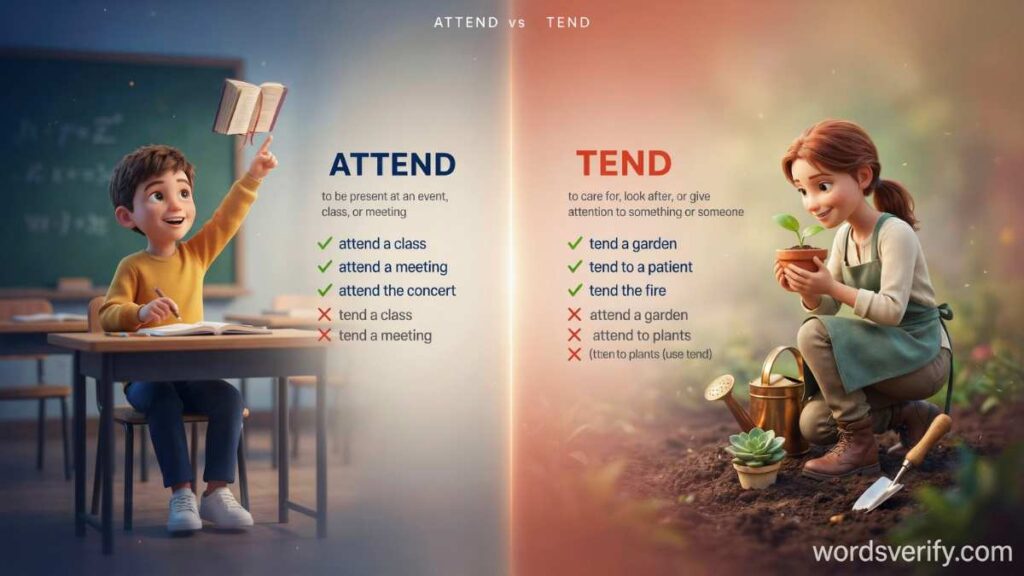
Have you ever mixed up attending a meeting with tending a garden? These two words may look and sound similar, but they serve very different purposes. The confusion between Attend vs Tend can easily sneak into your writing and turn an otherwise clear sentence into an amusing mix-up. After all, showing up for a meeting isn’t quite the same as taking care of a garden! Fortunately, understanding the difference is simple once you know what each word means. In this guide, you’ll explore their definitions, discover how to use them correctly, and learn to avoid common grammar mistakes.
Attend vs Tend Quick Answer
The Attend vs tend are both verbs, but they describe different actions.
Attend means to be present at an event or give attention to someone or something.
Tend means to care for or look after someone or something. It can also describe a habit or something that is likely to happen.
Consider these examples:
- Attend: Sarah will attend the conference on Friday.
- Tend: Sarah tends to arrive early for important meetings.
- Attend to: The receptionist will attend to your request.
- Tend to: The nurse will tend to the patient’s needs.
The difference lies in what each sentence describes. Attend often relates to presence or dealing with a matter, while tend relates to care or a general pattern of behavior.
| Feature | Attend | Tend |
|---|---|---|
| Part of speech | Verb | Verb |
| Main meaning | Be present or give attention | Care for or be likely to |
| Common structure | Attend + noun | Tend + noun |
| Another structure | Attend to + noun | Tend to + noun or verb |
| Common contexts | Meetings, classes, events | Habits, caregiving, gardening |
| Past tense | Attended | Tended |
| Present participle | Attending | Tending |
| Related noun | Attendance | Tendency |
A simple way to remember the difference is this: you attend an event, but you tend to a garden. You attend to a problem, but you tend to make mistakes.
Learn the difference between tricky more English words
Hoodie vs Hoody Which one Is Correct?
What Does Attend Mean?
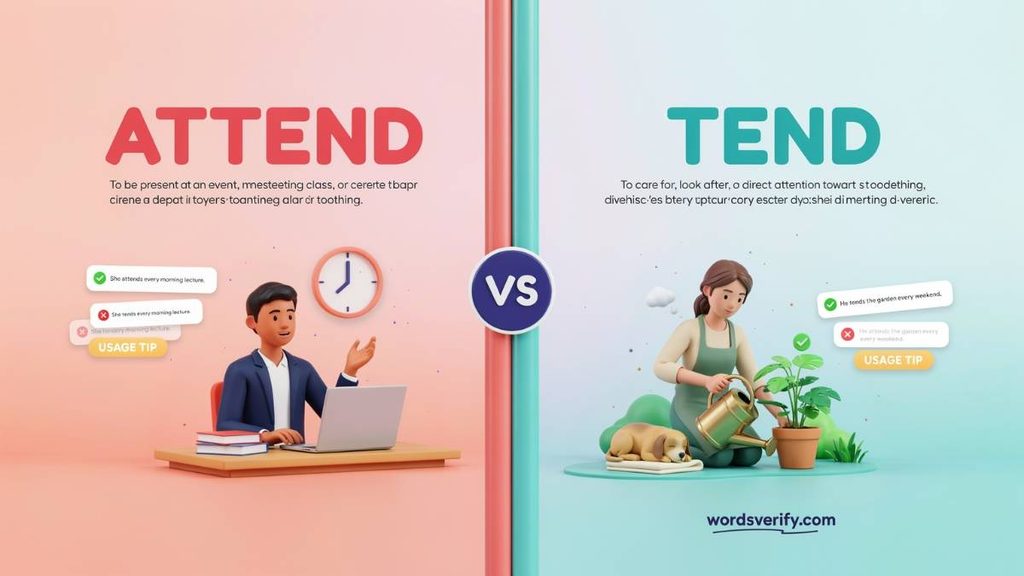
Attend means to be present at an event, meeting, class, or other activity. It can also mean to give attention to someone or deal with something that needs your help.
For example:
- I attend a weekly business meeting.
- The students attend school five days a week.
- The manager attended to the customer’s complaint.
- A nurse attended to the injured passenger.
In the first two sentences, attend describes being present. In the last two, attend to means giving attention or dealing with someone’s needs.
The meaning depends on how you use the word.
Attend as a Verb
Attend is an action verb. It describes something a person does, such as going to a meeting, joining a class, or giving attention to a particular matter.
When attend means being present, it usually takes a direct object without a preposition.
For example:
- She attends university.
- They attended the wedding.
- We attended the training session.
- My brother attends evening classes.
In each sentence, the word following attend identifies the event or institution someone is present at.
However, attend has another common construction: attend to. This expression means to give attention to, handle, or deal with something.
For example:
- Please attend to the paperwork before leaving.
- The assistant attended to the visitor’s questions.
- I need to attend to an urgent matter.
Here, nobody is attending an event. Instead, someone is dealing with a task or responding to a need.
Attend an Event, Class or Meeting
One of the most common uses of attend involves being present at an organized activity. You can attend almost any gathering, appointment, educational activity, or professional event.
Common expressions include:
- Attend an event.
- Attend a meeting.
- Attend school.
- Attend university.
- Attend a conference.
- Attend a wedding.
- Attend a class.
- Attend a lecture.
- Attend an appointment.
- Attend a formal function.
For example, consider this sentence:
“Michael will attend a conference in Chicago next month.”
This means Michael plans to be present at the conference. It doesn’t necessarily mean he’ll give a speech, present research, or take an active part in every discussion.
That’s an important distinction. Attending something means being present, not necessarily participating actively.
Compare these sentences:
- Emma attended the lecture but didn’t ask any questions.
- Emma participated in the lecture by answering questions and sharing ideas.
Both describe involvement in an educational setting. However, participate suggests a more active role.
Attend To Someone or Something
Adding to after attend changes its meaning. Attend to means to give attention to someone, handle a task, or deal with a particular matter.
You might use this expression when someone needs assistance or a responsibility requires attention.
For example:
- The doctor attended to the injured cyclist.
- Please attend to the customer’s complaint.
- I have several emails to attend to.
- The manager attended to the urgent paperwork.
The expression appears in many everyday and professional situations.
| Expression | Meaning |
|---|---|
| Attend to a customer | Give the customer assistance |
| Attend to a problem | Deal with the problem |
| Attend to paperwork | Handle necessary documents |
| Attend to business | Deal with business matters |
| Attend to someone | Give someone attention or assistance |
| Attend to responsibilities | Handle assigned duties |
You might also hear someone say, “I have several matters to attend to.”
This simply means the person has tasks or responsibilities that need attention.
Examples of Attend in Sentences
Here are some everyday examples showing how attend works in different situations.
- My sister attends university in California.
- We attended a wedding last Saturday.
- The employees must attend the safety training session.
- David attends a fitness class every morning.
- The director will attend the annual conference.
- Several important guests attended the opening ceremony.
- The teacher attended to the student’s concerns.
- Please attend to the documents before the deadline.
- The nurse attended to the patient immediately.
- I cannot attend the meeting because I have another appointment.
Learn the difference between tricky more English words
Outting vs Outing which one is correct?
What Does Tend Mean?
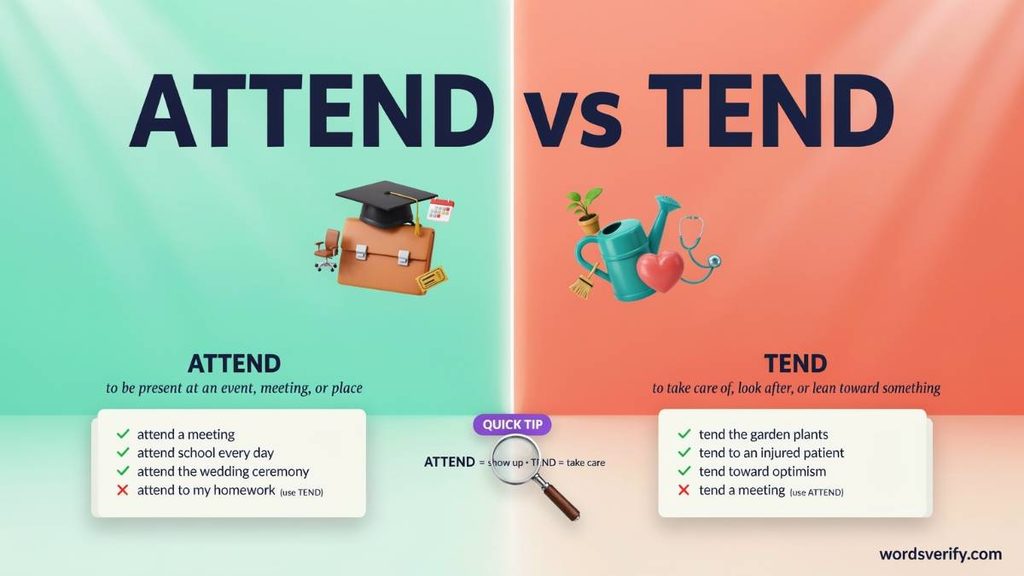
Tend has two main meanings. It can describe something someone usually does or something that is likely to happen. It can also mean to look after, care for, or maintain someone or something.
For example:
- Children tend to ask many questions.
- I tend to drink coffee in the morning.
- She tends her garden every weekend.
- The farmer tends his animals carefully.
The first two sentences describe habits or tendencies. The last two describe caring for something.
Although these meanings belong to the same verb, they follow different sentence patterns.
Tend as a Verb
Tend describes either a recurring pattern or an action involving care and maintenance.
When it describes a tendency, it commonly appears with to followed by a base verb.
For example:
- People tend to forget small details.
- Prices tend to increase during periods of high demand.
- My brother tends to speak quickly.
- Young children tend to learn through observation.
When tend means to care for something, it can take a direct object without to.
For example:
- She tends her garden.
- The farmer tends his cattle.
- He tends the fire while everyone prepares dinner.
These examples show why context matters. The words surrounding tend help you understand its intended meaning.
Tend to Mean “Usually Do” or “Be Likely To”
One of the most common uses of tend is to describe a habit, general behavior, or recurring pattern.
The expression tend to followed by a base verb means that something usually happens or that someone is likely to behave in a particular way.
For example:
- I tend to wake up early.
- People tend to feel tired after a long journey.
- My dog tends to bark whenever someone rings the doorbell.
- Students tend to perform better when they prepare consistently.
These sentences describe general patterns rather than fixed rules.
For instance, saying “I tend to wake up early” doesn’t mean you wake up early every morning without exception. It simply describes your usual behavior.
You can also use this construction when discussing nature, business, and everyday situations.
- Hot air tends to rise.
- Small businesses tend to face financial challenges during their early years.
- Some plants tend to grow faster in warm weather.
- Online shopping trends tend to change over time.
Remember this grammar rule: when tend describes a tendency, use to followed by the base form of the next verb.
Correct:
- She tends to work late.
- They tend to arrive early.
Incorrect:
- She tends working late.
- They tend arriving early.
The word to introduces the infinitive in this construction.
Tend to Mean “Take Care Of”
Tend also means to look after, provide care for, or maintain something.
This meaning often appears in gardening, agriculture, healthcare, and everyday responsibilities.
For example:
- The gardener tends the flowers every morning.
- Farmers tend their crops throughout the growing season.
- The nurse tended the injured patient.
- He tends the fire while his family prepares dinner.
You can use tend when talking about people, animals, plants, and other things that need regular attention.
Common expressions include:
- Tend a garden.
- Tend crops.
- Tend animals.
- Tend a fire.
- Tend patients.
- Tend livestock.
- Tend plants.
- Tend a farm.
Consider the difference between these sentences:
- I tend to forget my keys.
- I tend my neighbor’s garden.
The first describes a recurring habit. The second describes taking care of a garden.
The same verb creates two different meanings because the sentence structure changes.
Examples of Tend in Sentences
Here are more examples showing both meanings of tend.
- I tend to drink tea before going to bed.
- Children tend to become curious about new things.
- She tends to arrive late when traffic gets heavy.
- Prices tend to fluctuate during uncertain economic periods.
- My father tends his vegetable garden every morning.
- The farmer tends his sheep during the winter.
- The nurse tended the injured patient.
- He carefully tended the fire throughout the night.
- Some people tend to avoid difficult conversations.
- These plants tend to grow well in direct sunlight.
Learn the difference between tricky more English words
Excel vs Excell which one is correct?
Attend vs Tend Key Differences

Now that both verbs are clear, it’s easier to understand why people sometimes confuse them. They share some connections with attention and responsibility, but their meanings aren’t interchangeable.
The difference becomes particularly clear when you examine their definitions, grammar, and common uses.
Difference in Meaning
Attend generally refers to being present or giving attention to a particular matter. Tend describes a likelihood, habitual behavior, or an act of care.
Consider these contrasting examples:
| Attend | Tend |
|---|---|
| I attend a weekly meeting. | I tend to work late. |
| She attends university. | She tends her garden. |
| He attended the wedding. | He tended the animals. |
| The assistant attended to the complaint. | The assistant tended to the customer’s needs. |
The last pair is particularly interesting. Both expressions can describe responding to someone’s needs. However, attend to often emphasizes addressing or handling a particular matter, while tend to can emphasize providing care.
Difference in Grammar and Sentence Structure
Understanding the grammar of attend vs tend helps you avoid mistakes, even when you’re unsure about their exact meanings.
Both verbs can take objects, but they follow different grammatical patterns.
Attend commonly follows these structures:
- Attend + noun: She attends university.
- Attend + event: They attended the ceremony.
- Attend to + noun: He attended to the problem.
Tend commonly follows these structures:
- Tend + noun: She tends the garden.
- Tend to + base verb: He tends to complain.
- Tend to + noun: The nurse tends to the patient.
Notice that tend doesn’t always require to. Its use depends on the intended meaning.
For example:
- Correct: She tends the plants.
- Correct: She tends to the plants.
- Correct: She tends to water the plants.
- Incorrect: She tends watering the plants.
The first two sentences describe caring for plants. The third describes a habit. The last sentence uses the wrong construction for that meaning.
Difference in Common Contexts
The two verbs also appear in different situations.
Attend commonly appears in:
- Education: attend school, attend university, attend a class.
- Professional life: attend a meeting, attend a conference.
- Social activities: attend a wedding, attend a function.
- Healthcare: attend to a patient or medical emergency.
- Responsibilities: attend to business or paperwork.
Tend commonly appears in:
- Gardening: tend flowers, tend a garden.
- Agriculture: tend crops, tend livestock.
- Healthcare: tend to patients.
- Everyday behavior: tend to forget, tend to arrive late.
- General patterns: prices tend to rise, temperatures tend to fall.
The difference is simple: attend often describes where someone goes or what they deal with, while tend describes what someone cares for or what generally happens.
Difference in Everyday Usage
Imagine two employees working in the same office.
One employee attends a business meeting every Monday. The other tends to arrive early and prepares the conference room.
Both sentences are correct, but they describe different actions.
Now consider a gardener. She attends a gardening workshop to learn new techniques. Later, she tends her plants by watering them, removing weeds, and checking their growth.
This example makes the difference easy to remember. You attend the workshop, but you tend the plants.
Learn the difference between tricky more English words
Studder vs Stutter which one is correct?
Attend To vs Tend To What’s the Difference?
This is where the comparison becomes slightly more complicated. Both expressions can involve giving attention, handling responsibilities, or providing care.
However, attend to and tend to don’t always mean the same thing. Their meanings depend on the words that follow them.
What Does Attend To Mean?
Attend to means to give attention to someone or something, handle a task, or deal with a particular matter.
It often appears when someone needs assistance or something requires attention.
For example:
- The receptionist will attend to your request.
- The doctor attended to the injured man.
- I need to attend to some urgent paperwork.
- The manager attended to the customer’s complaint.
- Please attend to your responsibilities before leaving.
In each sentence, attend to describes directing attention toward something that needs action.
The expression also appears in formal and professional conversations.
For instance, a manager might say, “There are several important matters that require my attention.”
In a more direct conversation, the same person could say, “I have several matters to attend to.”
Both expressions communicate that certain responsibilities need to be handled.
What Does Tend To Mean?
Tend to has two common meanings.
The first describes a tendency or something that usually happens. The second describes caring for or looking after someone or something.
Meaning 1: Usually do or be likely to
- People tend to make mistakes when they’re tired.
- My brother tends to forget important dates.
- Customers tend to compare prices before purchasing expensive products.
- Some children tend to become restless after sitting for too long.
Meaning 2: Care for or look after
- The nurse tends to the patient’s injuries.
- The farmer tends to his livestock.
- She tends to her older people.
- The gardener tends to the flowers every morning.
In the first group, tend to introduces a verb. In the second, it introduces a noun or noun phrase.
This distinction is important because the expression doesn’t always communicate the same idea.
Attend To vs Tend To Side by Side Examples
Let’s compare the expressions in similar situations.
| Attend to | Tend to |
|---|---|
| The nurse attended to the patient’s complaint. | The nurse tended to the patient’s injuries. |
| The assistant attended to the customer’s request. | The assistant tended to the customer’s needs. |
| The manager attended to the paperwork. | The manager tends to the office plants. |
| I attended to the problem immediately. | I tend to avoid similar problems. |
Both expressions can describe care or attention, but their emphasis differs.
Attend to generally suggests addressing a matter, responding to a need, or handling a task. Tend to often suggests looking after someone or something, particularly when the care continues over time.
Can Attend To and Tend To Be Used Interchangeably?
Sometimes, yes. Not always.
When discussing patient care, personal assistance, or someone’s needs, the two expressions can overlap.
For example:
- The nurse attended to the patient.
- The nurse tended to the patient.
Both sentences are grammatically correct. They describe the nurse providing attention and care.
However, consider these examples:
- People tend to become impatient in long queues.
- People attend to become impatient in long queues.
Only the first sentence is correct because tend to expresses a general tendency. Attend to cannot replace it.
Likewise:
- I need to attend to my emails.
- I need to tend to my emails.
The first is the more natural choice in ordinary professional English. The second may be understood, but it sounds less conventional.
When describing a habit or likelihood, use tend to. When describing the act of addressing a task or giving attention to a matter, attend to is often the better choice.
Learn the difference between tricky more English words
Choosing vs Chosing which one is correct?
Attend vs Tend in Different Contexts
The best way to understand these words is to see how people use them in everyday situations. The following examples show how attend vs tend work in different areas of life.
in School and Education
In education, attend usually describes being present at a school, class, lecture, or educational activity.
For example:
- My daughter attends elementary school.
- James attends university in New York.
- All students must attend the final examination.
- We attended a science lecture yesterday.
Tend, on the other hand, usually describes learning patterns or habits.
For example:
- Young children tend to learn through play.
- Students tend to perform better when they study regularly.
- Some learners tend to remember information through visual examples.
Imagine a student named Daniel who attends university five days a week. He also tends to study late at night because he finds it easier to concentrate when his surroundings are quiet.
Here, attend describes his presence at an educational institution, while tend describes his usual behavior.
in Work and Business
Professional environments offer plenty of opportunities to use both verbs.
Employees attend meetings, conferences, training sessions, and business functions. They may also attend to important responsibilities and customer requests.
Examples:
- The sales team will attend a conference next month.
- Our manager attended the quarterly meeting.
- The receptionist attended to several customer complaints.
- I need to attend to business before the end of the day.
Tend usually describes workplace habits, recurring patterns, or care-related responsibilities.
Examples:
- Employees tend to work more efficiently in organized environments.
- New businesses tend to face financial challenges during their early stages.
- Some managers tend to delegate routine tasks.
- The maintenance team tends the equipment regularly.
Attend to business or tend to business?
Both expressions are correct.
Attend to business means to deal with business matters or responsibilities. Tend to business also means to take care of business matters, although attend to business is a familiar expression in formal communication.
For example:
- The director must attend to business before joining the conference.
- She spent the morning tending to business matters.
The choice depends on the sentence and the intended tone.
in Healthcare and Caregiving
Healthcare is another area where the difference between attend vs tend becomes important.
Medical professionals attend to patients by responding to their medical needs, examining them, and providing assistance.
They can also tend to patients by caring for them and monitoring their condition.
For example:
- The doctor attended to the injured cyclist.
- The nurse tended to the patient throughout the night.
- The medical team attended to several emergency cases.
- The caregiver tends to the older people man’s daily needs.
Attend to a patient vs tend to a patient
Both expressions are correct.
However, attend to a patient often emphasizes responding to a medical need or providing professional attention. Tend to a patient can emphasize looking after the person and providing continuing care.
A simple distinction:
- Attend to a patient: Respond to the patient’s needs.
- Tend to a patient: Care for and look after the patient.
The meanings overlap, particularly in medical settings.
in Everyday Conversation
In everyday conversation, attend usually appears when talking about activities and events.
For example:
- Are you attending the party tonight?
- I attended my friend’s birthday celebration.
- She attends a yoga class every weekend.
Tend is more common when describing personal habits or looking after something.
For example:
- I tend to get hungry in the afternoon.
- He tends to speak very quickly.
- She tends her plants before breakfast.
- We tend to spend more time indoors during winter.
These examples show how context determines the correct verb.
Learn the difference between tricky more English words
Accross vs Across Which one Is Correct?
Attend vs Tend More Example Sentences
Sometimes, a few additional examples make a grammar rule easier to remember. Here are more sentences showing the correct use of attend vs tend.
1.Examples of Attend in Sentences
- My parents attended the graduation ceremony.
- Lisa attends a language class every Tuesday.
- The company invited its employees to attend a professional development workshop.
- I couldn’t attend the meeting because of a scheduling conflict.
- Hundreds of people attended the music festival.
- He attends church with his family every Sunday.
- The principal attended the school assembly.
- Several journalists attended the press conference.
- You must attend the appointment on time.
- The assistant attended to the visitor while the manager was away.
2.Examples of Tend in Sentences
- I tend to lose track of time when reading.
- She tends to worry about small things.
- The weather tends to become colder in December.
- My parents tend their vegetable garden together.
- The farmer tends his crops throughout the growing season.
- He tends to speak more confidently during presentations.
- The nurse tended the injured child.
- They tend their animals before sunrise.
- Some businesses tend to grow slowly during their first year.
- My grandfather tends the fire while cooking outdoors.
3.Examples of Attend To in Sentences
- The receptionist attended to the visitor’s request.
- I have several emails to attend to this morning.
- The doctor attended to the injured passenger.
- Please attend to the leaking pipe immediately.
- The manager needs to attend to an important business matter.
- She attended to the customer’s concerns patiently.
4.Examples of Tend To in Sentences
- I tend to drink water throughout the day.
- People tend to remember experiences that make them happy.
- The gardener tends to the flowers every morning.
- The nurse tends to the patient’s daily needs.
- Young children tend to ask many questions.
- Farmers tend to their livestock before starting other work.
Learn the difference between tricky more English words
Sponsor vs Sponser Which one Is Correct?
Attend, Attended, Attending Understanding the Word Forms
Knowing the different forms of attend helps you use the verb correctly in different tenses. Although its meaning remains closely related to presence and attention, its form changes depending on the sentence.
Attend vs Attended
Attend is the base form, while attended is both the simple past form and the past participle.
Use attend for present habits, general statements, and future actions when paired with an appropriate auxiliary.
Use attended for completed actions in the past.
Examples:
- I attend a weekly English class.
- She attended the conference last month.
- They have attended several professional workshops.
- We attended the wedding together.
Attended also appears with auxiliary verbs in perfect tenses.
For example:
“She has attended several conferences this year.”
Attend vs Attending
Attending is the present participle and gerund form of attend.
It commonly appears in continuous tenses to describe an ongoing activity.
Examples:
- I am attending a business meeting.
- She is attending university this semester.
- They were attending a training session when the announcement arrived.
Attending can also function as a gerund, which means it acts like a noun.
For example:
“Attending professional conferences can help employees develop new skills.”
Here, attending describes an activity rather than serving as the main verb.
Attendance and Attendee
The Attendance and attendee are related words, but neither is a verb.
Attendance is a noun that describes the act or state of being present. It can also refer to a record or count of people who attend an event.
Examples:
- Student attendance is recorded every morning.
- The conference had an attendance of 500 people.
- Regular attendance is important for academic progress.
Attendee refers to a person who attends an event, meeting, or gathering.
Examples:
- Every attendee received a conference badge.
- The event organizers welcomed more than 200 attendees.
- Each attendee must register before entering the venue.
The distinction is straightforward:
- Attend = the action.
- Attendance = the state or record of being present.
- Attendee = the person who is present.
Learn the difference between tricky more English words
Chalet vs Château which one is corrcet?
Tend, Tended, Tending Understanding the Word Forms
Tend also changes its form according to tense and sentence structure. These variations appear in sentences about habits, caregiving, gardening, and maintenance.
Tend vs Tended
Tend is the base form, while tended is the simple past and past participle.
Examples:
- I tend my garden every morning.
- She tended the animals during the winter.
- The nurse has tended to several patients today.
- They tended the fire throughout the evening.
Tended can also appear with auxiliary verbs in perfect tenses.
For example:
“She has tended the garden for many years.”
This sentence describes an activity that began in the past and continues to have relevance in the present.
Tend vs Tending
Tending is the present participle and gerund form of tend.
When used in continuous tenses, it describes an ongoing action.
Examples:
- He is tending the garden.
- The farmer is tending his livestock.
- The nurse was tending to the injured patient.
- They are tending the crops during the growing season.
Tending can also function as a gerund.
For example:
“Tending a garden requires patience and regular attention.”
Here, tending acts as the subject of the sentence.
Tendency and Tendencies
Tendency is a noun related to the verb tend. It describes a person’s inclination, a recurring behavior, or the likelihood that something will happen.
Examples:
- She has a tendency to overthink small problems.
- Children often have a tendency to ask questions.
- There is a tendency toward higher prices during periods of strong demand.
The plural form is tendencies.
For example:
“People have different tendencies when making important decisions.”
You may also encounter the expression tendency to, which often introduces an action or behavior.
Compare:
- People tend to forget small details.
- People have a tendency to forget small details.
Both sentences communicate a similar idea, although the first is more concise.
Learn the difference between tricky more English words
Reins vs Reigns which one is correct?
Common Expressions With Attend vs Tend
Some words naturally appear together in English. Learning these combinations helps you choose expressions that sound natural in everyday conversations.
Common Expressions With Attend
| Expression | Example |
|---|---|
| Attend a meeting | I will attend the meeting tomorrow. |
| Attend a class | She attends an English class. |
| Attend school | The children attend school nearby. |
| Attend university | He attends university in Boston. |
| Attend a conference | We attended a marketing conference. |
| Attend an event | They attended the charity event. |
| Attend a wedding | I attended my cousin’s wedding. |
| Attend a lecture | Students attended the lecture. |
| Attend an appointment | She attended her medical appointment. |
| Attend to a request | The assistant attended to the request. |
One important point: attend usually takes a direct object when it means being present somewhere.
You attend a meeting, not attend to a meeting, when you simply mean being present.
However, attend to a meeting can mean giving attention to the matters discussed or handling something related to it.
Common Expressions With Tend
| Expression | Example |
|---|---|
| Tend to happen | Mistakes tend to happen under pressure. |
| Tend to be | Children tend to be curious. |
| Tend to do | I tend to work late. |
| Tend to forget | People tend to forget small details. |
| Tend a garden | She tends a beautiful garden. |
| Tend a fire | He tends the fire carefully. |
| Tend animals | Farmers tend their animals daily. |
| Tend crops | Workers tend the crops throughout the season. |
| Tend to patients | Nurses tend to patients in the hospital. |
| Tend to someone’s needs | Caregivers tend to their clients’ needs. |
Pay attention to the difference between these expressions.
“Tend to forget” describes a habit, while “tend to patients” describes providing care.
Both are correct, but they communicate different things.
Learn the difference between tricky more English words
Stellar vs Steller which one is correct?
Common Mistakes When Using Attend vs Tend
Even people with strong English skills sometimes confuse these verbs. Most mistakes happen because they focus on similar meanings rather than the grammatical structures.
Here are some errors worth avoiding.
Using Tend Instead of Attend
One common mistake is using tend when talking about being present at an event.
Incorrect: I will tend the conference tomorrow.
Correct: I will attend the conference tomorrow.
Tend doesn’t normally mean to be present at a meeting or gathering. Attend is the appropriate verb.
More examples:
1. Incorrect: She tends university every day.
Correct: She attends university every day.
2. Incorrect: We tended the wedding last weekend.
Correct: We attended the wedding last weekend.
Remember that you attend an event rather than tend it.
Confusing Attend To With Tend To
These expressions sometimes overlap, but they aren’t interchangeable in every situation.
Consider the following:
- Correct: The receptionist attended to the customer’s complaint.
- Correct: The nurse tended to the patient’s injuries.
- Correct: People tend to become impatient in long queues.
- Incorrect: People attend to become impatient in long queues.
The final sentence is incorrect because attend to doesn’t express a general tendency.
When describing what usually happens, use tend to followed by a base verb.
Forgetting the Word To After Tend
Another common error involves leaving out to when tend describes a habit or likelihood.
Incorrect: People tend become impatient during long delays.
Correct: People tend to become impatient during long delays.
However, don’t assume that tend always requires to.
Compare:
- She tends the garden.
- She tends to the garden.
- She tends to water the garden.
All three are correct, but their grammatical structures and meanings differ.
The first two describe gardening care. The third describes her usual behavior.
Using the Wrong Verb Form
Attend vs tend follow regular verb patterns.
Their past forms take -ed, and their present participles take -ing.
| Base form | Third-person singular | Past tense | Present participle |
|---|---|---|---|
| Attend | Attends | Attended | Attending |
| Tend | Tends | Tended | Tending |
Examples:
- She attends meetings regularly.
- He tends the garden every morning.
- They attended the ceremony yesterday.
- The gardener is tending the flowers.
Be careful with subject-verb agreement.
Correct: She tends to arrive early.
Incorrect: She tend to arrive early.
When the subject is he, she, or it in the simple present tense, add -s or -es as required.
Confusing Attend With Attendance
Attend is a verb, whereas attendance is a noun.
Incorrect: My attendance the meeting was important.
Correct: My attendance at the meeting was important.
Another correct sentence would be:
“I attended the meeting.”
The two words serve different grammatical purposes. Use attend when describing the action and attendance when discussing presence as a concept.
Confusing Tend With Intend
Tend and intend look similar, but their meanings are different.
Tend describes a habit, tendency, or act of care.
Intend means to plan, aim, or have a purpose.
Compare:
- I tend to wake up early. (This is my usual habit.)
- I intend to wake up early. (This is my plan.)
Another example:
- She tends to avoid difficult conversations.
- She intends to avoid difficult conversations.
The first describes her general behavior. The second describes a deliberate plan.
Don’t confuse a tendency with an intention. One describes what usually happens; the other describes what someone plans to do.
Attend vs Tend vs Intend What’s the Difference?
Although attend, tend, and intend look somewhat similar, they have distinct meanings and grammatical uses.
Understanding these three verbs can help you avoid another common English vocabulary mistake.
| Word | Meaning | Example |
|---|---|---|
| Attend | Be present at an event or give attention to something | I will attend the conference. |
| Tend | Care for something or be likely to do something | I tend to work late. |
| Intend | Plan or mean to do something | I intend to finish the project. |
Here are the differences in more detail.
Attend focuses on presence or attention.
“She attended the business meeting yesterday.”
This means she was present at the meeting.
Tend focuses on a tendency or an act of care.
“She tends to arrive early.”
This describes her usual behavior.
Intend focuses on a plan or purpose.
“She intends to attend the meeting.”
This means she plans to be present.
Notice how all three verbs can appear in a related situation without becoming interchangeable.
For example:
“I intend to attend the meeting because I tend to miss important announcements.”
Each verb has a separate job:
- Intend = plan.
- Attend = be present.
- Tend = have a habit or tendency.
How to Remember the Difference Between Attend and Tend
If you frequently mix up attend vs tend, a simple memory trick can help.
Associate attend with attendance and tend with taking care.
When you attend something, you show up. When you tend something, you look after it or describe what usually happens.
Try remembering these four examples:
- Attend a meeting: Be present at a meeting.
- Attend to a problem: Give attention to a problem.
- Tend a garden: Take care of a garden.
- Tend to forget: Usually forget something.
You can also ask yourself a quick question before choosing a word:
- Are you talking about being present at an event? Use attend.
- Are you talking about handling a matter? Consider attend to.
- Are you describing a habit or likelihood? Use tend to.
- Are you talking about caring for something? Use tend or tend to, depending on the sentence.
This small distinction makes the correct use of attend and tend much easier to remember.
Practice session Attend vs Tend
Test your understanding of “attend” vs “tend” with these sentences. Choose the correct form of the word in parentheses. Pay attention to the context because a small spelling difference can change the meaning!
- I will ______ the annual business conference next week.
- The nurse must ______ to the patient’s needs.
- My grandmother loves to ______ her garden every morning.
- All employees are expected to ______ the training session.
- The teacher asked the students to ______ carefully during the lesson.
- He needs to ______ to some urgent business before leaving.
- Sarah usually ______ to her younger brother after school.
- Did you ______ the wedding ceremony last weekend?
- Farmers must ______ their crops throughout the growing season.
- I ______ to forget people’s names when I’m nervous.
- The doctor will ______ to your concerns during the appointment.
- She plans to ______ university in the fall.
- Volunteers ______ to the animals at the local shelter.
- Please ______ to the instructions before starting the task.
- He has to ______ to his family responsibilities.
- Many people ______ to feel tired after a long journey.
- Will you ______ the parent-teacher meeting tomorrow?
- The gardener carefully ______ the flowers during the summer.
- The receptionist will ______ to your questions shortly.
- I couldn’t ______ the lecture because I was feeling unwell.
- She ______ to her business while her partner is away.
- Please ______ to the guests while I prepare dinner.
- Children often ______ to learn quickly through play.
- He forgot to ______ the meeting, even though he had confirmed his presence.
- The staff members take turns to ______ the front desk.
Answers
- Attend
- Attend
- Tend
- Attend
- Attend
- Attend
- Tends
- Attend
- Tend
- Tend
- Attend
- Attend
- Tend
- Attend
- Attend
- Tend
- Attend
- Tends
- Attend
- Attend
- Tends
- Attend
- Tend
- Attend
- Attend
Here’s a trusted source for clear word meanings:
FAQs
What does it mean to tend to someone?
To tend to someone means to care for them, look after their needs, or provide help when necessary. For example, a nurse tends to patients by checking their condition and providing medical care.
Is it correct to say “attend to”?
Yes. “Attend to” is correct when you mean to deal with, help, or take care of someone or something. For example, “The receptionist will attend to your request.”
What is the difference between “tend to” and “attend to”?
“Tend to” usually means to care for or look after someone or something. “Attend to” means to give attention to a person, task, or problem. The phrases sometimes overlap, but they aren’t always interchangeable.
Should I say “tend not to” or “tend to not”?
Both forms are grammatically acceptable. “Tend not to” is generally more natural and common in everyday writing. For example, “I tend not to drink coffee at night.”
What does “I have to tend to” mean?
“I have to tend to” means you need to take care of or deal with something. For example, “I have to tend to the children” means you need to look after them.
What does “tend it” mean?
“Tend it” means to care for, maintain, or look after something already mentioned. For example, “She planted a garden and tends it every morning.”
Is “tend” a regular or irregular verb?
“Tend” is a regular verb. Its main forms are tend, tended, and tending. For example, “He tends the garden,” “He tended the garden,” and “He is tending the garden.”
Can “tend” describe a habit or behavior?
Yes. “Tend to” can describe something that happens regularly or is generally likely to happen. For example, “Children tend to ask lots of questions” means children are generally likely to ask many questions.
What does “tend toward” mean?
“Tend toward” means to have a natural preference, inclination, or movement in a particular direction. For example, “Her writing tends toward humor” means her writing usually has a humorous style.
Can “attend” be used without an object?
Yes. “Attend” can stand alone when the event or activity is understood from context. For example, “Are you going to the conference?” “Yes, I’ll attend.”
What is the difference between “attend” and “participate”?
“Attend” means to be present at an event or activity. “Participate” means to take an active part in it. You can attend a workshop without participating in its discussions.
Is “attend” always related to meetings or events?
No. Although attend commonly means to be present at a meeting, class, or event, it can also mean to give attention or provide care when used in phrases such as “attend to a problem” or “attend to a patient.”
Can I use “attend” when talking about school?
Yes. “Attend school” means to go to school regularly. For example, “She attends high school in Chicago.” You can also say “attend a class” or “attend a lecture.”
What does “attendant” mean, and is it related to “attend”?
Yes. “Attendant” is related to “attend.” It can describe someone who provides a service or assistance, such as a flight attendant, or something that accompanies another thing, as in “attendant risks.”
Is “attendance” related to “attend”?
Yes. “Attendance” is the noun form related to “attend.” It refers to the act of being present or the number of people present. For example, “Attendance at the meeting was higher than expected.”
conclusion
Although attend vs tend look similar, they have different jobs in the English language. Attend means to be present at an event, meeting, class, or appointment, while tend means to care for, look after, or deal with something. Mixing them up can create confusing sentences, such as suggesting you’re showing up for a garden instead of taking care of it! The easiest way to remember the difference is to connect attend with being present and tend with providing care or attention. Once you understand these meanings, you’ll find it much easier to choose the right word. A little attention to spelling can save your sentences from quite an awkward misunderstanding!

Lisa AJS is an experienced blogger and language enthusiast at Words Verify, dedicated to making grammar simple, practical, and enjoyable. She writes engaging content on commonly confused words, grammar mistakes, word meanings, and everyday language challenges.